The ‘Impressum’ in the UK

We translators spend a long time arguing about the (mis)translation of the German word Impressum into English.

In this connection it’s sometimes suggested that the duty to have such a notice of contact details for legal purposes is a German peculiarity. It fits so well into the image of German bureaucracy. But not at all – it’s an EU requirement, and has been implemented in the UK too.

There’s a post (in German) on the terrors of the UK equivalent today by Max-Lion Keller in it-recht kanzlei.

This is about online shops, so I don’t think translators have to have it. Nor do German online businesses, unless they have a branch in the UK – then they can use their friendly German Impressum.

But if they do have a UK branch, they are subject to The Electronic Commerce (EC Directive) Regulations 2002. Here you go:

General information to be provided by a person providing an information society service
6.—(1) A person providing an information society service shall make available to the recipient of the service and any relevant enforcement authority, in a form and manner which is easily, directly and permanently accessible, the following information—

(a) the name of the service provider;

(b) the geographic address at which the service provider is established;

(c) the details of the service provider, including his electronic mail address, which make it possible to contact him rapidly and communicate with him in a direct and effective manner;

(d) where the service provider is registered in a trade or similar register available to the public, details of the register in which the service provider is entered and his registration number, or equivalent means of identification in that register;

(e) where the provision of the service is subject to an authorisation scheme, the particulars of the relevant supervisory authority;

(f) where the service provider exercises a regulated profession—

(i) the details of any professional body or similar institution with which the service provider is registered;

(ii) his professional title and the member State where that title has been granted;

(iii) a reference to the professional rules applicable to the service provider in the member State of establishment and the means to access them; and

(g) where the service provider undertakes an activity that is subject to value added tax, the identification number referred to in Article 22(1) of the sixth Council Directive 77/388/EEC of 17 May 1977 on the harmonisation of the laws of the member States relating to turnover taxes—Common system of value added tax: uniform basis of assessment(1).

(2) Where a person providing an information society service refers to prices, these shall be indicated clearly and unambiguously and, in particular, shall indicate whether they are inclusive of tax and delivery costs.

It’s pretty draconian. Of course, we do not find any term there equivalent to Impressum.

Pinsent Masons have a guide here.

Tage wie diese

It was amusing to see the CDU in Berlin dancing to An Tagen wie Diesem (sp?) by the Tote(n) Hosen (that was difficult to spell in an English sentence). Watch them here, led by Volker Kauder.
Here’s the song plus translation.

The band distanced itself from the use of its songs in political campaigns (strafakte.de).

Die Toten Hosen distanzierten sich durch Erklärung schon im Wahlkampf von der Verwendung ihrer Musik durch die Parteien zu Wahlkampfzwecken, stellen aber wohl rechtlich richtig fest:

In letzter Zeit sind wir mehrmals darauf aufmerksam gemacht worden, dass unser Lied „Tage wie diese“ immer wieder auf verschiedenen Wahlkampfveranstaltungen eingesetzt wird, vor allen Dingen bei CDU und SPD. Die Rechtslage ist leider so, dass wir dagegen nichts tun können.

Is this a violation of the rights of personality of Die Toten Hosen?

(via Strafrecht Itzehoe)

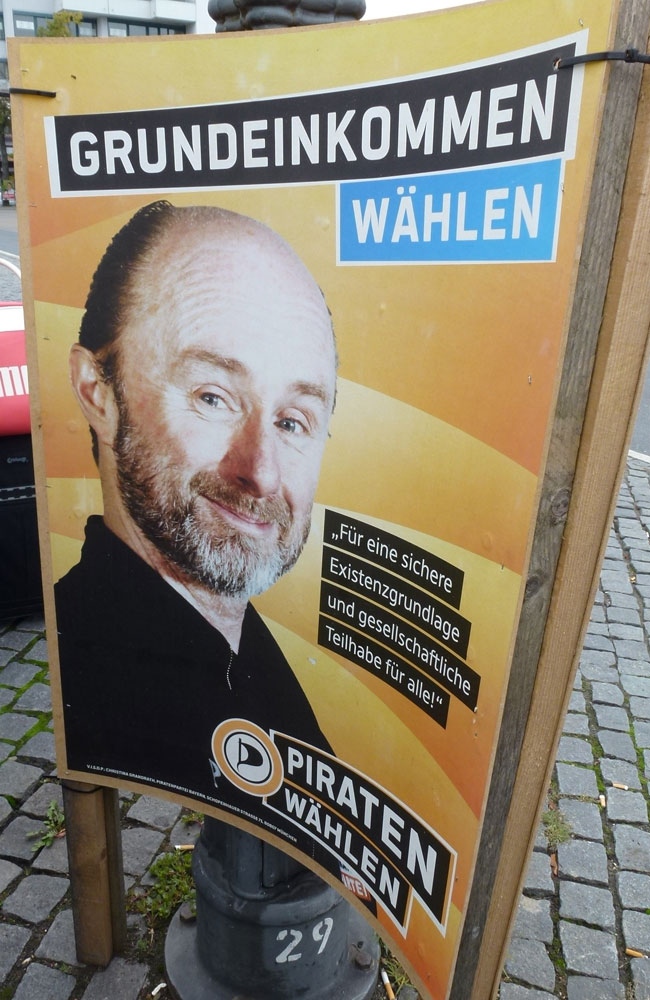
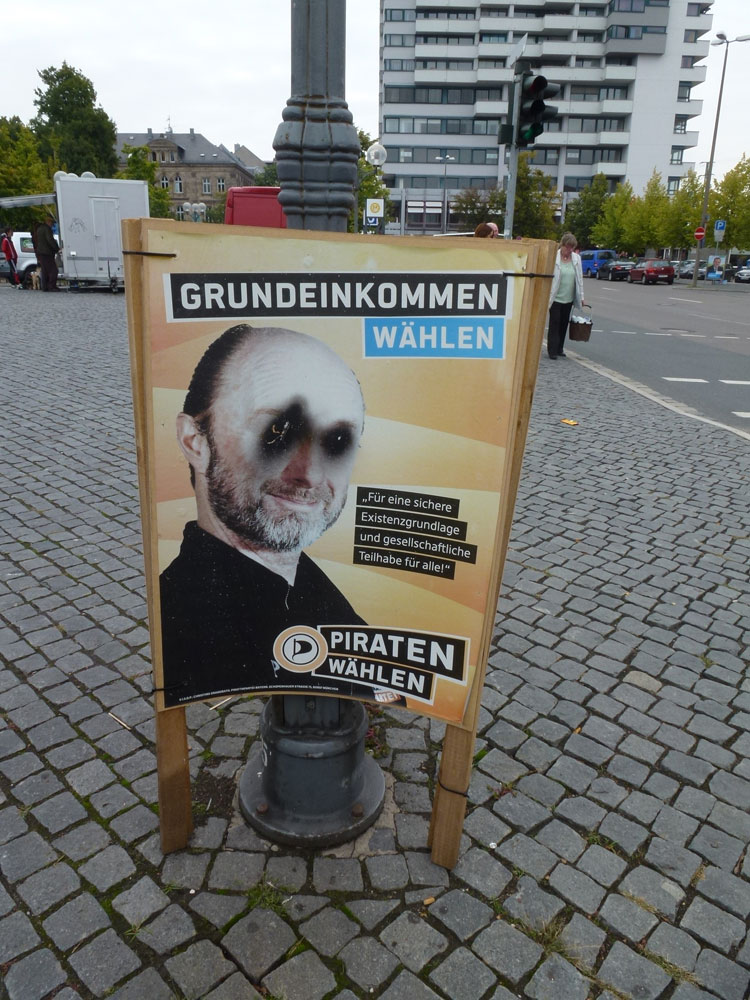
Election posters

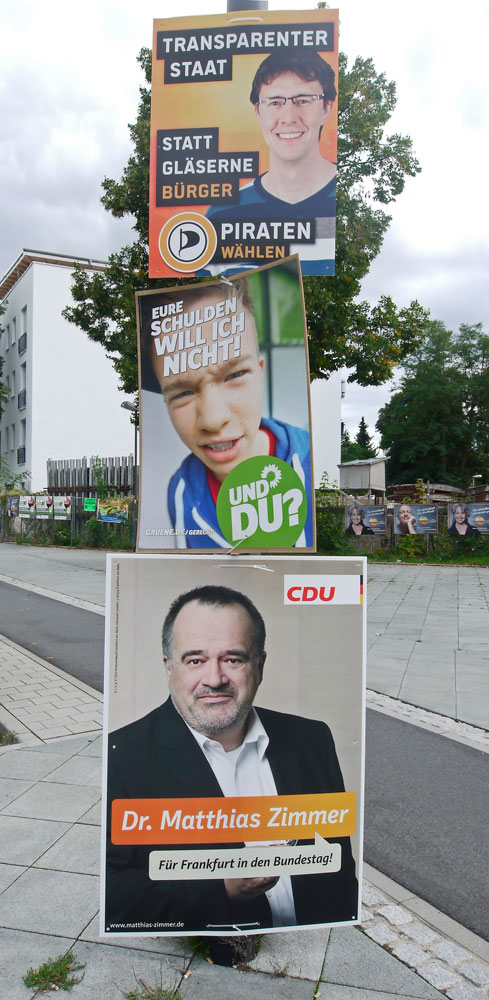
It’s looking rather colourful here. Not only did Bavaria have elections last Sunday, Hesse has them next Sunday at the same time as the Bundestag elections.

This seemed inappropriate in retrospect:

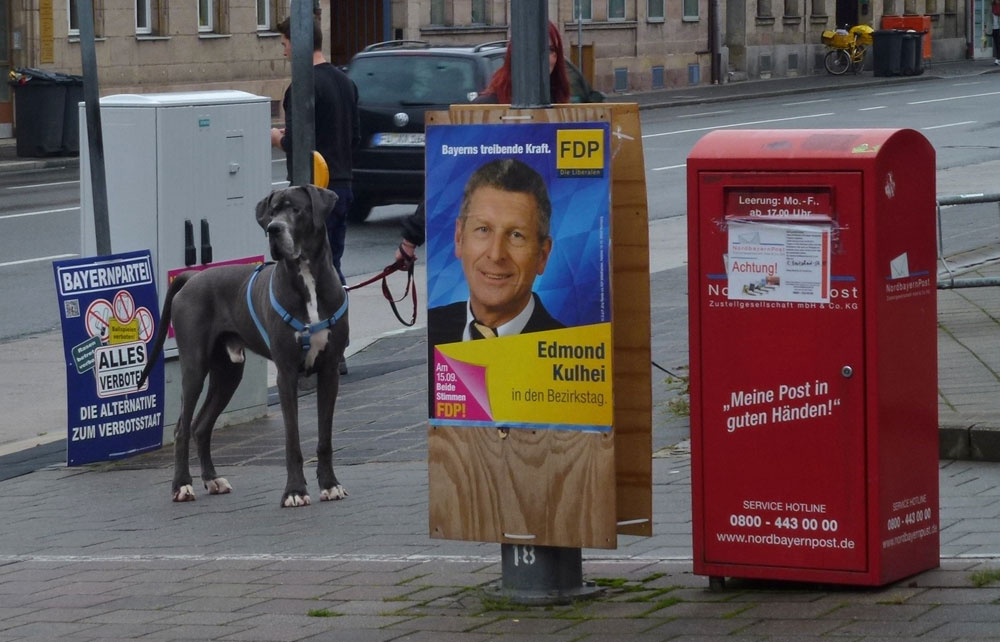
Local. Notice complete Great Dane:

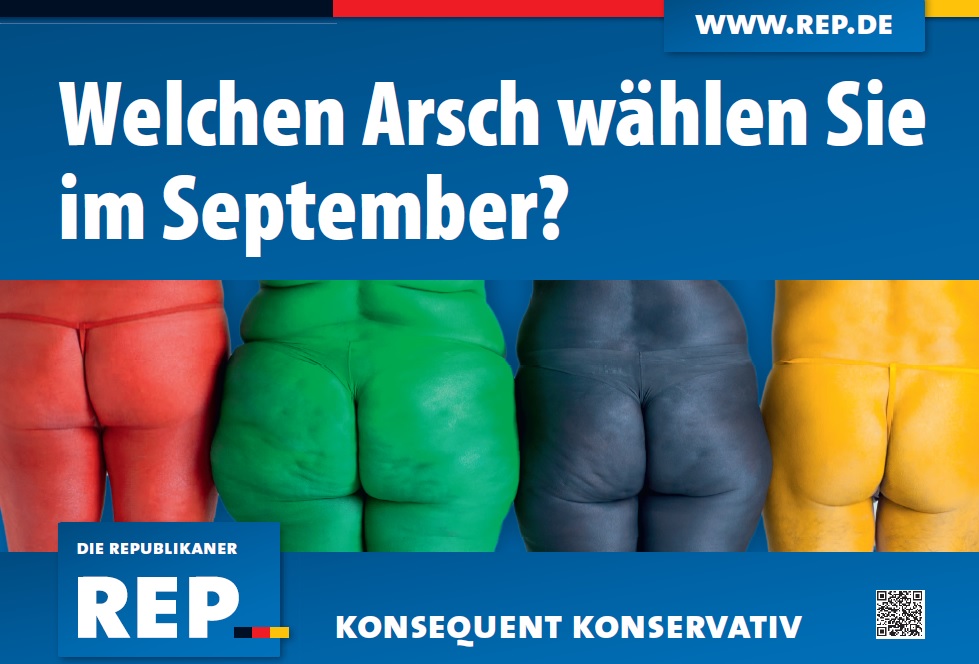
This one I saw in a spot where I could neither park nor photograph (that’s where some of the worst posters always are):

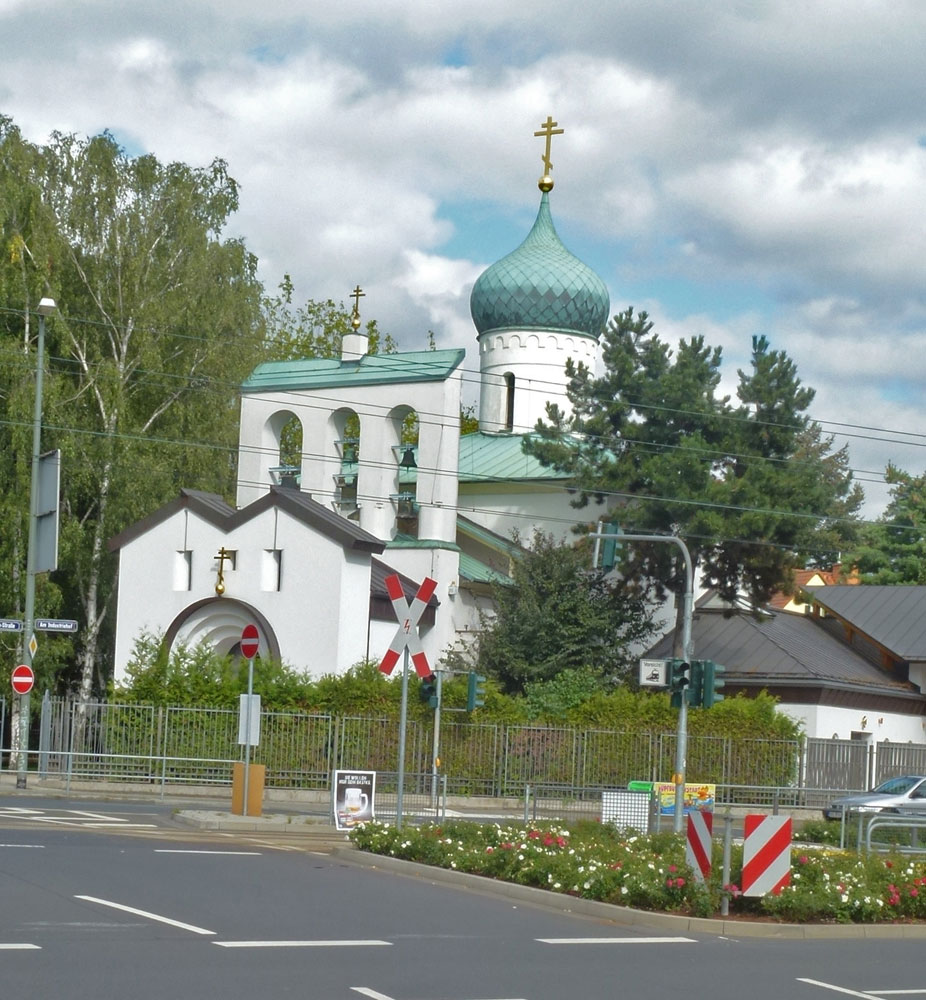
In Frankfurt last week, near that church:

Russian Orthodox Church in Frankfurt am Main

Sat-nav devices have at least three times let me down just when I wanted to drive back to Germany, and I once got lost in Frankfurt am Main and found myself facing this Russian Orthodox church of St. Nicholas.

I was lucky enough to actually stop there on Sunday.

However, we were not welcome. The church is not for tourists, but for God. My friend said she was from Frankfurt, but this made no difference. Photos of the interior were not welcome and we were rapidly escorted out.

We were told that had we attempted to photograph the inside of a mosque, we would have found our heads cut off next to our bodies. The Russians were less aggressive, however.

Somehow I feel Nathan der Weise would have seen things differently.

German speakers and using ‘will’ in contracts

Ken Adams drew my attention to his post on German speakers and the use of ‘will’ in contracts. The subject is why some Germans don’t like the use of ‘will’ as opposed to shall.

The theories seem to be:

1. ‘will’ and ‘wollen’ have completely different meanings (I’m not convinced by the wordreference definitions, or rather by the examples it gives, which to me seem to be ‘also rans’ rather than good illustrations.

2. Germans think ‘will’ is a ‘simple future’ (horrible term) and expect ‘shall’ for compulsion (this is the view I incline to)

Apropos ‘simple future’: there are at least five ways of expressing the future in English and they overlap with modal meanings. ‘Will’ often implies a promise.

Ken refers to ‘will’ in contracts as ‘language of policy’, which I need to investigate further.

In my experience, contracts of insurance often use ‘will’ for the insurer and ‘shall’ for the insured. I take the two verbs both to mean an obligation, although stylistically (but not legally9 there is a sense of ‘will’ being an act of grace and favour from the more powerful party.

In translations, I sometimes use ‘will’ mixed with ‘shall’ myself, but I may avoid it because I fear the German client may not like it. At one of the conferences I attended some weeks ago, someone mentioned the phenomenon where translators simplify the English language in order to avoid arguments with clients.