Shitstorm

It’s been widely reported in both the German and the British press (inter alia) that the Duden has included the new German word shitstorm. Shitstorm seems to be an American word for an internet uproar. I wonder what a synonym would be? Online sources are not helpful. I think it must be something like a flame war.

Anyway, it seems that the word has come to be seen by many Germans as a standard English expression. Nothing strange about drawing such conclusions about a foreign language. We had a discussion about public viewing, a term possibly originally used in English but much more widely so in German. The thing about shitstorm is that it epitomizes itself, in that these language discussions do become a veritable … shitstorm.

Sense can be found in Sprachblog and Lexicographieblog.

English press reports are frequently accompanied by pictures of Angela Merkel pulling faces, apparently because she used the term recently. (The Independent)

In the Guardian, Philip Oltermann regurgitates the reasons why it is wrong to think Germans are obsessed with shit.
A shitstorm in a dictionary
Germans are not obsessed with faecal matters, just very reluctant to use sexual metaphors in a negative way

And he adds:

The question remains why the German language would, in any case, need to import an English word such as “shitstorm” if it already suffered from such a surfeit of faeces-related metaphors. The answer may be that “shitstorm” in German actually means something very different from what it means in English. The Duden defines it as “a storm of outrage on the internet” – highlighting how social media have increased the speed and reduced the length of our daily outrage. The Urban Dictionary, on the other hand, defines it as a disaster in a much broader sense (and Collins doesn’t recognise the term at all).

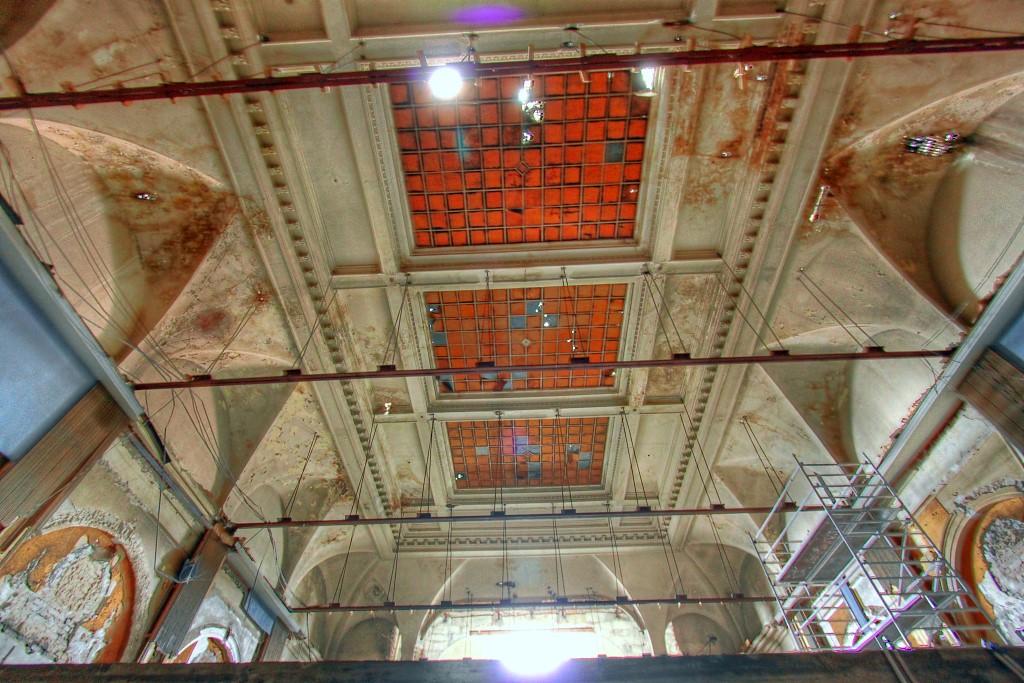
Banqueting hall before demolition/Festsaaldecke jetzt freigelegt.

I’ve mentioned the Festsaal in the Park Hotel before, but when I saw it the ceiling construction was hidden.

The ceiling is pretty undamaged, but the (listed) banqueting hall doesn’t fit into the idea of a modern shopping centre so it is about to be demolished.

In this process, the ceiling has now been opened up. Ralph Stenzel has published some photos of it on the Fürther Freiheit blog under the title Wachgeküßt, um zu sterben? (he prefers the alte Rechtschreibung). I’ve stolen one here as a taster – please click through for five photos plus one of the demolition in progress of the adjoining Fiedler building, all thumbnails clickable to enlarge:

EU drafting

At both conferences we were recommended to look at the EU drafting guidelines: Joint practical guide of the European Parliament, the Council and the Commission for persons involved in the drafting of legislation within the Community institutions .

As Eleanor Sharpston, the UK Advocate General, said today with a smile, who could possibly object to the following advice?

1.1 The drafting of a legislative act must be:

clear, easy to understand and unambiguous;
simple, concise, containing no unnecessary elements;
precise, leaving no uncertainty in the mind of the reader.

1.4.1. The author should attempt to reduce the legislative intention to simple terms, in order to be able to express it simply. In so far as possible, everyday language should be used. Where necessary, clarity of expression should take precedence over felicity of style. For example, the use of synonyms and different expressions to convey the same idea should be avoided

6.The terminology used in a given act shall be consistent both internally and with acts already in force, especially in the same field.

Identical concepts shall be expressed in the same terms, as far as possible without departing from their meaning in ordinary, legal or technical language.

Some of the German lawyers I translate for might consider that last point. Why define terms when you aren’t going to stick to them?

In fact EU legislation is first drafted in English nowadays, often by non-lawyers whose native tongue is not English. The ‘translations’ into the other Community languages count as equal originals, even if the country is one, like Slovenia, which wasn’t a Member State at the date of the drafting.

There is a nice section on the problems of multilingual drafting, concluding with the following:

5.5. Finally, two essentially practical comments must be made as to the relationship between the original text and translations of it.

5.5.1. First, the author must ensure that translators can immediately identify the sources drawn on in the original text. If a passage in the original text has been taken from an existing text (Treaty, directive, regulation, etc.) that must be clear from the text or indicated separately, where necessary by appropriate electronic means (see Guideline 6). There is a risk that any hidden citations without a reference to the source will be translated freely in one or more languages, even though the author specifically intended to use the authentic wording of an existing provision.

5.5.2. Second, the author must realise that comments from translators and, more generally, all departments which carry out a linguistic check of the text can be extremely useful. Such checks provide an opportunity to identify any errors and ambiguities in the original text, even after a lengthy gestation period and even — perhaps especially — when the drafting has been the subject of much discussion between a number of people. The problems encountered may then be brought to the attention of the author. In many cases, the best solution will be to alter the original, rather than the translation.

According to Wikipedia, Eleanor Sharpston speaks a number of languages:

Advocate General Sharpston is also a member of the Irish Bar and the Gibraltar Bar. She has published books and articles on EU law. Having spent her childhood in Brazil and then her adolescence and half her practising life in continental Europe, she speaks a number of European languages. Her off-duty activities include: playing classical guitar and violin, rowing and squash (in both of which she got University “blues”), sailing square riggers, skiing and scuba diving.[

On Thursday, the first speaker was Richard Heaton, First Parliamentary Counsel. He told us he does not draft, but he did not tell us what he does do. However, the internet reveals more.

Richard Heaton had a nice diagram showing the dozens of links between a new or revised statute and the existing law. He said that the language used is the second most important element – what is most important is creating law that works and that fits in the system, and this in itself is extremely hard to do.

It was pointed out that specialized drafters are the norm in common-law countries but not in civil-law countries.

One of the speakers used the term ‘plain language freaks’, which was an elegant way to bypass that argument, which reminds me of people getting angry about ‘grammar mistakes’ on the internet.

Legal language and translation conferences in London yesterday and today

I’ve been to a half-day seminar on drafting and language at the IALS
Legislative drafting and language

and a CIoL legal translation conference with a heavy EU element.

They were both excellent, but I have given up reviewing conferences (after starting with the ATA one in New Jersey when this blog started in 2003). All the presenters were good, but one is always interested in one thing more than another.

Details at the bottom, in case the links die.

It was great to put faces to some colleagues I only knew virtually. Alas, the CIoL conference gave us no list of participants. I think they were mostly IoL people, but I must have missed a few I knew. We were put on language-based tables, so I was on DE>EN, presumably in preparation for the afternoon translation session, which I did not attend.

I think I will put a few notes and links I picked up in a separate entry later or tomorrow.

Thursday 27 June 2013

Title: Legislative Drafting and Language

Speakers: Richard Heaton, First Parliamentary Counsel; Maurizio Gotti, University of Bergamo; Adrian Hogarth, Senior Parliamentary Counsel, Law Commission; via skype, Vijai K Bhatia, City University of Hong Kong. William Robinson, Associate Research Fellow, Institute of Advanced Legal Studies, former Law Reviser, European Commission; Ingemar Strandvik, European Commission; Thomas Glyn Watkins, University of Cardiff, former First Welsh Legislative Counsel.

Event details and online registration: http://www.sas.ac.uk/events/view/14014

Description

This afternoon conference will include the following speakers and discussants:

Richard Heaton, First Parliamentary Counsel;
Professor Maurizio Gotti, University of Bergamo;
Adrian Hogarth, Senior Parliamentary Counsel, The Law Commission;
Giulia Adriana Pennisi, University of Palermo;
William Robinson, Associate Research Fellow, Institute of Advanced Legal Studies, former Law Reviser, European Commission;
Hayley Rodgers, Office of Parliamentary Counsel;
Ingemar Strandvik, European Commission;
Jonathan Teasdale, Sir William Dale Fellow, formerly Law Commission;

Professor Thomas Glyn Watkin, University of Cardiff, former First Welsh Legislative Counsel;
Professor Helen Xanthaki, Academic Director, Sir William Dale Centre;
and via Skype, Professor Vijai K. Bhatia , City University of Hong Kong.

Legal Translation Conference
Friday 28 June 2013 10.00 to 16.15 (registration from 09.30)

This full-day seminar is being generously supported by the European Commission Representation in the UK and will be held at its conference centre in central London.

The event is aimed at all translators with an interest in legal translation and will include a practical legal translation workshop session in the afternoon.

Speakers:

Anthony Pym, Professor of Translation and Intercultural Studies and coordinator of the Intercultural Studies Group at the Rovira i Virgili University in Tarragona, Spain.
“Managing Risk and Trust in Legal Translation”

Brian Porro, Directorate-General for Translation, European Commission
“Legal translation at the Court of Justice and the European Commission: a view from the boiler room”

Eleanor Sharpston, Advocate General at the European Court of Justice
“Transparency and Clear Legal Language: why are there problems with EU law; and how does the European Court of Justice set about resolving them?”

Juliette Scott, Legal translator, PhD student in legal translation and author of the legal translation blog From Words to Deeds: translation and the law
“Training is all around us, all of the time”

Venue:
Europe House, 32 Smith Square, London SW1P 3EU

The afternoon translation workshop session will use texts in French, German, Spanish, Italian and Polish for translation into English and English texts for translation into French, German, Spanish, Italian or Polish.