Miscellaneous/Dies und das

In lieu of a longer post, some links and comments that have come up this week:

1. A commenter on an earlier entry wondered how to translate Bereinigungsgesetz into English. There’s some discussion there, and also a mention of how to translate Gesetz into English: as part of the name of a statute, I always write Act. This works in BrE and AmE. Some prefer law, and as far as I remember the argument given for using law is that there is a difference in the way Gesetze are made in Germany and Acts in the UK and USA. One aspect that struck me only recently is that it’s quite common in BrE to do what I do, capitalize Act in running text (in this generic sense, one could also use statute). I think it tends to be done by lawyers and it only struck me when a colleague queried it.

2. In Language mystery, Victor Dewsbery posted a blog entry on Terminology for parts of a city just after I wrote about Land. An even more complex topic!

Help! What can I do in my text?

This variety of terms in both languages means first of all that there is no absolute right answer for any terminology question. Perhaps I could suggest a provisional sub-division into primary, secondary and informal parts of the town or city, although some of the terms will overlap, and many distinctions are likely to be relative.

3. Another blog I enjoy reading, False friends, good and bad translation, has a post on Mahnverfahren auf Englisch. It’s a guest post, I think, by Laura Macdonald. She opts for dunning process. This is certainly OK. Process, because it includes court proceedings among other things. But I would have said debt collection procedure, I think. I wonder if dunning is more common in AmE than BrE? I have always felt it was a colloquial term, but maybe I’m wrong. I also feel it is not widely understood by English (British?) readers. Mind you, when I look in the legal dictionaries and find default action, I’m mystified.

LATER NOTE: In the comments, the patron saint of lawyers points out that the EU term is order for payment – as in European Order for Payment Procedure. So maybe that will take over.

Land and (federal) state

This is one of those thorny issues that stop me from writing up a guide to DE>EN legal translation. If you read to the end you will also realize that enough is enough.

Germany is divided into sixteen Länder, sometimes called Bundesländer. I think it is customary in US English to call them states or federal states. I have been heard to say that Germany is a federal state so its constituent parts can’t be, but I am feeling so confused now that I can’t remember if I believe that. In British English I think Land (plural Länder) is often used, sometimes in italics. The capital L marks it as foreign; the plural is a problem. But even here, I suspect that state is becoming the more common term.

The problem doesn’t end there, because these entities have different titles: Freistaat Bayern, Freistaat Sachsen, Freistaat Thüringen, and possibly Stadtstaat for Hamburg, Bremen and Berlin. I don’t really like to write Free State of Bavaria, but it’s often done.

There’s a wonderful illustration of the dreadful longwindedness and complexity of discussions on translation in the Talk section of the Wikipedia article on States of Germany. Do these sections get deleted? I assume not, but here’s a taster:

The article states right in the beginning “Germany is a federal republic made up of 16 states formally known in German as Bundesländer (“Federal States”; singular Bundesland), or more commonly, Länder (singular Land).”
As far as my information goes, that is actually totally incorrect. The term “Bundesländer” is used in common parlance, however legally speaking it does not even exist and is misleading and wrong actually. The sentence should be the other way around. I took a look into the Grundgesetz, Chapter II is titled “Der Bund und die Länder”, in the english version it says “The Federation and the Länder”. Chapter IV Der Bundesrat reads: “Durch den Bundesrat wirken die Länder bei der Gesetzgebung und Verwaltung des Bundes und in Angelegenheiten der Europäischen Union.” translated as “The Länder shall participate through the Bunderat in the legislation …etc.” Nowhere in the Grundgesetz does it ever talk of “Bundesländer”. The state-governments are also just called that, Landesregierung and not Bundeslandregierung. Of course the term Bundesländer is popularly used, however legally speaking it does not even exist and is factually wrong. Germany by its constitution is made up of the german states first, who got together to create a federation, the Bundesrepublik. Therefore anything that has to do with “Bund-” is only at the federal level, by its nature it cannot be at the state “Land” level. Therefore a word like Bundesland in itself is actually a contradiction.

It goes on.

The article itself refers inter alia to federated states. It prefers Länder (as I have to date) but gives as authority for this the use in the ‘official’ translation of the Basic Law (I tend to find none of the translations of the Basic Law totally satisfactory and have my doubts about ‘official’ translations) and in UK parliamentary proceedings, in this case qoting one debate in 1991.

Now, the EU English Style Guide recommends:

Land, Länder Translate as ‘federal state(s)’, adding ‘German’ if necessary for clarity, or leave the terms in German.

But here’s the list of suggestions that threw me, in the recommendations of the Auswärtiges Amt:

(Land) Baden-Württemberg
(Free State of) Bavaria
(Land) Berlin
(Land) Brandenburg
(Free Hanseatic City of) Bremen
(Free and Hanseatic City of) Hamburg
(Land) Hesse
(Land) Mecklenburg-Western Pomerania
(Land) Lower Saxony
(Land) North Rhine-Westphalia
(Land) Rhineland-Palatinate
(Land) Saarland
(Free State of) Saxony
(Land) Saxony-Anhalt
(Land) Schleswig-Holstein
(Free State of) Thuringia

This means that not only do they distinguish between Freistaat, Land etc., but they require an of after state and not after Land.

I discussed this with ITI colleagues and the agreement was that we say:
state of Saarland
Land of Saarland
putting of in both. But German institutions which follow the Auswärtiges Amt recommendations are going to distinguish grammatically.

I don’t like it, but it’s a little difficult to research since the term Land is not an English one. Wherever it’s used in English, non-native speakers are likely to be involved to a greater degree than with native English terms. But why, if you are writing English, would you write ‘city of …’ and ‘state of …’ but not ‘Land of …’?

Happy New Year/Alles Gute für 2013

Just before starting work again, here is what it looks like here in Fürth now:

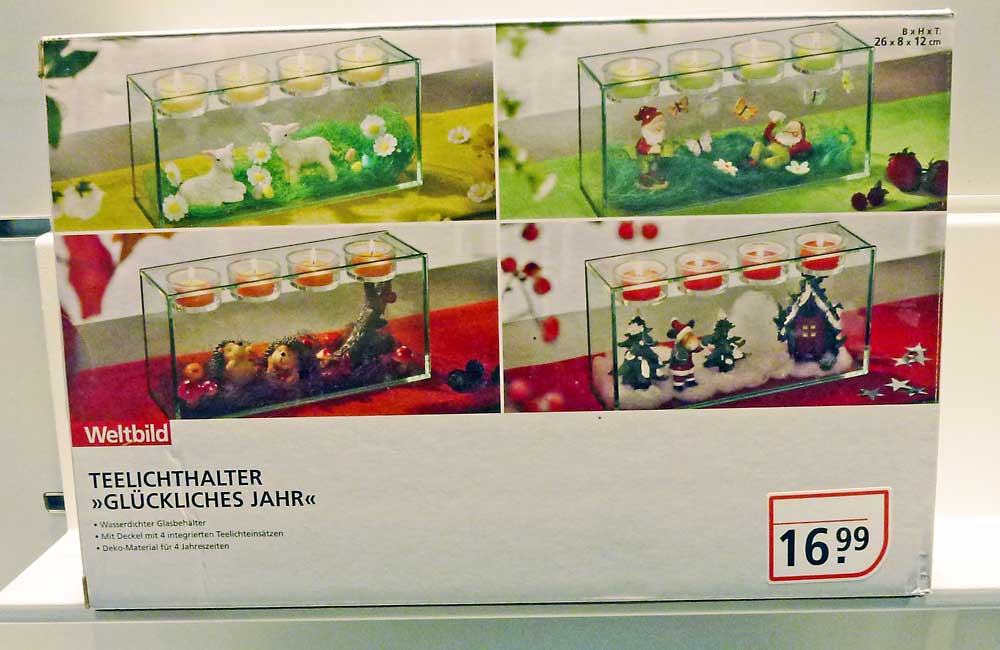
I can’t help feeling that containers for Advent lights are being repurposed here.

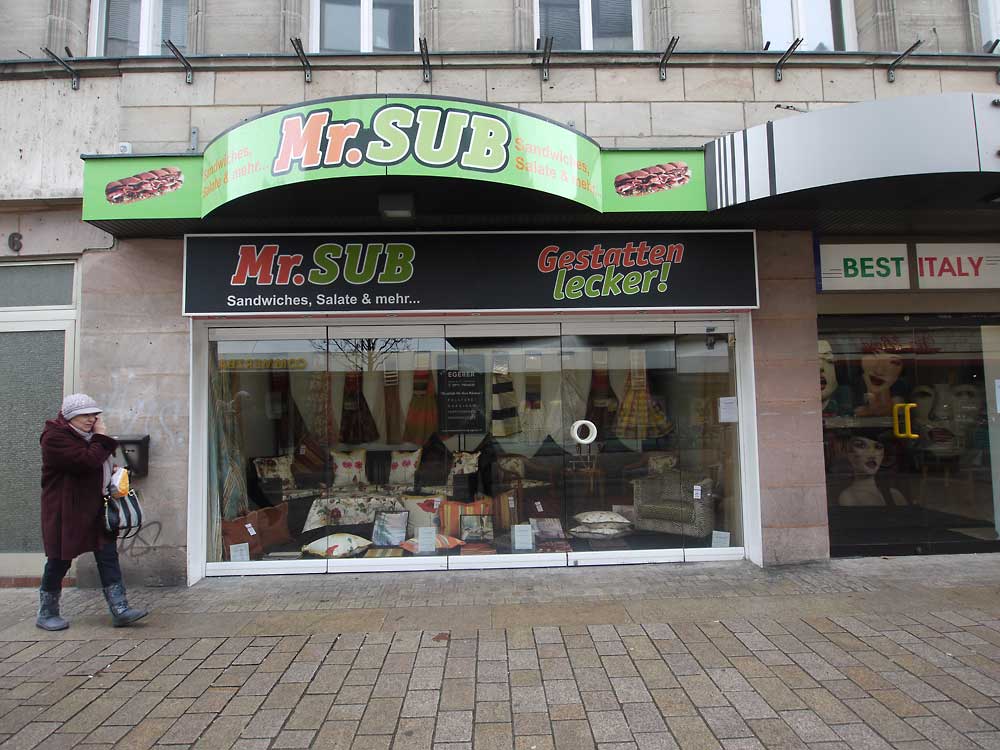
This is what I saw on Saturday:

(Note the German indentation on the cushion in the shop window)

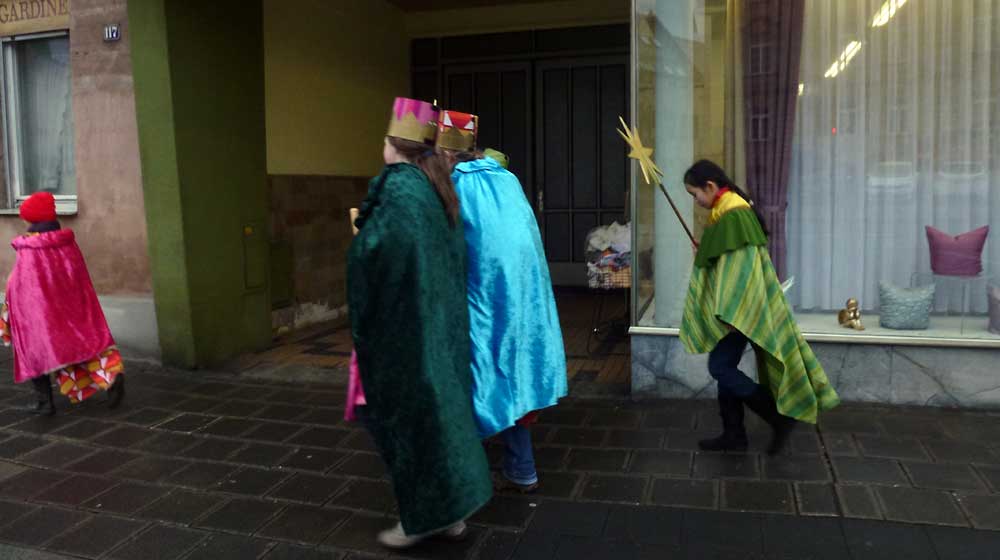
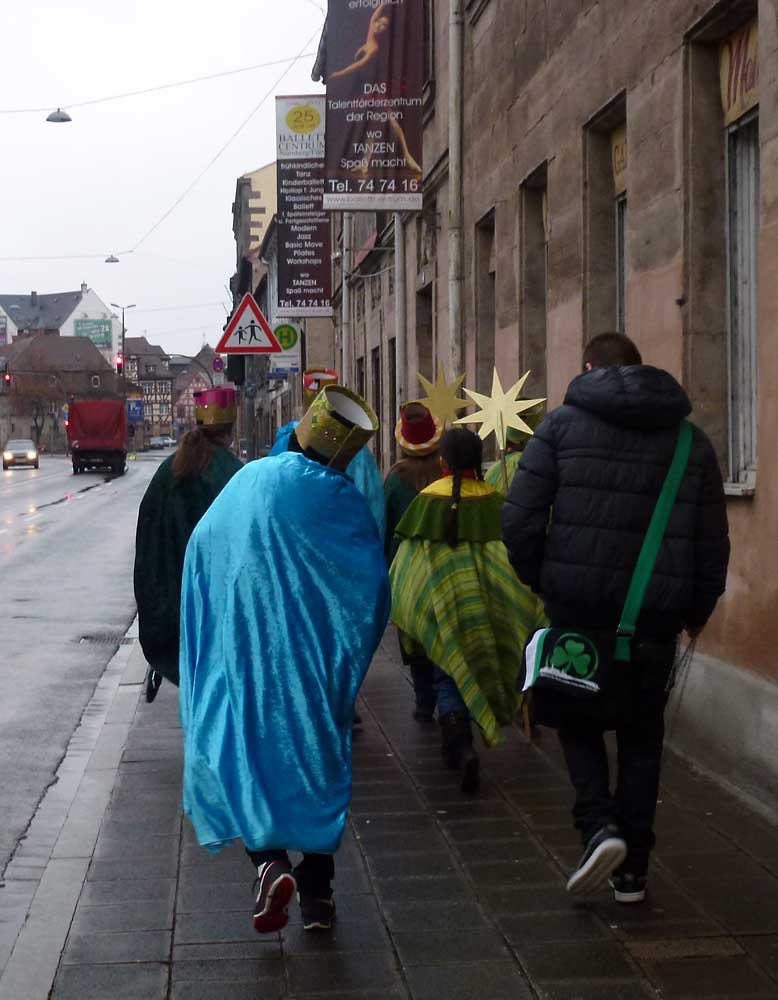
These are the Sternsinger – rather too many Three Kings. They did have real incense with them. I would have given them a donation after photographing them, but they were hastening off somewhere. According to Toytown Germany (link with picture), the “C + M + B” they chalk on the door means not “Caspar, Melchior und Balthasar”, but “Christus Mansionam Benedicat”. More in English in Wikipedia. I have never encountered the Three Kings Cake in Germany.

Meanwhile, a beaver has returned. It has been working on one tree only and I will have to see if it manages to fell it:

And finally, a photo showing what it looks like when rebuilding is about to take place and shops move out:

Lost luggage/Verlorenes Gepäck

I’ve just been to London for a week, flying Lufthansa from Nuremberg with a change in Frankfurt. In both directions, my suitcase (checked-in baggage) did not make it. On the first journey, I was told the stopover in Frankfurt had been too short. The suitcase was delivered the next afternoon, about 24 hours after arrival. On the return journey, the suitcase was totally mislaid. I was told the label had torn off. It was delivered less than 48 hours later.

Advice for future trips: if you talk to Lufthansa staff in German, check how they translate what you say into English. Ein roter Band auf den Griff geklebt/ein roter Klebeband is not a red ribbon (eine rote Schleife). I did get them to change it to red tape, but that was only after I saw it online the next day.

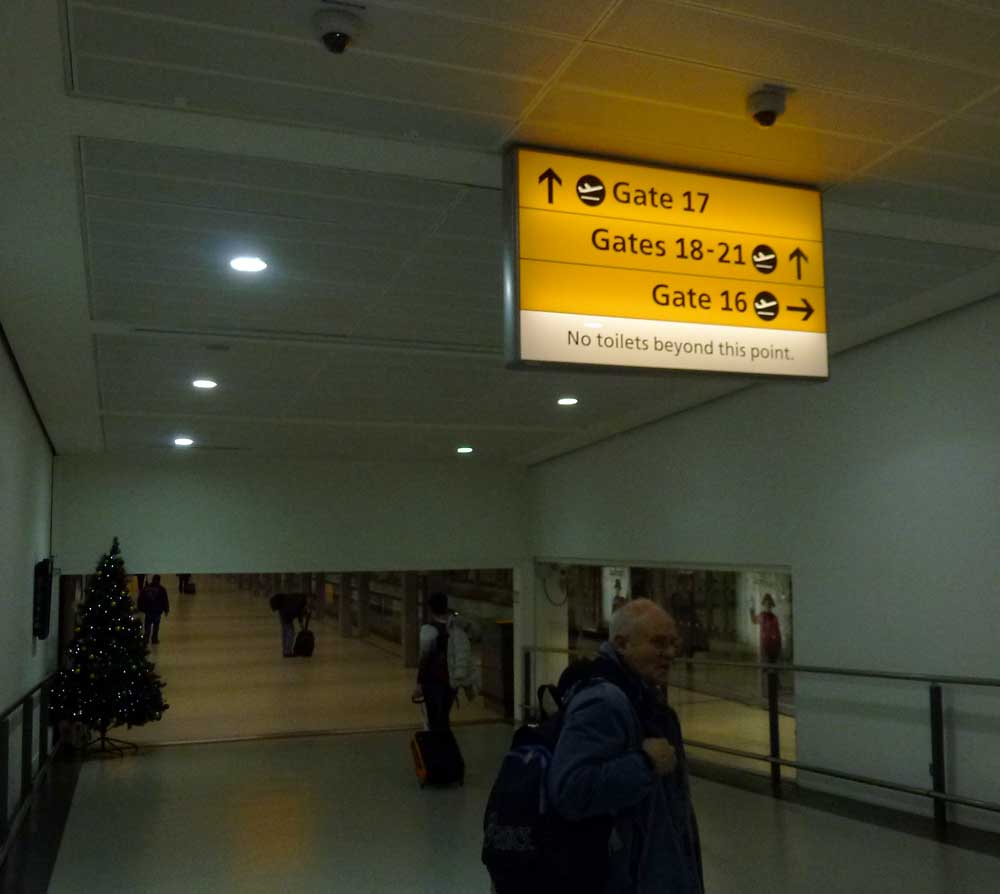
It was also a pain walking 25 minutes to the next terminal to buy a toothbrush in London. I was told there were no shops where I landed.

One good thing at Heathrow:

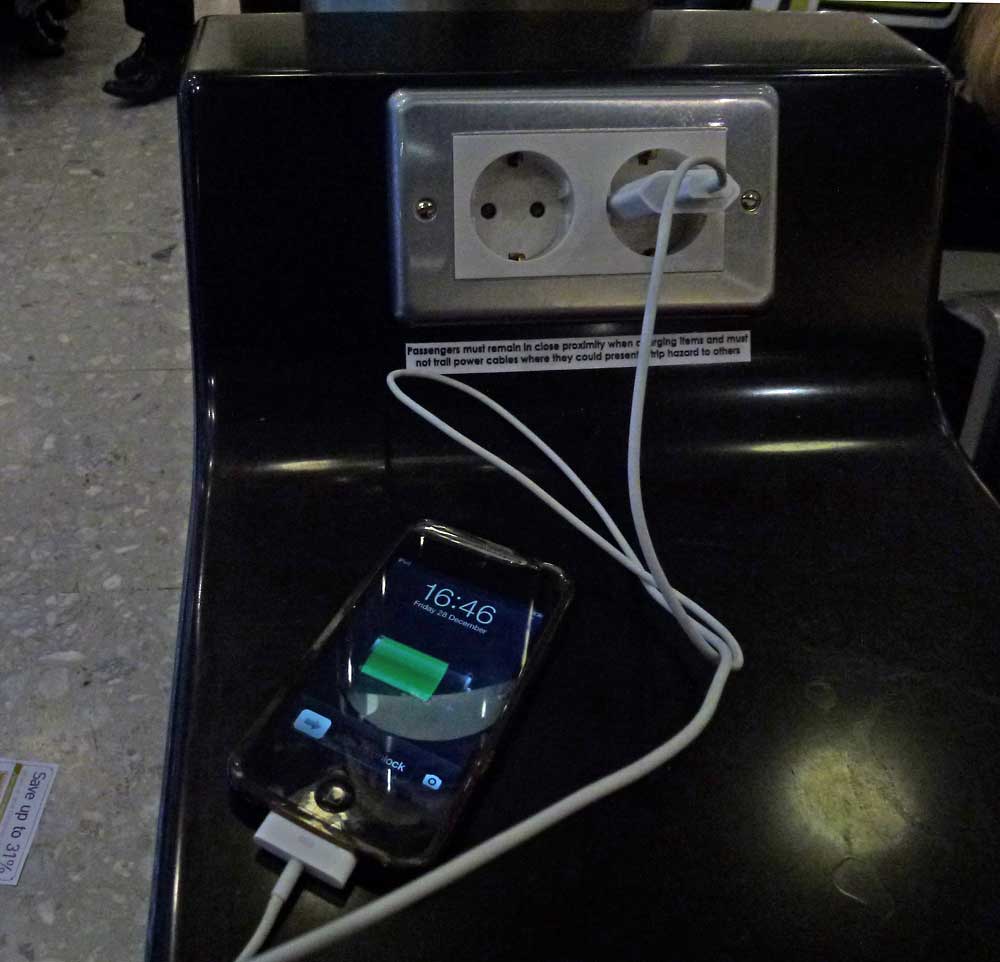
Not only is my iPod being charged, but it has continental sockets on one side and UK sockets on the other.

How do you get to ride those carts at Frankfurt? It seems I am always attempting to run through the airport to catch the connecting flight, but I saw some Chinese people using one of those carts and was very envious.

Leading decision/Grundsatzentscheidung

It’s been widely reported today that Haribo (which markets a sweet called Goldbär – gold bear) won in a case against Lindt Sprüngli, which has been introducing a gold-foil-wrapped bear for Christmas. The court in Cologne held that people would refer to the Lindt product as ‘gold bear’, thus diluting the mark into which Haribo has pumped huge amounts of money in advertising. (No, commenters, the court did not say that people could not tell the difference between a ‘gummy bear’ and a chocolate bear). Die Welt (German):

Denn die meisten Verbraucher werden laut Gericht den “Lindt Teddy” naheliegenderweise und ungezwungen als “Goldbären” bezeichnen – und eben nicht als Teddy”, “goldene Bärenfigur”, “goldfoliierten Bär” oder als “goldfarbenen Schokoladenteddybär”.

Haribo konnte auf die Umfrage eines unabhängigen Meinungsforschungsinstituts verweisen: 95 Prozent der Verbraucher würden die traditionsreiche Wort-Bildmarke “Goldbär” kennen.

The Local (English):

But the judges said that shoppers were likely to refer to the Lindt product as a “Gold Bear” because of its appearance and thus dilute the Haribo brand.

“Most consumers would not use descriptions such as ‘golden bear figure’, ‘gold foil-wrapped bear’ or ‘gold-coloured chocolate teddy bear’… but rather the closest description, particularly considering how well-known the other brand is: Gold Bear,” it said in a statement.

The decision isn’t final – Lindt will be appealing. It was commented that this particular point of law – whether a word mark can be diluted by the appearance of another mark – has not been decided by the highest courts (höchstrichterlich), or that there has not been a fundamental decision (Grundsatzentscheidung).

Die Welt:

Eine höchstrichterliche Rechtssprechung gebe es zu einer solchen Kollision nämlich noch nicht, erklärte das Kölner Landgericht.

The Local:

“What is special about the case is that there has been no high court ruling on the issue of a collision between a brand name and a three-dimensional product design,” it said.

That is very American. It’s common in the USA to refer to the Supreme Court as the ‘high court’.

I’m not sure if the highest court here would be the Bundesgerichtshof or the Bundespatentgericht. At all events, to call such a decision a ‘landmark decision’ would not be correct. What is meant is a binding decision – not that Germany has an official system of precedent, but in practice it seems like that. A landmark decision is one that makes the news in a big way.

LATER NOTE: Guardian article – with mug shots of the two bears.