The book you want to read next/Das Buch, das du als nächstes lesen willst

I have a couple of boxes full of books that I once wanted to read next, but the one I actually intend to read next is Heimsuchung, by Jenny Erpenbeck, which has just come out in an English translation, Visitation. It’s the story of a house near Berlin and twelve successive inhabitants through the political vicissitudes of German history. It is said to take a while to get into (see the German description by Isabel Bogdan) – it does start off 24,000 years earlier when the ice finishes shaping the landscape.

I was alerted to the book not by the review by Michel Faber in the Guardian (which seems to suggest we should not be reading Jonathan Franzen), but from Katy Derbyshire’s weblog love german books (whose RSS feed never works, so I have to go to the site every few days). Katy writes in English and mainly about books already translated into English, and she always gives me the feeling of telling it like it is, as in the latest entry on the reading at Soho House in Berlin from the original and Susan Bernofsky’s translation.

The book came out in paperback in February 2010, and German books take ages to come out in paperback, so it’s not surprising I couldn’t find it in the small bookshops in Fürth at the weekend, but I did order it at Genniges for Monday. What I wonder is whether I would have found it at Hugendubel in Nuremberg, or even Thalia.

The book you are reading now/Das Buch, das du zurzeit liest

I just got a Sony eReader, of which perhaps more anon, and I decided to read Ulysses in full. We always had that book at home but I could not get far with it, although I liked the beginning. Maybe it was when we were shown extracts from Finnegans Wake in the sixth form that I felt Joyce was not for me. I think we ‘did’ Portrait of the Artist as a Young Man at university (I studied German with subsidiary English).

So on the Reader I have a Penguin copy of the Odyssey, and lying around an old library copy of Harry Blamires guide to Ulysses, The Bloomsday Book – A guide through Joyce’s Ulysses (there is a newer one, but AFAIK it just adapts the page numbers to a newer edition). I bought it through abebooks. It was originally much consulted at West Sussex County Library. It is an unpretentious guide. In the Odyssey, I’ve just got to the point where Odysseus arrives back in Ithaca. The Penguin edition – an E.V.Rieu translation edited by his son – has a very useful chronological summary of the events in it. The Odyssey is anything but chronological in sequence.

I also have and am reading Richard David Precht, Wer bin ich – und wenn ja, wie viele? . This book is a bestseller in Germany. Precht studied philosophy and he set out to explain it to his stepchildren. His approach is unusual. He describes what fun it was to study philosophy and discuss it with other students, and how dry the lectures were, based on a historical approach. I think the title is a quote from a fellow student who was drunk.

An English edition is to be published in April 2011. Here is a page about selling the rights. Here’s the British publisher’s blurb:

There are many books about philosophy, but “Who Am I? And If So How Many?” is different from the rest. Never before has anyone introduced readers so expertly and, at the same time, so light-heartedly and elegantly to the big philosophical questions. Drawing on neuroscience, psychology, history, and even pop culture, Richard David Precht deftly elucidates the questions at the heart of human existence: What is truth? Does life have meaning? Why should I be good? And presents them in concise, witty, and engaging prose. The result is an exhilarating journey through the history of philosophy and a lucid introduction to current research on the brain. “Who Am I? And If So, How Many?” is a wonderfully accessible introduction to philosophy. The book is a kaleidoscope of philosophical problems, anecdotal information, neurological and biological science, and psychological research. The books is divided into three parts: What Can I Know? focuses on the brain and the nature and scope of human knowledge, starting with questions posed by Kant, Descartes, Nietzsche, Freud, and others; What Should I Do? deals with human morals and ethics, using neurological and sociological research to explain why we empathize with others and are compelled to act morally, and discusses the morality of euthanasia, abortion, cloning, and other controversial topics; and, What Can I Hope For? centers around the most important questions in life: What is happiness and why do we fall in love? Is there a God and how can we prove God’s existence? What is freedom? What is the purpose of life?

The final book I am reading is Defending the Guilty, by Alex McBride. This is an inside life of the criminal bar, both prosecuting and defending. You can look inside it at amazon – I have an amazon.de link in the right-hand sidebar. McBride is not like Ferdinand von Schirach – he doesn’t try to keep himself out of the stories. He alternates between stories of courtroom successes and failures and becoming a criminal barrister and brief considerations of problems in criminal law. Thus he starts on a lighthearted note (insofar as chopping up the body of a rabbi and getting the refuse collection day wrong is amusing) before turning to the problems of making a mistake in cross-examination which lets in precisely the evidence which will convict your client. Some of the successful trials are the result of luck.


Books meme/Bücherstöckchen

There is a lot of other legal stuff I should be blogging when I find more time, but meanwhile, a meme has been doing the rounds in German literature weblogs and I can’t resist it, or at least part of it. For German examples, see is a blog, Anke Gröner and Vorspeisenplatte, and now Ich kann Balkan has started it.

So now I will dip a toe in. However, I can’t see myself spreading it over thirty-one days or having much to say on every question.

Here is the list of topics for 31 days:

Tag 1 – Das Buch, das du zurzeit liest – The book you are reading now
Tag 2 – Das Buch, das du als nächstes lesen willst – The book you want to read next
Tag 3 – Dein Lieblingsbuch – Your favourite book
Tag 4 – Dein Hassbuch – The book you hate
Tag 5 – Ein Buch, das du immer und immer wieder lesen könntest – A book you could read again and again
Tag 6 – Ein Buch, das du nur einmal lesen kannst (egal, ob du es hasst oder nicht) – A book you can read only once (whether you hate it or not)
Tag 7 – Ein Buch, das dich an jemanden erinnert – A book that reminds you of someone
Tag 8 – Ein Buch, das dich an einen Ort erinnert – A book that reminds you of a place
Tag 9 – Das erste Buch, das du je gelesen hast – The first book you ever read
Tag 10 – Ein Buch von deinem Lieblingsautor – A book by your favourite author
Tag 11 – Ein Buch, das du mal geliebt hast, aber jetzt hasst – A book you once loved but now hate
Tag 12 – Ein Buch, das du von jemandem empfohlen bekommen hast – A book that someone else recommended you
Tag 13 – Ein Buch, bei dem du nur lachen kannst – A book you can do nothing but laugh at
Tag 14 – Ein Buch aus deiner Kindheit – A book from your childhood
Tag 15 – Das 4. Buch in deinem Regal v.l. – The fourth book from the left on your bookshelf
Tag 16 – Das 9. Buch in deinem Regal v.r. – The ninth book from the right on your bookshelf.
Tag 17 – Augen zu und irgendein Buch aus dem Regal nehmen – Shut your eyes and take any book from the shelf
Tag 18 – Das Buch mit dem schönsten Cover, das du besitzt – The book with the most beautiful cover you own
Tag 19 – Ein Buch, das du schon immer lesen wolltest – A book you always wanted to read
Tag 20 – Das beste Buch, das du während der Schulzeit als Lektüre gelesen hast – The best book you read as school reading
Tag 21 – Das blödeste Buch, das du während der Schulzeit als Lektüre gelesen hast – The most stupid book you read as school reading
Tag 22 – Das Buch in deinem Regal, das die meisten Seiten hat – The book on your shelves with the most pages
Tag 23 – Das Buch in deinem Regal, das die wenigsten Seiten hat – The book on your shelves with the fewest pages
Tag 24 – Ein Buch, von dem niemand gedacht hätte, dass du es gelesen hast – A book nobody would think you had read
Tag 25 – Ein Buch, bei dem die Hauptperson dich ziemlich gut beschreibt – A book whose main character is a good description of you
Tag 26 – Ein Buch, aus dem du deinen Kindern vorlesen würdest – A book from which you would read to your children
Tag 27 – Ein Buch, dessen Hauptperson dein „Ideal“ ist – A book whose main character is your ideal
Tag 28 – Zum Glück wurde dieses Buch verfilmt! – It’s good that this book was made into a film
Tag 29 – Warum zur Hölle wurde dieses Buch verfilmt? – Why on earth was this book made into a film?
Tag 30 – Warum zur Hölle wurde dieses Buch noch nicht verfilmt? – Why on earth was this book not made into a film?
Tag 31 – Das Buch, das du am häufigsten verschenkt hast – The book you have most often given as a present

Anwalt englisch in Düsseldorf/Autotext

Sie sollten es nicht versäumen, Ihren Anwalt englisch nach den Erfolgsaussichten des Verfahrens zu befragen. Informieren Sie Ihren Anwalt englisch möglichst detailliert über den entstanden Schaden. Der Name des Schadensverursachers ist eine wichtige Information für Ihren Anwalt englisch. Für alle Tätigkeiten, die der Anwalt englisch im Rahmen des gerichtlichen Verfahrens vornimmt, sind sowohl gesetzliche Gebühren als auch Individualvereinbarungen relevant. Für die Durchsetzung Ihrer Ansprüche sollten Sie Ihrem Anwalt englisch auch alle vorhandenen Beweise zur Verfügung stellen. Ein zuverlässiger Indikator dafür, wie gut Ihr Anwalt englisch Ihre Sache vertreten wird, ist auch immer sein Erfahrungshorizont und der seiner Rechtsanwaltskanzlei. Bereiten Sie sich darauf vor, von Ihrem Anwalt englisch genauestens nach Zeugen befragt zu werden. Zielsetzung des ersten Gesprächs sollte sein, Ihren Anwalt englisch so gut es geht über Ihr Anliegen in Kenntnis zu setzen.
…weitere Keywords

This text was automatically generated on the site of a Düsseldorf lawyer when I did a Google search for anwaltlich englisch. This reminds me of those dictionary sites that respond to a query with ‘No precise equivalent found’.

I was actually wondering if anyone had a good idea for the old chestnut ‘es wird anwaltlich versichert, dass…’ (we lawyers guarantee that …). Probably a waste of time.

Incidentally, I have the impression that Google has started searching very widely – I did not want the word Anwalt, but anwaltlich. I would have to put it in inverted commas now. I did find some discussion at dict. cc., but nothing sensible. One Peter informed the questioner that attorney is ‘American dialect and not English’. Good for you, Peter, helping show the world that British people aren’t necessarily polite or educated. Derek Gill Franßen made more sense at ProZ.

Signs/Schilder

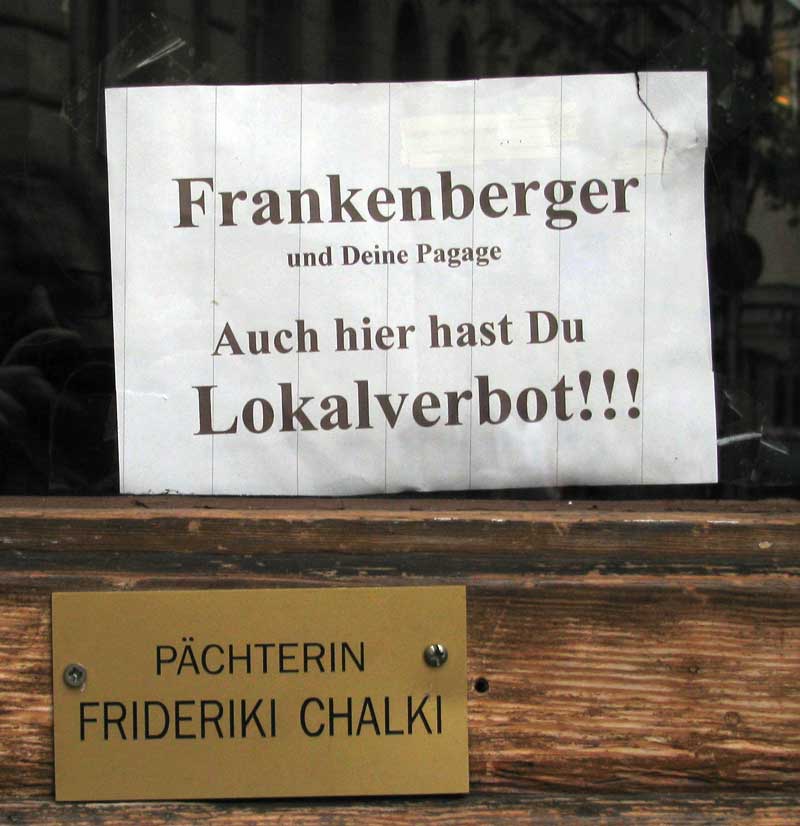
Yesterday was a public holiday, at least in Bavaria. Here are some signs you would see if you went for a walk by the canal (near the harbour). For the insects at the top, see earlier entry. The bottom sign indicates that this is where search and rescue dogs (Rettungshunde) train.

And here is another person using the Pagage text. I doubt whether Herr Frankenberger visits Fürth.

Case law/Rechtsprechung

This came up on a legal translators’ mailing list, and I can’t resist blogging it.

Apparently it has been argued that the German word Rechtsprechung should not be translated as case law, because the term case law implies the whole common-law system of judicial precedent, and German law has nothing like that. (This is an imprecise quotation: the suggestion was said to be that it is inappropriate to refer to court decisions of countries like Germany and Austria, which emphasize codification, as case law).

I disagree with this: there are differences between the importance of cases in German and English law, but the term case law can still apply to both. And it is applied to both, for instance by Markesinis, by Raymond Youngs, by other writers on German law. A search on German case law in Google Books will produce many examples, some of them good. Markesinis uses precedent too. That is probably a clearer term for non-English speakers, but it certainly does not suggest that cases are not law in Germany.

Anyway, the upshot is that for me, German Rechtsprechung and English case law are close enough to allow the translation. The translation of legal terminology often hinges on how close the translator finds two legal institutions. (I don’t translate Rechtsanwalt as solicitor, unlike many, because I think it’s too narrow – I prefer attorney, even though the term may be seen as historical or American).

Incidentally, German case law was relied on by judges when the Civil Code was first introduced: it was not a blank slate or Stunde Null as far as civil law was concerned. Cases are used to fill gaps in codes and statutes, and in some cases this happens by the legislature’s design. Commentaries on codes and statutes are full of references to cases. Of course, a court is not obliged to be bound, but it often will follow cases. The Federal Constitutional Court binds itself too.

The source of the opinion, which some other legal translators agree with, was a seminar by Russell Miller preceding the current ATA conference in Denver. Here is the summary:

Contending Legal Traditions in German Law
Russell Miller
(Wednesday, 9:00am-12:00pm; All Levels; Presented in: English)

The law is an inherent part of legal translation. With this truism in mind, this seminar aims to introduce German-language translators who work with legal translations to some of the traditions vying for influence in German law and legal culture, particularly the civil law tradition and the constitutional law tradition. It is hoped that a better grasp of the spirit and substance of German law will improve and enrich the work of translators dealing with German legal materials.

I wish I could have been there – it must have been interesting. Has anyone got some materials? Russell Miller is well qualified in German and US law, but one can still disagree on terminology.

Here is a quotation from a book on Google Books by Martin Vranken, admittedly a Belgian, who teaches at Melbourne University, which illustrates a use of case law which I find perfectly acceptable and which is common:

…the dogmatics of the BGB has not prevented the German law of tort being shaped heavily by case law. …the courts use Para 823, I BGB as the legal basis for important developments in tort law.

Incidentally, one of the suggestions for an alternative given on the mailing list was jurisprudence. It’s in the title of ‘The Constitutional Jurisprudence of the Federal Republic of Germany’ by Donald P. Kommers. And I’ve now seen it used in the German Law Journal. There’s an article there by Antonio K. Esposito and Christoph J.M. Safferling entitled Report – Recent Case Law (sic) of the Bundesgerichtshof (Federal Court of Justice) in Strafsachen (Criminal Law). The first sentence is:

Reporting on one year of the Bundesgerichtshof’s (BGH – Federal Court of Justice)
jurisprudence in criminal affairs is always a delicate matter.

I find this use of jurisprudence really weird. To me it means legal scholarship – Rechtswissenschaft. It seems it may have come via Lousiana.

Alternatives to case law, for those who object, are: court decisions, judicial decisions. Adjudication was also suggested.