Deutsche Bahn/Bedeutung von “Single”

I booked a train ticket on Tuesday. I was not properly informed before I did so. This is a warning not to try booking a train ticket without assistance from someone who knows what they’re doing.

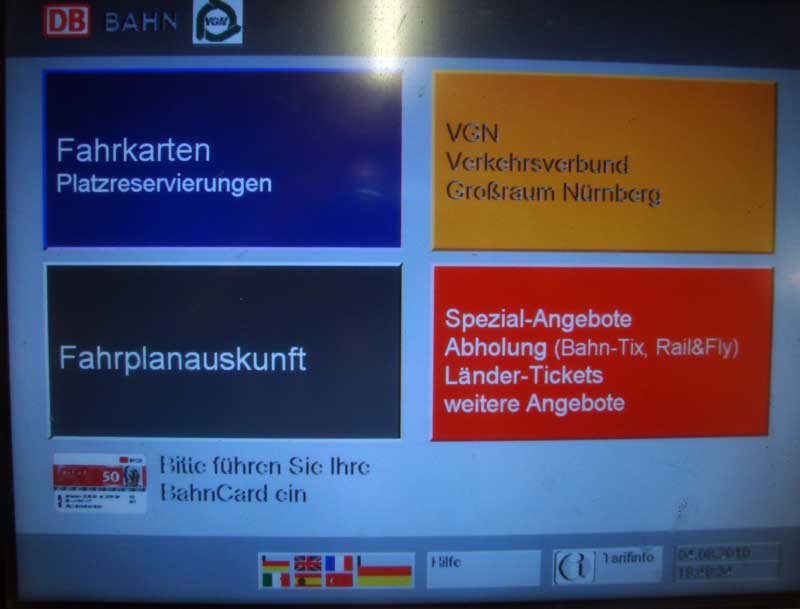
This is the screen with which Deutsche Bahn ticket machines greet the would-be passenger. The woman looks a bit odd, which may indicate the age of the software. I wanted a return ticket from Fürth to Regensburg, which I understood would cost about 40 euro. Online, I picked out a few trains. They were Regional-Express trains, so it wouldn’t be possible to book a seat.

I started by pressing the screen (haven’t got a BahnCard). Here is the next screen:

I decided to go for Fahrkarten (tickets), but the result of this was that I finished up with a timetable offering me a return time of nearly 2 hours with a train called ALX. No chance of buying a ticket.

I then went into the booking office. There were no queues. The two staff said they were not permitted to sell me a ticket. They told me that ALX means Alex, a private railway that goes through Schwabach and is no use to me at all. But that wasn’t the problem: I wanted to know how to get a ticket. Then they said I should get a Bayern Ticket, which would only cost me 22 euros.

Back at the machine, where do I find Bayern Ticket?

Back to the office: I have to press Länder-Tickets (bottom right on the screen above).

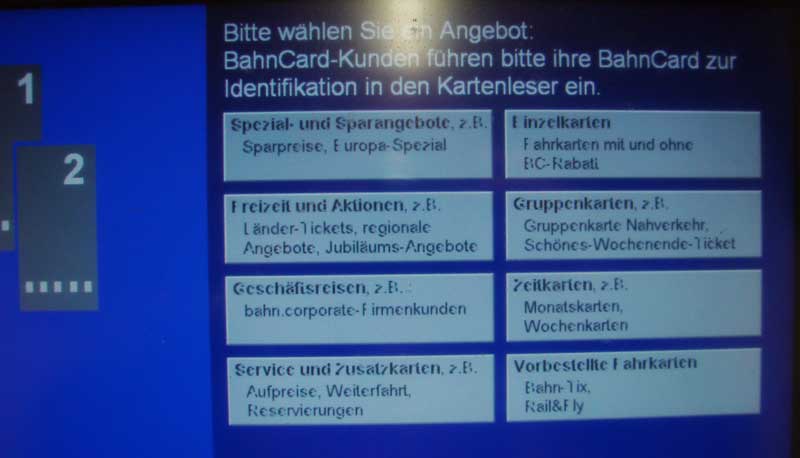
Next screen:

I spent a long time looking at this, but eventually I saw Länder-Tickets again, left column, 2nd from top.

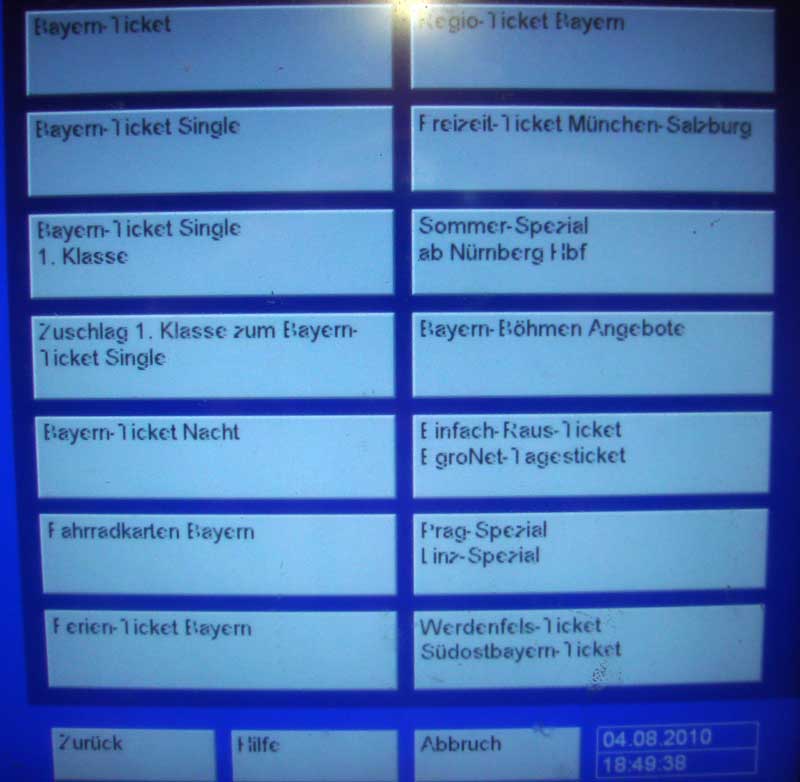
Next screen:

At last, there is the Bayern-Ticket – top left. (Note the sneaky Bayern-Ticket Single below it). Heaven knows what all the rest are. You need an education to know which to choose.

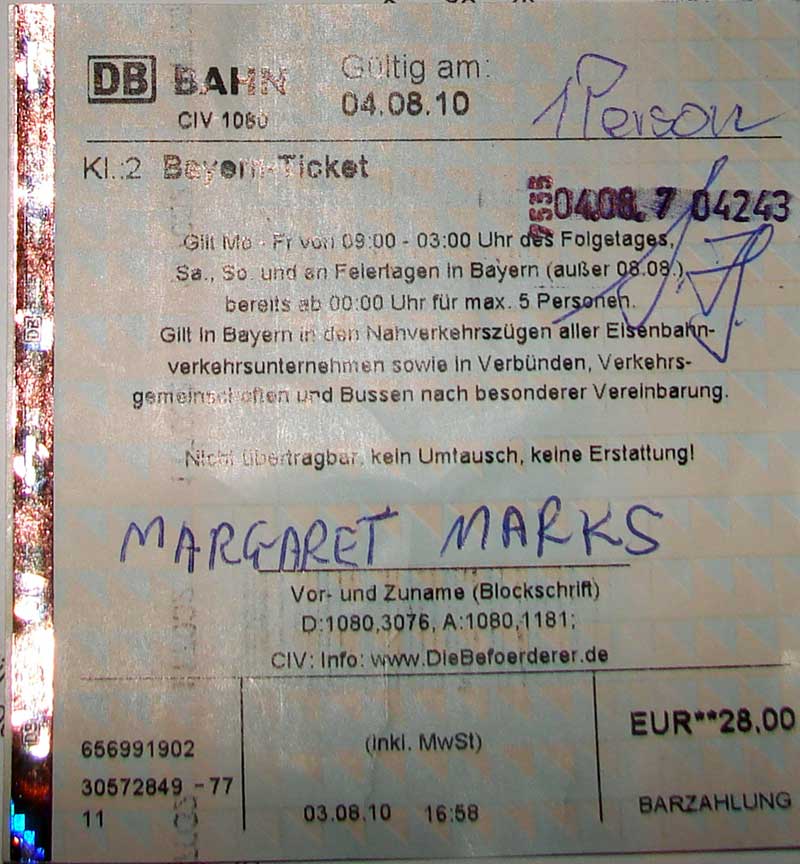
And here is my Bayern-Ticket at last:

You may note it was 28 euros rather than 22. On the train, the conductor asked me who was travelling with me. That was when I realized that in Deutsche Bahn German, Single means one person, not one way. Why they don’t write Gruppen on the 28 euro one I have no idea. I think the idea in Bavaria is that we still need people, not machines.

I should probably add that I was told recently how easy it is to book a train from London to Cologne (4 hours) or Düsseldorf (thanks Chris). I’ve lost the link, but it may have started here.

Here it is (see comments): best website for London-Cologne by train.

Incidentally, I took the photos on my way home at night, when no-one else was using the machine.

New UK statute law website/Neue Website für Gesetze im Vereinigten Königreich

http://www.legislation.gov.uk/ is the new website replacing previous sites.

Q. What has happened to the OPSI and Statute Law Database (SLD) websites?

A. Legislation.gov.uk brings together the legislative content currently held on the OPSI website and revised legislation from the Statute Law Database to provide a single legislation service that replaces the current services. The OPSI and SLD websites are in the process of being decommissioned with users re-directed to this new service.

The UK Human Rights Blog says:

Making the law of the land readily available to the general public is probably the most basic requirement of ensuring access to justice. This is particularly so given that many people chose to litigate their own cases these days rather than instructing costly solicitors and barristers, a trend which is likely to increase once legal aid is further reduced in the coming “brutal” reforms. It is Kafkaesque to expect people to litigate in criminal or civil proceedings without any cheap way of knowing what the up-to-date law is.

Apparently it isn’t quite completed yet, and as with its predecessors, there is no guarantee that law after 2002 is up to date.

-ise and -ize spellings/Englisch Orthographie

In British English, both organise and organize are correct. In American English, it has to be organize.

One of the English sources that recommends -ize in BE is the Oxford University Press. However, I wouldn’t call -ize Oxford spelling. I prefer to use it myself, but there are a number of verbs that still have to be spelt -ise, such as advertise and exercise. Here’s a list. So it’s actually easier to use -ise.

Reasons to use -ise might be: it’s easier (see above), the EU English Style Guide recommends it (why?!), and some clients, whether British or German, will insist on it as the only correct British form. They are wrong, but may not wish to admit this. Also, a client may have a house style, and the translator should then stick to that.

June 2010 PDF of the EU English Style Guide. A handbook for authors and translators in the European Commission (lots of interesting stuff on legal texts here too).

1.2 Words in -ise/-ize. Use -ise. Both spellings are correct in British English, but
the -ise form is now much more common in the media. Using the -ise spelling
does away with the need to list the most common cases where it must be used
anyway. (There are up to 40 exceptions to the -ize convention: the lists vary in
length, few claiming to be exhaustive.)

The spelling organisation should thus be used for all international
organisations, even if they more commonly use the -ize spelling, e.g.
International Labour Organisation (its website uses International Labour
Organization, while Americans will write International Labor Organization).
However, following the rule in 1.1 above, the spellings of bodies native to the
USA and other countries that use the –ize spelling may be retained.

I like the second paragraph, which I can’t remember seeing before. OHIM is a European organization but it spells itself Office for Harmonization in the Internal Market, which I’ve always appreciated.

What has brought this topic to the fore is the latest entry in the JIPLP weblog, American spellings — or English? in which Jeremy, of IPKAT, receives a curt reply from OUP. The entry shows the problems of dealing with people who are convinced that -ise is the only correct British form.

A commenter there refers to a Wikipedia entry on Oxford spelling.

In digital documents, Oxford spelling can be indicated with the language tag en-GB-oed.

The Wikipedia article also disagrees with the Commission Style Guide on International Labour Organization.

Another peculiarity of OUP is its support for the serial comma (bread, butter, and cheese). It’s worth knowing that -ise and the serial comma are often, outside OUP, regarded as incorrect in British English.

Literary translators and cleaners/Putzfrauenprinzip für Literaturübersetzer

An article by Katharina Granzin in taz about literary translators and how reviews of books usually omit to mention them.

Burkhard Müller recently gave a talk (symposium at Literaturhaus in Munich) after analysing the book pages of newspapers. Over half of the reviews of translated books totally omitted reference to the translation. The translator Frank Heibert reported that a large German weekly paper devoted a whole page to a review of a book he had translated and particularly praised the language, but did not mention that the book was a translation.

However, at this symposium there was also criticism of the lack of understanding of language and of translation of reviewers. Joachim Kalke said he did not mind not being mentioned, since current literary criticism has descended to such a level that it is better not to be subjected to it.

On the whole, however, Granzin concludes that no great work of foreign literature seems to have been ruined by a bad translation and it is perhaps not necessary to mention the translation in every review. An exception has been made for new German translations of Dostojevsky (Swetlana Geier) and Chekhov (Peter Urban), and for translations where the original presented particular problems.

She concludes that literary translators might make do with the charwoman’s slogan: ‘As long as nobody complains, everything is OK’:

Möglicherweise sollten die ÜbersetzerInnen sich die Putzfrauenhypothese zu eigen machen: “Solange nicht gemeckert wird, ist alles in Ordnung.” Außerdem können sie sich ja, falls es bei ihrer Forderung nach mehr Übersetzungskritik wirklich um den Wunsch geht, Übersetzungen besser zu machen, innerhalb der eigenen Netzwerke spezialisierte Strukturen dafür schaffen.

(via Perlentaucher)

Sarkozy’s interpreter/Sarkozys Dolmetscherin

Amanda Galsworthy has been the French-English interpreter for three French presidents. I listened to the BBC podcast recently, but it is no longer available as such.

Her diplomat father was an extreme europhile who brought up his four children in four different languages and wanted her to be an interpreter, which eventually she became. He was impressed by simultaneous interpreters, as is the interviewer. She is apparently bilingual: she does quick mental calculations in French.

I mentioned the Thatcher anecdote before.

There is also a Gerhard Schröder anecdote. There is some discussion of how interpreters at official meals get to eat. She sits beside Sarkozy. She stood behind Chirac. Chirac would sometimes butter bread and hand it back to her. When Gerhard Schröder saw this, he decided to follow suit, and he passed a bowl of soup back to his interpreter, who found it more of a hindrance than a help.

Article in Guardian

BBC podcast of interview

Podcast no longer available from 30 July, but programme can still be listened to here.