DE>EN>DE law dictionary/Karin Linhart, Wörterbuch Recht

I summarized a number of small German-English law dictionaries some time ago. Here’s another one, by Karin Linhart: Wörterbuch Recht, Beck Verlag.

Now a review of this dictionary, in German, by Christine Haselwarter, has appeared in the ADÜ Nord Infoblatt, 2/2010, available online as a PDF at www.adue-nord.de.

As I’ve said before, I don’t think these small dictionaries are so useful for translators, because there are bigger ones available and there is a limit to the number one wants to consult. But they are an ideal size to be carried in a bag, for instance by law students.

This seems to me – on a cursory inspection – a good and reliable dictionary from US legal English into German. It has a number of Infokästchen – boxes on a grey background with extra information – very popular with students and with the review too. For instance, on contingency fees (only US), punitive damages, zealous lawyer (seems to be a US term), jurisdiction (US only) and many more. There are frequent references to US terms that are not translated into German, but cited and explained. In the DE>EN direction, there are fewer boxes.

There is extra material at the end, for example ten rules on how German lawyers should behave ‘im englisch-sprachigen Ausland’. Here I note that Karin Linhart is familiar with US law and South African law, but I don’t know how far her rules apply to all common-law countries. For example, there is no need to use euphemisms when looking for the loo in the UK – in fact, it might be counter-productive. I have my doubts about South Africa too, but I’ve never been there (‘Fragen Sie niemals nach der “Toilet”!).

So without doing a proper full review, I would just like to say I think this dictionary should be seen in an American context, and I think that’s what very many German law students want in any case.

There is another book by Karin Linhart, Englische Rechtssprache – Ein Studien- und Arbeitsbuch. I really must say I have no idea why the book is so huge – A4 with thick paper. The paper may be because one’s supposed to write the answers on it. The nice thing about this book is that it really is full of exercises, with fairly short introductions. It has suggested solutions in the back. Many books on English for lawyers, at least those written for lawyers, have pages and pages of reading and only short exercises, if any. For those who want the terminology first and learn vocabulary in this way, this is an attractive volume. There are many English-German lists and comments on vocabulary too. The book is based on Karin Linhart’s work with students at Würzburg University. (Incidentally, there is a small section on Office Language, quite useful I think, with terms like paperclip, stapler, ring binder, hole punch – this EN>DE list possibly explains the presence of some of the terms the ADÜ dictionary reviewer found superfluous).

LATER NOTE: Richard Schreiber has an entry on this dictionary at the Übersetzerportal.

Football hooligans/Ein Hool

One of Werner Siebers’ clients is a football fan:

Der Mandant ist Fußballfan; nicht Hardcore, nicht Ultra, kein Hool, aber mit Überzeugung.

On Google, there are about 1480 ghits for “ein hool site:de”. It seems to be an abbreviation of hooligan.

I don’t know how long this has been around. There is a 2009 song ‘Meine Mutti ist ein Hool‘, but whether that invented the term, I don’t know.

Easter customs in the UK/Osterbräuche in England

From Süddeutsche Zeitung:

Kätzchen-Tätschler in Großbritannien

In Großbritannien berühren sich die Menschen gegenseitig mit gesammelten Weidenkätzchen, das soll Glück für das nächste Jahr bringen.

‘(At Easter) In Great Britain, people touch each other with pussy willow branches to bring luck for the coming year.’ (Kätzchen: catkins)

Highly mysterious.

It also says, apparently correctly, that in Australia, chocolate bunnies are sometimes replaced by chocolate bilbies – the bilby is a rabbit-sized marsupial which was a victim of the plague of rabbits. See the At the Elephant blog. Mind you, the chocolate rabbit is more of a German thing. I have heard of people in Upminster buying chocolate rabbits at Aldi, though.

Here’s another curiosity from a site in global English:

As a part of Easter tradition, there is a trend among British people to eat yummy hams, in order to commemorate the Easter Sunday.

Surely it takes more than three days to make a ham?

The same site refers to unisex Easter bonnets:

For offering prayers in the church, men and women dress up in their special outfits and as a part of their wardrobe, colorful Easter bonnets embellished with flowers is like a must.

Easter/Ostern

Happy Easter to everyone. Here’s what it looks like in Fürth:

Russian Easter cake (from Russia):

Easter bunny of quark-oil dough:

I was looking for one of these but only found it at Greller’s Backhaus (Fürther Freiheit). The quark and oil yeast dough is very soft and moist. You can find recipes via Google, but most of them are for the baking-powder variety, which I have never tried. Here is a fairly similar recipe (top one with butter and yeast, not bottom one with oil and baking powder) and here is a recipe in German.

Pictures of English deeds/Beispiele englischer Urkunden

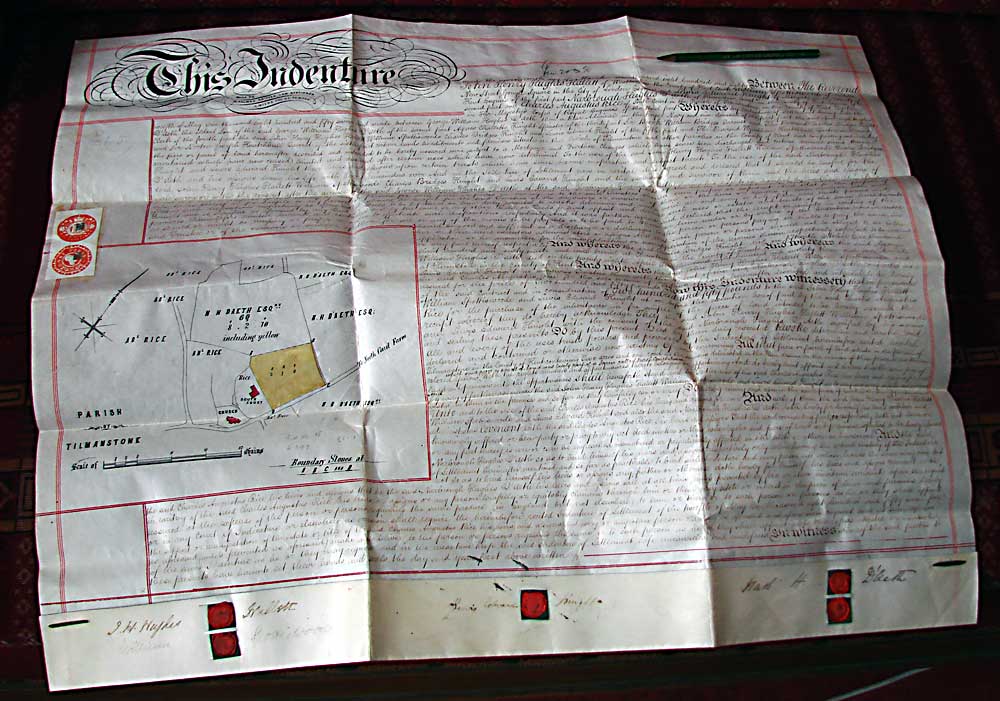
Here’s a bird’s-eye view of an 1880 conveyance (click to enlarge):

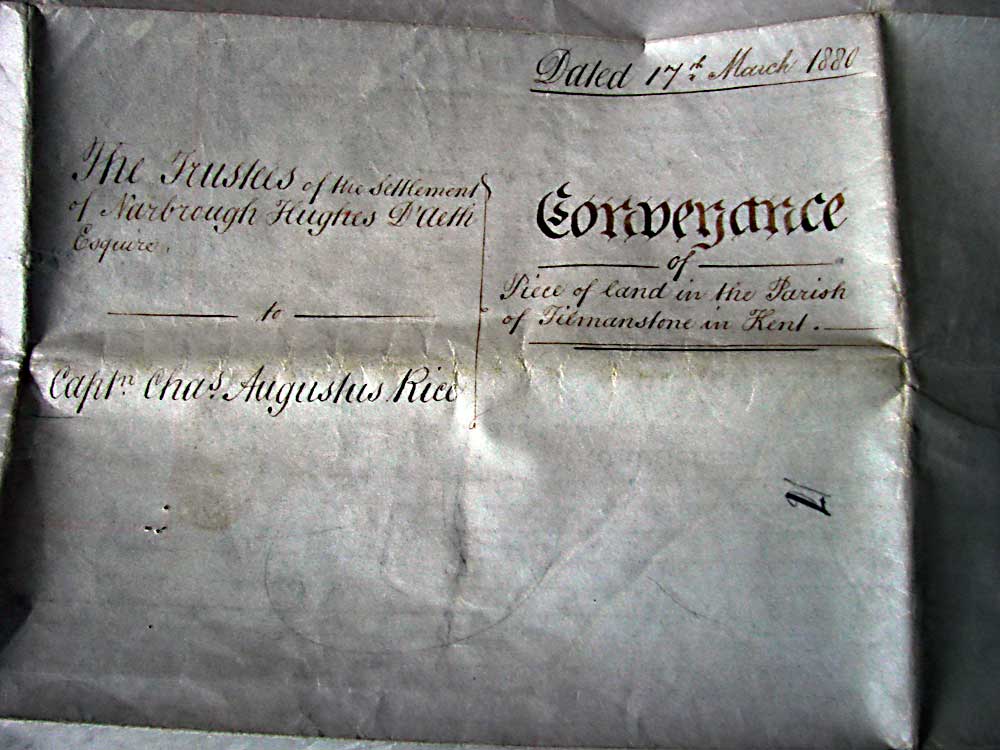
and here’s the backing sheet:

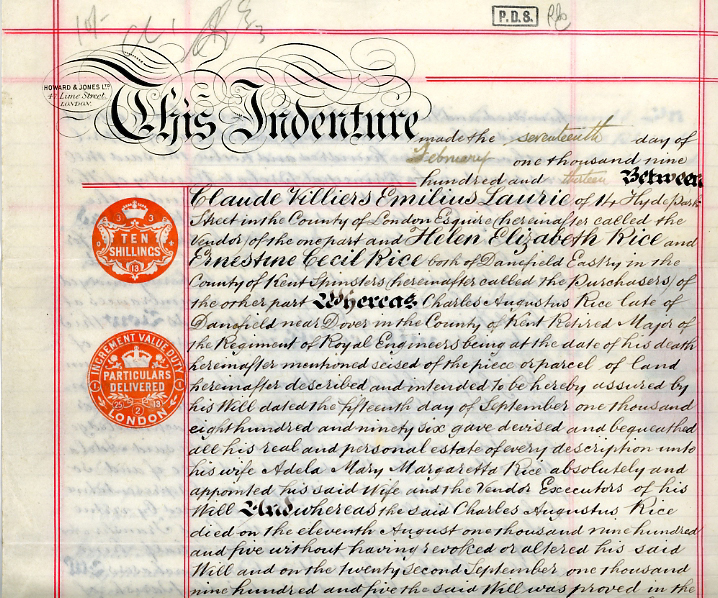
and here a small extract:

I put a pencil at the top right to show the size.

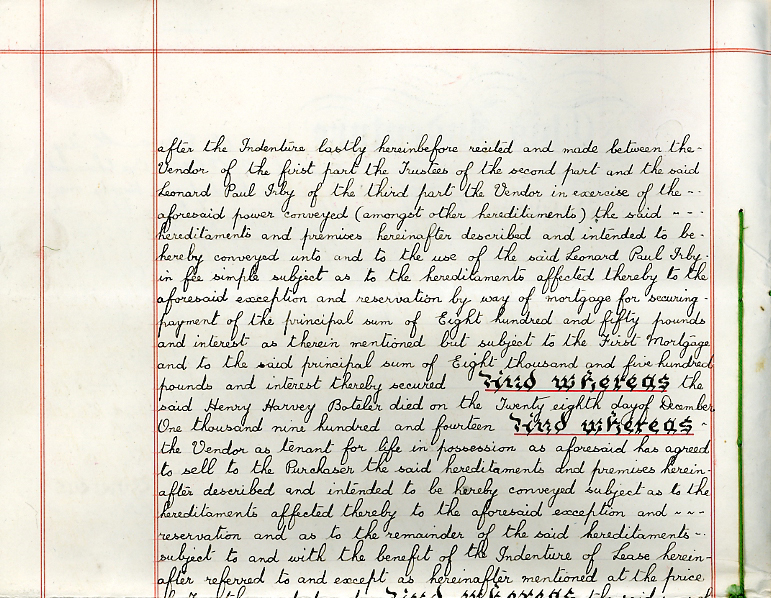
The parchment was pre-printed with the word ‘Indenture’. The rest was written in hand by a clerk. You can see how important the large words are to orient the reader. You can tell that ‘Whereas’ always refers to preliminary information, whereas ‘Now this Indenture witnesseth’ is the beginning of the operative part, and ‘All that’ precedes the definition of the land being sold (‘All that piece or parcel of land situate in the parish of ..’).

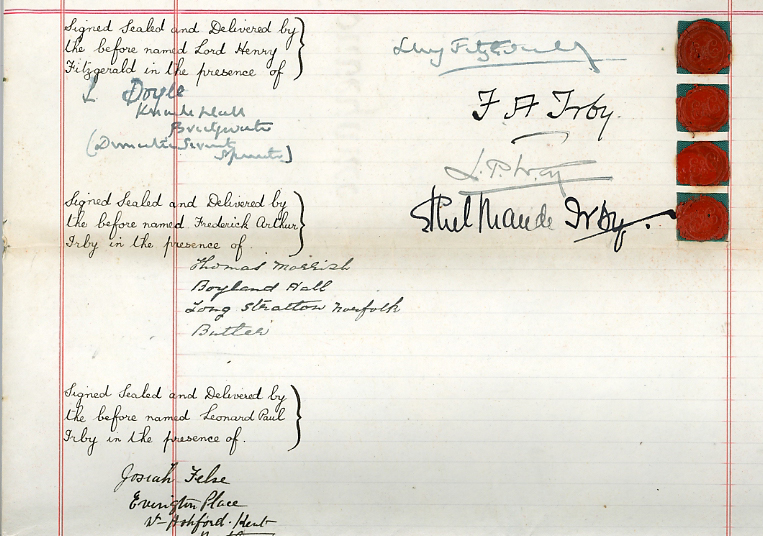
Only the really traditional connecting words are written in a different, italic script, but other words are written larger and darker (Two hundred and fifty ounds, Revoke). ‘Deed’ is capitalized but does not stand out – this is reminiscent of the current capitalization of Claimant, Plaintiff and so on. The red lines on the margin should be completely filled out, to prevent additions. You can see the stamps on the left showing that fees have been paid, and the witnessed signatures below, with a standard red seal on green ribbon.

There are photocopy shops near the Law Courts in London where you can photocopy this size of document, but it isn’t easy to read.

Here’s part of a 1913 document on the same land, now on foolscap paper:

and here a 1921 one, on which you can see the typical sewing of documents with green cord (notice the little squiggles filling up the ends of lines on the right):

and finally, a close-up of some of the signatures on the last one: