
grundsätzlich

Grundsätzlich can have two completely different meanings – see the quote from Philip Slotkin below.
grundsw

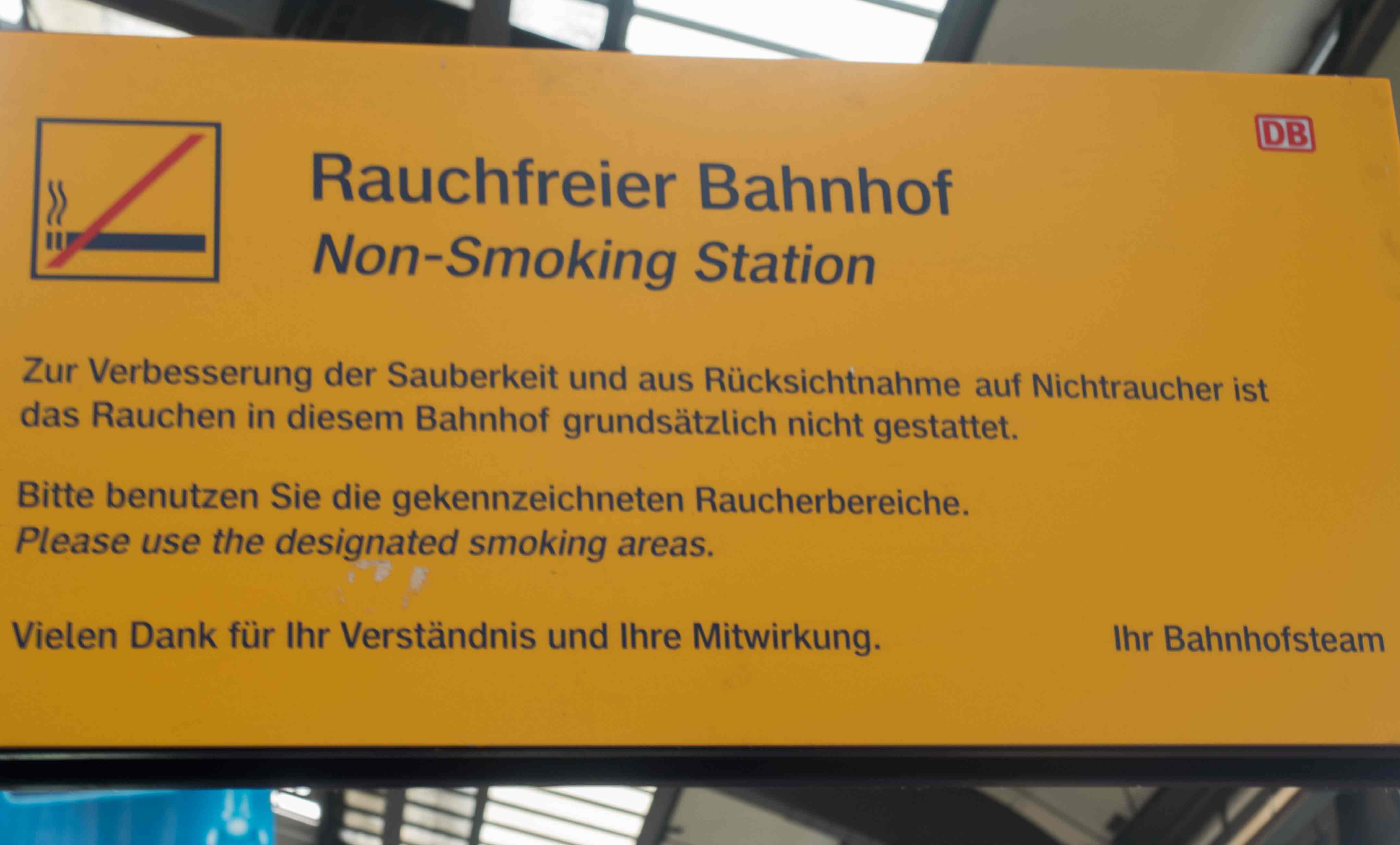
This sign at Berlin Hauptbahnhof (formerly Anhalter Bahnhof) shows the problem of translating the word grundsätzlich into English.

This sentence is one of those that are not translated into English on the sign – no wonder!

Zur Verbesserung der Sauberkeit und aus Rücksichtnahme auf Nichtraucher ist das Rauchen in diesem Bahnhof grundsätzlich nicht gestattet.

(To keep the station clean and in consideration for non-smokers, smoking is in principle/as a general rule/absolutely not permitted.)

But it goes on to say

Bitte benutzen Sie die gekennzeichneten Raucherbereiche.
Please use the designated smoking areas.

It therefore appears that grundsätzlich here means ‘in general’ or ‘with a few exceptions’.

The sign doesn’t define what kind of Mitwirkung is envisaged and who constitutes Ihr Bahnhofsteam.

Actually grundsätzlich sometimes means ‘on the whole’ and sometimes ‘with no exceptions’.

A few years ago, Philip Slotkin wrote an article for Netzblatt, the publication of the ITI German Network, about awkward words, and here is what he wrote about grundsätzlich:

grundsätzlich
This is an interesting one because it can convey two almost diametrically opposite ideas: “always (with no exceptions ever)” or “in principle (normally, but with the possibility of exceptions)”. Sometimes the word, sonorous and important though it sounds, is best deliberately omitted: muss auch der beim EPA zugelassene und in die entsprechende Liste eingetragene Vertreter grundsätzlich eine von dem Anmelder oder den Anmeldern, für die er handeln soll, unterzeichnete Vollmachtserklärung einreichen: “even professional representatives who are included in the EPO’s list must submit a declaration of authorisation signed by the applicant or applicants on whose behalf they are to act” (omitted; the meaning is “always, without exception”).
But:
Das EPA kann grundsätzlich von jedem PCT-Staat als IPEA angegeben werden: “It is in principle open to any PCT State to specify the EPO as IPEA.” (That is, a PCT state does not have to do this.)

As Philip says, it is worth considering omitting the word altogether. But clients won’t always accept this. The number of times I’ve written ‘in principle’ in a translation and it sounded weird – but if the German text uses this silly word, it creates problems for the translator.

LATER NOTE: I’ve just had a similar problem with generell, and one suggestion which might also work for grundsätzlich is to translate it as ‘unless otherwise specified’.

Lang & Rahmann Rechtsanwälte Newsletter

I recently received a newsletter from Lang & Rahmann Rechtsanwälte in Düsseldorf. I don’t know how you can get it, but I suspect you write to newsletter@lang-rahmann.de, which is given as the email address to unsubscribe. But in fact the newsletter consists of links to texts on the firm’s website, so if you go straight to the website you can read summaries of a number of recent cases in German, French and English. One of the lawyers at the firm is Dr. Stephan Kettler, who has published bilingual legal dictionaries and is a certified translator and interpreter for English and French. I use his Wörterbuch Gewerblicher Rechtsschutz und Urheberrecht: Englisch-Deutsch / Deutsch-Englisch, 2011 alongside Uexküll (Wörterbuch der Patent- und Markenpraxis). It’s great to have both.
There must have been more than one person working on the English texts. I did wonder about the translation of Schwarzarbeit as black labour, but then I read recently that consideration has been given to having James Bond played by a black actor, so it must be OK.

I see they use Federal Supreme Court for Bundesgerichtshof, which I’ve commented on before. But they always give the German name the first time around, so that is good. They have, I think, an American touch (Sect., docket) and they capitalize Plaintiff, which is not usual in this kind of text. I was also intrigued by the reference to the preponement of a flight – this is apparently well established in Indian English though. I intend to use it myself whenever I can from now on.

German Law Archive new site

The German Law Archive at Oxford University has moved to a new site, which was launched on August 6 2015. I was forwarded to it for a specific statute from the Centre for German Legal Information.

After a period in which we had allowed both content and design to collect dust, we are pleased to welcome our users to our new design, launched on 6 August 2015. We hope you will find it more user friendly. We will now work on an update of content. Feedback to the editors (see below) is welcome!

The site is still run by Gerhard Dannemann, now with Christoph König as assistant editor.

A catapult in Berlin: Strafbefehl translated into English

Andreas Jede is a German lawyer (Rechtsanwalt) who has a blog on German weapons law: Deutsches Waffenrecht (found via Jurablogs). His latest post is about an American who brought a catapult (US slingshot, German Zwille) as a present for his nephews in Berlin and was fined 900 euros plus costs. The catapult was only a little thing, but banned; he could have got away with a crossbow (then could have used it to shoot lions too).

One interesting thing is that a certified translation of the Strafbefehl is shown on the site.

I have recorded Strafbefehl as order of summary punishment – it’s called ‘penal order’ in this translation – and have often done certified translations of them for the German courts. It’s a bit like a parking ticket: for a minor offence, you are sent this document which convicts you provided you accept the conviction and pay a fine, or allows you to appeal and in this way start court proceedings.

About certified translations for the German courts, I intend to write a separate post when I get round to it. You can see here that at the beginning it says ‘Certified translation from the German language’ followed by a line. At the end comes the translator’s certification – I would have put a line and certified under the line, but in this case the translator didn’t want to use a third page and has put the certification in italics. The translator’s stamp and signature have been omitted for reasons of privacy.

It’s a good translation. I do have a grammatical quibble with ‘thirty daily rates’ – I would say ‘thirty daily units’. The German term Tagessatz, by the way, is not an instalment – it’s an amount regarded by the court as appropriate for the financial circumstances of the payer. To my mind, ‘rate’ in this sense is uncountable, and there was a time when weekly ‘units’ were introduced in England, but I think the tabloid press killed them – when people heard how much rich people were paying per week for trivial offences, they were shocked.

Anyway, back to the offence:

Lieber Gutmensch, erklären Sie mir bitte, warum er auch mit diesem Kinderspielzeug genauso hart bestraft worden wäre, genau genommen sogar noch härter, weil er die erheblichen Gutachterkosten hätte bezahlen müssen?

There’s something wonderfully German about the calculations that must be made by an expert witness to determine if the catapult breaches the law:

Der Gutachter muß nämlich feststellen, ob die maximale Bewegungsenergie der Geschossspitzen je Flächeneinheit von 0,16 J/cm2 überschritten wird (Anlage 1, Abschnitt 1, Unterabschnitt 1.2.2 WaffG).

“Wir sind da ein Rechtsstaat”

There’s been some discussion of how Angela Merkel responded to a Palestinian girl who spoke very fluently of her situation but afterwards began to cry, apparently in the stress of the moment. Merkel took the line that Germany can’t take all immigrants without exception, because there are too many. In a TV interview ranging over the political situation before the summer break, Merkel defended her statement, saying Germany is a Rechtsstaat. From Die Zeit:

In diesem Zusammenhang verteidigte Merkel ihre Reaktion auf ein weinendes Mädchen aus dem Libanon. “Ich finde, die Geste war in Ordnung.” Sie könne ja nicht Menschen, mit denen sie diskutiere, sagen, “weil du jetzt die Bundeskanzlerin getroffen hast, ist dein Schicksal schneller zu lösen als das von vielen, vielen anderen”, sagte Merkel. “Wir sind da ein Rechtsstaat.”

The Local translates this as follows:

“I think the gesture was fine,” Merkel, 61, said Sunday.

She said it would be wrong to tell people “just because you met the chancellor, we can resolve your case faster than many, many other people’s”.

“We are a state under the rule of law,” she said.

I often use that translation for Rechtsstaat, but it seems to me that state under the rule of law puts the wrong emphasis here: it emphasizes that the individual has rights and can enforce them at court, whereas Merkel is emphasizing law as a system that needs to be enforced. Maybe constitutional state would work better here.

This problem is particularly acute for interpreters, who have to translate this kind of thing off the cuff, and may also encounter references to the Third Reich as Unrechtsstaat: however you translate it, it tends to lose its rhetorical punch.

Don’t love your translator

I agree with Alain Rosenmund (his blog is Effizient Übersetzen (Lassen): don’t love your translator.

Davon abgesehen, dass sich die Aktion an die falschen Adressaten richtet, kommen die Übersetzerinnen und Übersetzer als Bittsteller daher, statt als Partner, denen man auf Augenhöhe begegnet. Diese Aktion schwächt mit anderen Worten die Position der Übersetzerinnen und Übersetzer. Genauer: Die Übersetzerinnen und Übersetzer, die bei dieser Aktion mitmachen, schwächen ihre eigene Position.

Rosenmund goes on to give advice on how translators should really establish a serious professional relationship.

Fortunately, it sounds as if the stickers can be removed easily:

Our stickers can be removed easily and do not leave marks. The act of sticking them to street lamps and the like will therefore not be considered vandalism in most countries. However, we know that countries like Switzerland and Singapore are very strict and we ask you to consider your country’s law and use common sense when you go out tagging.

Our stickers are vegan, made of biodegradable plastics, and don’t have any negative environmental effects.