Perpetrators (pool of)

(Excuse the lack of spaces between sections – I don’t understand the latest edition of WordPress)


On the platform formerly known as Twitter, Mary Aspinall-Miles (followed by 27 people I follow) wrote:

May I ask a question about criminal justice language: When did the word “perpetrators/perp” start getting wide-scale use in the UK generally?
I understand the reply from FaithfulDefenceAdvocate:
After the pandemic when we all started watching too many US cop shows on Netflix?
But that may not be the context in which the term has been used so much.
Reply from Inspector Morose:
Has it though? I don’t hear this at work: it’s suspect / offender / nominal / defendant; and very occasionally accused / subject / target / person of interest. I think it may be more common in victim support services, maybe ?
In a court context, the defendant has not yet been convicted, and after conviction becomes the prisoner/prisoner at th
I gather it has become common to refer to “domestic abuse perpetrators”. Was this not always the case? It sounds a bit US but I suppose there are few alternatives. ‘”Domestic abuser” is a possibility.
As one commenter mentions, the term “pool of perpetrators” is used:
In the light of concerns about the Ben Butler case in June 2016, this post by Sarah Phillimore attempts to explain the law that will apply in the family courts when a child has been hurt and there are a number of adults who could have done it – the so called ‘pool of perpetrators’.
Here’s a 2022 case, Re A (Children) (Pool of Perpetrators) with more information on the term.
In Re B (Children: Uncertain Perpetrator) [2019] EWCA Civ 575, [2019] 2 FLR 211 (“Re B: 2019″), Peter Jackson LJ clarified the proper approach in respect of uncertain perpetrator cases and the concept of a pool of perpetrators.
I have traced the term “pool of perpetrators” to a case as early as 2003 and I think it is probably a term that was introduced and taken up in case law.
The Oxford English Dictionary was not likely to solve this one. But here is part of the entry:
A person who perpetrates something, esp. a crime or evil deed.
  1. 1570

    Estemed as menquellers and perpetratours of most wicked factes.

    J. Foxe, Actes & Monumentes (revised edition) vol. I. 110/2

The actor or absolute perpetrator of the crime.

W. Blackstone, Commentaries on Laws of England vol. IV. iii. 34
1796

What is often said..of other crimes..if the perpetrator be sufficiently illustrious, it becomes a virtue.

J. H. Burton, Book-hunter (1863) 183
1951

Harington was the Queen’s godson—clever,..naughty, a light~weight, perpetrator of puns and practical jokes.

A. L. Rowse, English Past 24
1995

He wanted the perpetrators captured and executed.

T. Clancy, Op-center xx. 100

Even lawyers do not like legalese

Even lawyers do not like legal language according to this article.

I found the reference through a colleague who subscribes to Frankfurter Allgemeine Zeitung (thanks, Marisa!) and quoted this, from 31.05.2023:

Warum so kompliziert?

Von Sibylle Anderl

Wer Texte von Anwälten liest, ist hinterher selten schlauer. Die Motivation dahinter haben nun US-Forscher entschlüsselt.

Wie naiv die Vorstellung ist, menschliche Sprache diene stets dem möglichst reibungsfreien Austausch von Informationen zwischen Sender und Empfänger, illustriert wohl kaum etwas besser als die Ausdrucksweise von Juristen. Das Missverständnis, dem Leser solle im juristischen Schriftverkehr Verständnis ermöglicht werden, ist meist nach wenigen Worten vom Tisch. Die Gründe dafür sind gut erforscht: Der Trick liegt in der Kombination von Schachtelsätzen mit unüblichen Fachtermini. …

The article referred to appeared in PNAS: Even lawyers do not like legalese (paywall but I paid the $10). Here’s the abstract:

Across modern civilization, societal norms and rules are established and communicated largely in the form of written laws. Despite their prevalence and importance, legal documents have long been widely acknowledged to be difficult to understand for those who are required to comply with them (i.e., everyone). Why? Across two preregistered experiments, we evaluated five hypotheses for why lawyers write in a complex manner. Experiment 1 revealed that lawyers, like laypeople, were less able to recall and comprehend legal content drafted in a complex “legalese” register than content of equivalent meaning drafted in a simplified register. Experiment 2 revealed that lawyers rated simplified contracts as equally enforceable as legalese contracts, and rated simplified contracts as preferable to legalese contracts on several dimensions–including overall quality, appropriateness of style, and likelihood of being signed by a client. These results suggest that lawyers who write in a convoluted manner do so as a matter of convenience and tradition as opposed to an outright preference and that simplifying legal documents would be both tractable and beneficial for lawyers and nonlawyers alike.

The text types referred to are contracts and statutes (judgments and correspondence are my favourites though).

I wondered what the German Schachtelsätze referred to specifically. It seems the villain is the centre-embedded clause (“leading to long-distance syntactic dependencies”), which I hadn’t heard of but does seem similar to the convoluted German sentences.

The authors cited five hypotheses as to why lawyers write in a more complex manner than they themselves would prefer:

1. Curse of knowledge hypothesis – curse of knowledge is assuming other people know as much as you do and so failing to explain enough.

2. Copy-and-paste hypothesis – when you are putting a contract together, you use archaic clauses by copying them rather than amending or adapting them. I suppose that cut and paste predates word processing.

From Wikipedia:
The term “cut and paste” comes from the traditional practice in manuscript-editings whereby people would cut paragraphs from a page with scissors and paste them onto another page. This practice remained standard into the 1980s. Stationery stores sold “editing scissors” with blades long enough to cut an 8½”-wide page. The advent of photocopiers made the practice easier and more flexible.

I hadn’t heard of editing scissors, an exciting term.

3. In-Group signalling hypothesis: signalling to other lawyers that you’re part of the tribe, sounding more “lawyerly”.

4. It’s just business hypothesis: writing in a convoluted way to preserve your monopoly on legal services and justify your fees.

5. Complexity of information hypothesis: thinking that law is so complex that only complex language can do justice to it.

Most of these hypotheses are debunked in the article, but the copy-and-paste idea seems to stand up.It’s a problem for translators since you are translating for someone who doesn’t really understand what they wrote.

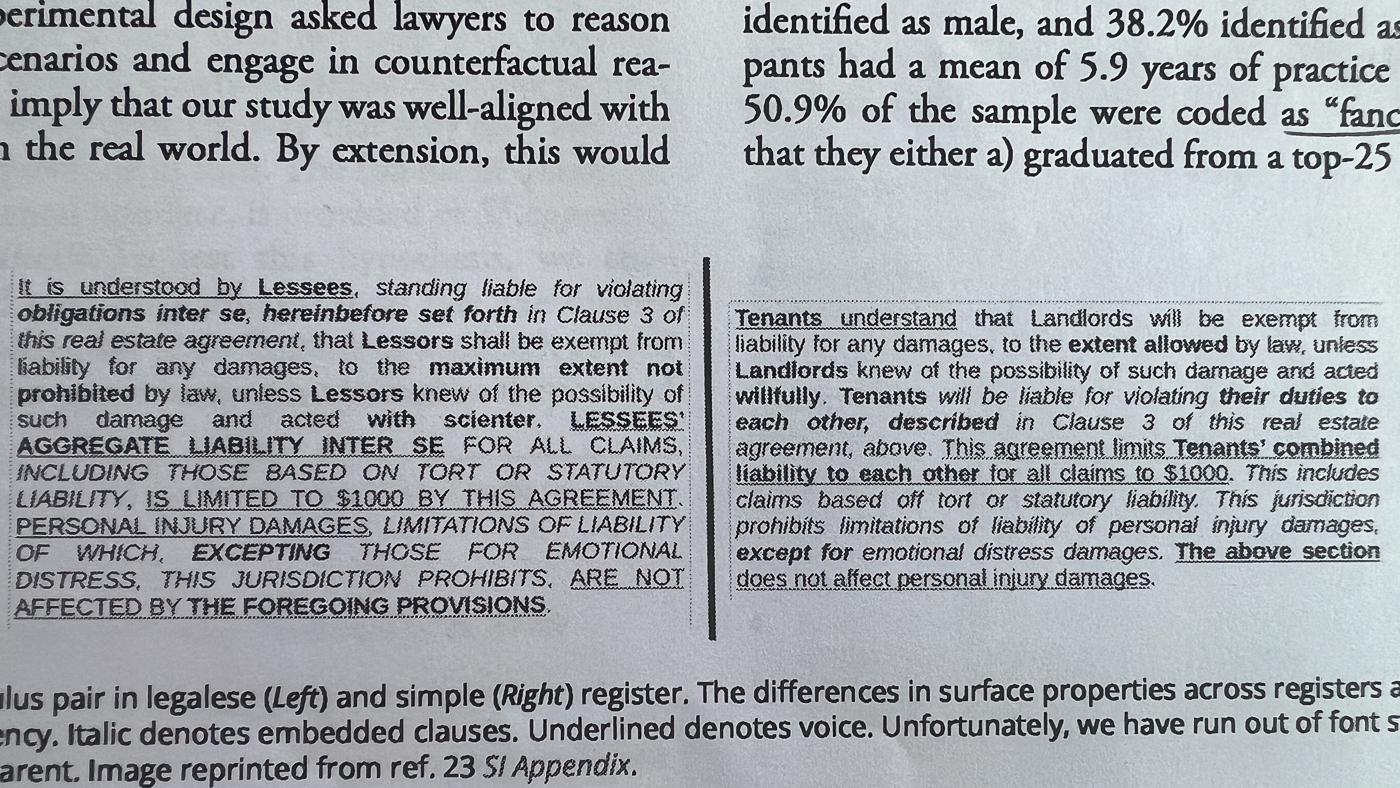
Here is an example of contract language in tradition legalese (left) and simpler language (right), highlighting the differences:
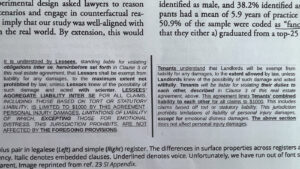
No participant saw those paired versions – the traditional and simpler versions did not match. There are details of how the study was recruited for and conducted. See the article for these. For example, in one experiment, 60% of participants identified as male, 38% as non-White. Lawyers were further categorized, for example 50% were coded as “fancy” lawyers, meaning that they either graduated from a top-25 law school according to US News and World report or worked at a top-200 law firm according to American Lawyer magazine.

How to translate numbers

Victor Dewsbery has added a post in his blog Language Mystery going into great (and alas necessary) detail on millions, milliards, billions, trillions etc.

Translating numbers: 1. How much is a billion?

This history of the number systems has also created “false friends” for translators. A German “Billion” is not the same as an English “billion”. The words “Trillion” and “Quadrillion” are also misleading. And a German “Milliarde” is not a “milliard”.

This much I remember, and I am very grateful to Victor for setting it out so well. Take a look around for other topics while you’re there.

How to address a judge

Via Joshua Rozenberg’s newsletter – the free version – at A Lawyer Writes – nowadays most judges can be addressed as “Judge” rather than “Sir” or “Madam”. I suppose this avoids gender problems and wonder if that was the reason for the change (announced on December 1 2022).

You should still address lay magistrates as Sir or Madam. If you are not sure which is appropriate, try Your Worship. That also works as a collective: Your Worships. Many magistrates will tell you they have been addressed as Your Holiness by confused defendants or those hoping for a more benign sentence.

The diagram What do I call a judge? makes it no clearer. I love the surnames used – “District Judge Kherallah” or “First-tier Tribunal Judge Curry”.


In response to a comment unexpectedly received, here is a longer quote from Rozenberg’s newsletter (i.e. virtually the whole thing):

How do you address a judge in court? Top judges are addressed as My Lord or My Lady. Most circuit judges are addressed as Your Honour. I was taught to address any High court master as Master. And until yesterday some of the most junior judges in England and Wales were simply called Sir or Madam.


That’s all gone. From now onwards, any judge in one of the following categories is to be addressed simply as Judge:

  • Masters
  • Upper Tribunal Judges
  • Judges of the Employment Appeal Tribunal
  • District Judges
  • District Judges (Magistrates Courts)
  • First-Tier Tribunal Judges
  • Employment Judges

Why? According to the lord chief justice and the senior president of tribunals,

the move away from “Sir or Madam” involves modern and simple terminology, reflecting the important judicial role whilst maintaining the necessary degree of respect.

We also hope this change in language will assist litigants-in-person involved in court and tribunal proceedings.


And, I suppose, it will reduces the risk of misgendering judges.

Calling a judge “Judge” may sound a bit disrespectful. But it’s how you address them formally when they’re not sitting in open court.

You should still address lay magistrates as Sir or Madam. If you are not sure which is appropriate, try Your Worship. That also works as a collective: Your Worships. Many magistrates will tell you they have been addressed as Your Holiness by confused defendants or those hoping for a more benign sentence.

And Sir or Madam remains appropriate for lay members of a tribunal. High Court registrars should be addressed as Registrar, which is inconsistent and a bit harder to say.

The changes apply only to the way in which judges are addressed in court or at tribunals. It does not affect judicial titles.


I have now found my copy of The Language of Advocacy by Keith Evans, one of my favourite books and not just about England and Wales. It is dated 1998 (but still in print), so before the House of Lords became the Supreme Court. Evans writes that “no appeal court Justice will ever take offence at being called simply ‘Judge’. It’s an illustration of the old truism that those who matter don#t care, and those who care don’t matter.”

Of course, now the judges of the Supreme Court are called justices, which might not alter the relevance of the above but did prompt the judges of the German Constitutional Court to wish to be called “justices” in English translations.


There is also a post on this on free movement.

F for Frankfurt

Richard Schneider at uepo.de reports that there is a new DIN proposal for a German phonetic alphabet.

It seems a good idea to me to know the German phonetic or spelling alphabet and the international one, but nevertheless I usually get confused when speaking to Germans on the phone and needing to spell something. Wikipedia has a lot. I notice I’ve even been making mistakes spelling out my postcode in the UK, saying Romeo Michael instead of Romeo Mike.

I was not aware that in 1934 the German Buchstabiertafel was arianized. Thus David became Dora, Jacob became Jot, Nathan Nordpol, Samuel Siegfried, and Zacharias Zeppelin.

There was a plan to restore David, Jakob and Nathan – Samuel and Zacharias were changed back in 1948 – but this latest plan simply replaces all first names by town names, so D for Düsseldorf, J for Jena, N for Nürnberg, S for Stuttgart and Z for Zwickau.

It was pointed out that the Nazi changes were only partially reversed, and there were 16 male names and only six female ones. Other countries had good results using city names, it was said.

This DIN 5009 draft is now open for discussion. It has an appendix showing the original, mainly Weimar Republic, phonetic alphabet. The final version is likely to appear in mid-2022.

I can’t picture myself achieving any kind of consistency now.

‘Shall’ in English contracts

I recently heard a webinar by Christin Dallmann and Richard Delaney on translation problems in contract law. I highly recommend these webinars. It reminded me of that old chestnut: do we use ‘shall’ in a contract (when drafting or translating)?

Richard Delaney has now written a guest post on the use of ‘shall’ in Kevin Lossner’s Translation Tribulations blog, https://www.translationtribulations.com/2021/05/richard-delaney-on-shall.html. Kevin writes that this text was originally part of a social media discussion, but I don’t know where that was and didn’t see it. I am not going to argue point-by-point with Richard’s summary, just set out my own.

I think the mandatory verb in a contract can be shall, will or must. It ought to be used exclusively (some English contracts mix shall and will). I do not think the choice of verb form is likely to confuse any reader. The reader will realize that the verb imposes an obligation.

I posted on this on March 1 2013, since when I have surely changed my mind in some ways.
Shall I or shan’t I? Shall, must and the plain language brigade. The comments are interesting though.

Thornton on legislative drafting is relevant too, although it’s about legislation, not contracts.

  1. I use shall in the imperative or mandatory sense when I translate from the German (as Richard does). I use it even when it is not clear from the German original who the duty is imposed on.

One of the commenters on Kevin’s blog, Stephen Rifkin, writes:


According to the legal experts I have consulted in books and person, “shall” is very simple – legal obligation. A body, personal or legal, can have an obligation. Therefore, it is correct to say: The Tenant shall pay the rent on the 1st of the month but incorrect to say that “The rent shall be paid on the 1st of the month.”

I understand his point, but I would use shall here too, despite the lack of a subject. It does annoy me when German contracts appear to impose duties without indicating who is responsible, but I wonder what the alternative translation would be – varying the verb when the German doesn’t?

One objection to shall I have read recently is that since it is used in a variety of ways, it is more confusing than must for non-native speakers of English who nevertheless have to make do with English translations (rather than Arabic or whatever). That seems possible.

As often mentioned, Bryan Garner is an advocate of avoiding shall altogether (in original English contracts, of course). I think he got this from a movement in Australia and Canada. He lists something like 16 uses of shall, most of them unsatisfactory.

Writers who advocate plain English in law also condemn shall. One argument I’ve read is that if shall is used in different ways within one contract, a court might query whether it has a mandatory meaning at all. I would certain advise against using shall in more than one sense (for example, ‘If the landlord shall…’). Of course, I am not drafting a contract, but always translating a contract where the German version is defined as binding, so I doubt that a messily translated contract would be challenged in court, but you never know.

  1. Instead of shall, will can be used. If either party will do something, this is a promise by a party to the contract that has a binding effect. Some English contracts I have seen use both will and shall, for example, ‘the insurer will’ and ‘the insured shall’. This mixture is likely to confuse readers and so it is better to use either one or the other consistently when translating into English. Geoffrey Leech, see below, calls it a ‘quasi-imperative’.
  2. A third possibility is must. This is perfectly possible and avoids any unclarity. My only objection is that it sounds a bit unnatural to me.
  3. English grammar books not specifically about legal texts: when I first wrote about the use of shall, will and must for legal translation students, I was also teaching English grammar to a wider group. My understanding of English verb forms – tenses and modals – was based on the second edition of Geoffrey Leech’s book ‘Meaning and the English Verb’. I can’t agree with some writers who describe will and shall as ‘simple future’, because both verbs have a variety of uses and there is no simple future.

I will quote the third edition of Leech on will in contracts.

There is a difference between the will of insistence above and a QUASI-IMPERATIVE will found with second- and third-person subects: You will do as I say. The Duty Officer will report for duty at 0700 hours. This will is a stronger equivalent of must, and expre000sses the will of the originator of the message, rather than of the subject. It also differs from the will of insistence in that it is not strongly stressed. The quasi-imperative will seems to be a special use of the future will of ‘prediction’, the implication being that the speaker or writer has so much authority over the addressee that failure to perform the predicted action is out of the question. Hence it has military and despotic associations.

The verbs shall and will can be used to refer to the future but also as modal verbs (there is some overlap between future and modal uses). There is no ‘simple future’. For example, the German ‘morgen fahre ich nach Hause’ is not translated as ‘I will go home tomorrow’, but usually as ‘I am going home tomorrow’. ‘I will go home tomorrow’ might be said at the moment of decision or as a promise. Without going into more detail, in a contract I have always seen ‘The insurer will…reimburse’ as a promise made in a contract and therefore binding. (But Geoffrey Leech calls it ‘quasi-imperative’, see above).
When giving examples of usage, it is a good idea to stick to the affirmative use, excluding negatives and questions, which only confuse the description.

And on shall:
RULES AND REGULATIONS (with second-person or third-person subjects)
A player who bids incorrectly shall forfeit fifty points {rules of a card game. The hood shall be of scarlet cloth, with a silk lining of the colour of the faculty {rules for academic dress}.
This usage is found only in legal or quasi-legal documents. Here shall could be replaced by must (=’obligation’), or by the ‘quasi-imperative’ will.

  1. Use of present tense in German contracts.
    Something Richard Delaney mentioned in the webinar that I have never commented on but that is a constant problem is that the present tense in German contracts is usually used to mean an obligation, but it can also be a statement of fact.

Bryan A. Garner, Garner’s Dictionary of Legal Usage, 3rd ed. 2011