Interpreting Dagenham

In interpreting teenage slang for the jury, what could Mark Paltenghi do? Your honour, this is bare hard to understand: Laughter in court as barrister has to translate defendants’ teenage slang into plain English

A barrister had to translate text messages sent between teenagers into plain English in court after they included slang like ‘bare’ – meaning really- and ‘bait’ – meaning blatant – for the judge.

During the shooting spree in Dagenham, the group are said to have sent text messages to each other, which were read out by the prosecution along with the ‘translations’.

In one message, sent by the youngest defendant who is 16, to a contact called ‘female boss’, he wrote: ‘Hurry up I’ve got bare haters around me now.’

Prosecutor Mark Paltenghi – in his fifties – informed the jury: ‘Next to it in italics you have it re-written.

‘It means: ‘Hurry up, I’ve got a lot of people who don’t particularly like me here.’

Another text read: ‘Hurry up I’ve got a strap on me, this is bare bait’.
Mr Paltenghi told the jury: ‘We believe this means: ‘Hurry up, I’ve got a gun on me, and this is really risky’.’

Defendants Scott Stokes, 20, his brother Jason, 18, Anne-Marie Madden, 25, and 16-year-old who cannot be named for legal reasons, burst into laughter.

Jurors also giggled when Judge Patricia Lees asked the defence barristers: ‘Do you agree with these translations?’

(First seen in Metro headed I’m a barrister, innit)

LATER NOTE: Just in, the report of a witness speaking Sierra Leone creole (Krio) for an hour before anyone in court realized it was not an acoustics problem.

Witness gave evidence for an hour before anyone in court realised she wasn’t speaking proper English

Forensic linguistics in court

At Language Log, Mark Liberman has a post dated 28.11 and headed Plebgate judgment, in which he reports on his experience as an expert witness, with Peter French appearing for the other side (Mitchell’s).

As is widely known, Andrew Mitchell, the government chief whip, was stopped by police from cycling through a pedestrian entrance in Downing Street and is said to have told the policeman ‘Best you learn your fucking place – you don’t run this fucking government – you’re fucking plebs.’

The language aspect was that there were arguments that the police officer in questio, Toby Rowland, was thought unlikely to invent such an expression, and Mitchell was thought likely to use it.

Mark Liberman had to report on whether the time of the exchange recorded by CCTV cameras was long enough for the words to have been spoken. Both he and Peter French came to the conclusion that the time was long enough. Liberman quotes Archie Bland in The Guardian:

You couldn’t help but be lost in admiration for [Mitting’s] forensic command of the detail: you’d need a memory palace to keep it all straight. And yet it almost all seemed irrelevant. A judgment that took over an hour to read boiled down to the fact that two phonetic experts judged that Mitchell would have had time to say the “toxic phrases”, and that he had told his deputy that he didn’t know what he had said very soon after.

More from the case – full report here – in the Language Log post. Also the commenters get very involved in forms of address in court, starting with whether it was right for Mark to address an English judge as ‘My Lord’.

Forms of address

If, like me, you are an alumna or alumnus of King’s College London and, unlike me, you wish to attend The Lifeboat Debate: who will save humanity?, you have a choice of titles to enter. In my case, Dr was preselected, but here are more (thanks, Alison!):

Visc Dr Miss Mr Mrs Ms Professor Reverend Admiral Air Care Air Chiefe Marshal Air Cmdr Air Commodore Air Marshal Air Vice-Marshal Alderman Alderman & Sheriff Ambassador Archibishop Archdeacon Assistant Commissioner Baron Baron von Helmfels Baroness Bishop Brigadier Cader #N/A Canon Canon Emeritus Captain CB MBE PhD Chancellor Chief Justice Chief Officer Chief Rabbi Chief Technician Cllr CMG Colonel Comdt Commander Commander (D) Commodore Comtese Councillor Counsellor Count Countess Dame Datin Datin Nik Datin Sri Dato’ Dato’ Sr Datuk Deaconess Dean Detective Constable Dr & Mrs Dr Bishop Dr, Mr Dr. iur. Drs Duchess Duke Earl Elder Emeritus Emeritus Professor En Eur Ing Father Field Marshal Flight Lieutenant Flight Officer Flt Lt Flying Officer FR Frau General Group Captain Her Excellency Her Highness Her Honour Her Honour Judge Herr His Excellency His Highness High Highness Sheikh Sultan His Hon Judge His Honour His Majesty King His Royal Highess The Honourable HRH Prince HRH Princess Judge Justice Lady Lieutenant Lieutenant-Colonel Lieutenant-Commander Lieutenant-General Lord Lord Justice Lord Mayor of London Lt Col Lt Gen Madam Major Major (rtd) Major-General Marchioness Marchioness of Marquis Master Messrs Misses Mme Monsignor Pastor PC Pehin Pengiran Prebendary President Prince Princess Professor & Mrs Puan Sri Rabbi Rear-Admiral Rev Revd Canon Dr Revd Dr Right Reverend Rt Hon Rt Hon Lord Mayor Almerman Rt Revd Sanator Senior Evangelist Sergeant Sheikh Sheikha Sheriff Shri Sir Sister Smt Squadron Leader Staff Sergeant Sultan Surgeon Surgeon Captain Surgeon Commander Tan Sri Tan Sri Dato Tan Sri Datuk Tan Sri Dr The The Baroness The Dowager The Earl The Hon The Hon Mrs The Honourable The Lady The Lord The Lord Bishop The Marquess The Most Honourable The Most Rev The Rev Canon The Rev, Canon The Rev, Dr The Rev, Mr The Revd The Rev’s Canon The Revd Prebdy The Rt Hon The Rt Hon Lord The Rt Revd The Venerable The Very Rev The Viscount Toh Puan Tun Vice Admiral Viscount Viscountess W Bro Warrant Offcer 2 Bandmaster Wing Commander Sqn Ldr The Very Revd Captain Royal Navy

Some are highly dubious – I think they must have been harvested.

Boing Boing has been here before:
Brit Airways’ honorifics kick United’s ass – not at King’s, that is, but at British Airways. Who have not the same list, although they do have Her Majesty. And a German has added material in a comment.

I am particularly fond of The, standing alone.

Books on legal writing in English

There are many useful books for lawyers on how to write better legal English. How useful they are for translators is another matter. By all means, if you have time, work through some of the suggestions on legal writing (an internet search for ‘drafting’ is also a good idea). Consider whether you mind whether the book is for British or U.S. or another form of legal English.

But as I suggested in the post on virtual synonyms, when translating into English you can’t simplify at will. Consequently we tend to spend more time researching specific law and language problems than taking the wider view.

As a member of the BDÜ it probably doesn’t behoove me to look at the publications of the BDÜ Fachverlag with as much suspicion as I do, but I’ve never recovered from how a colleague salivated over a book on how to translated GmbH articles into English. The book was a student’s work written for a non-lawyer lecturer and was full of problems. But then, caveat emptor.

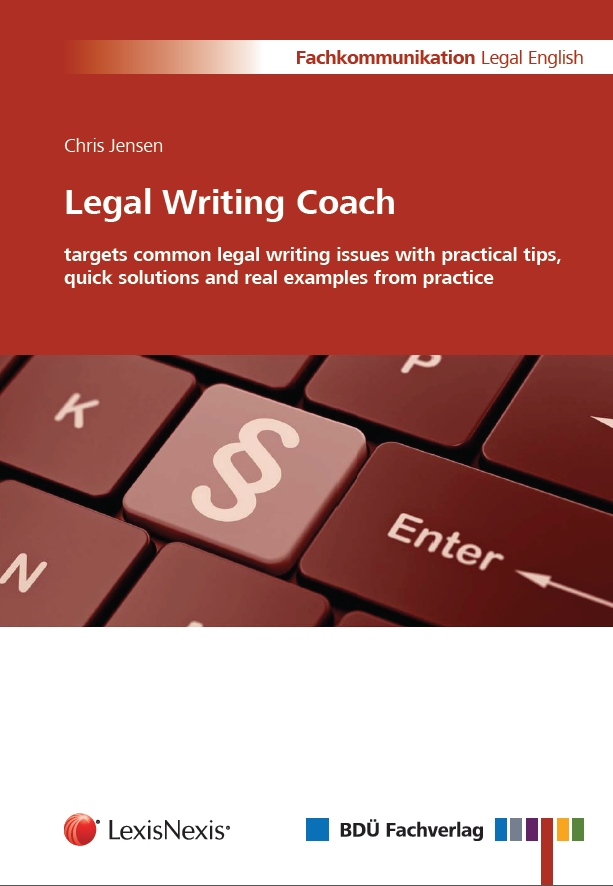
The latest book advertised to me is probably not at all bad, in fact it may be good, but is it a book for lawyers on how to write legal English or does it address translators into English too?

LegalWritingcoach_Titelbild

I couldn’t trace the LexisNexis edition, but what is that keyboard on the cover telling us? I suppose it is implying that there is a German element.

I am told (my emphasis):

Wenn Sie juristische Texte ins Englische übersetzen, dann kann ich Ihnen die jüngste Neuerscheinung aus dem BDÜ Fachverlag ans Herz legen, den „Legal Writing Coach“ – eine Sammlung von leicht verwendbaren Materialien, die an das begrenzte Zeitbudget von vielbeschäftigten Anwälten und Übersetzern angepasst ist. Der „Legal Writing Coach“ basiert auf der langjährigen internationalen Erfahrung des Autors und bietet eine Fülle von echten Praxisbeispielen und zielt auf die häufigsten Probleme beim Schreiben juristischer Texte ab. Die angebotenen Lösungen lassen sich schnell und einfach umsetzen. Mit diesem Buch können Sie Ihre Fähigkeiten verbessern, gute juristische Texte in englischer Sprache zu verfassen.

You can see the table of contents in a PDF linked to here. I can’t tell what about it is for translators. It does appear that the author is based in Vienna.

It does have an Annex on British and American legal usage and one on slutations, titles, and closings which might be interesting for translators.

Virtual synonyms: breach, violation or non-performance

‘Breach, violation or non-performance’ is just an example of the kind of problem encountered by translators working out of English. I have met native speakers of German who prefer to work into English largely to avoid this problem of contract translation.

What do the doublets or triplets mean? Probably the lawyer who drafted the contract wasn’t sure but used an established phrase.

How can you find out if they are synonyms or not?

Books on using plain language in the law can be helpful, because they sometimes say which doublets are synonyms and which aren’t. For instance, Mellinkoff, Legal Writing: Sense and Nonsense has an appendix B which lists coupled synonyms.

acknowledge and confess
act and deed
annual (sorry, should read ‘annul’)and set aside
authorize and empower
conjecture and surmise
covenant and gree (should read ‘agree’)

and many more.

The problem is mentioned by Enrique Alcaraz and Brian Hughes in Legal Translation Explained:

There is, of course, the possibility that the original phrase contains a mere tautology exhibiting neither subtlety nor rhetorical aptness, i.e. what is sometimes called ‘a distinction without a difference’. If this is the translator’s conclusion, there would seem to be two options open: silent simplification by dropping the less general term, or simple reproduction. Lawyers, after all, are not always breathtakingly compelling speakers or writers, and it is likely that most languages would tolerate literal renderings of rather weak pairings like ‘final and conclusive’, even if conscious stylists would not applaud them. On the other hand, the doublet ‘alter and change’ is a candidate for simplification to the equivalent of ‘alter’ or, alternatively, to some such treatment as ‘alter in any way’.

The problem is also addressed in this paper:


Exploring near-synonymous terms in legal language. A corpus-based, phraseological perspective

Stanislaw Gozdz-Roszkowski.

Abstract:

This paper aims to determine the extent to which a corpus-based, phraseological approach can be effectively applied to discriminate
among near-synonymous, semantically-related terms which often prove troublesome when translating legal texts. Based on a substantial multigenre
corpus of American legal texts, this study examines the collocational patterns of four legal terms ‘breach’, ‘contravention’, ‘infringement’ and ‘violation’, first in the genre of contracts and then in the multi-genre context of the entire corpus. The findings highlight the
area of overlap as well as specificity in the usage of these terms. While collocational constraints can be argued to play an important
disambiguating role in the semantic and functional analysis of both source and target text items carried out by translators prior to the
interlingual translation, this study emphasizes the applicability of the phraseological approach to English source texts.

I’ve long been tempted by the idea that computer study of collocations could help translation problems. But I’m not really sure. At all events, the author see this study as merely the beginning of an approach to analysing legal synonyms and near-synonyms.

The collocational information can be treated as a clue or a prompt to evoke a generic scenario in which a particular legal concept functions. Such is the case of breach, which reflects a unity of domain and genre with a well-defined and homogenous class of objects this term refers to. Similarly, the use of infringement is marked by domain-specificity. This tendency for certain legal terms to co-occur with other terms or phrases marked by semantic resemblance could also be accounted for by referring to the concept of semantic preference (Stubbs, 2001). In contrast, violation cuts across legal domains and genres and it is the most ‘inclusive’ of all the terms. Finally, contravention illustrates a heavy phraseological restriction to virtually one form of (a) phrase.

Rip Van Winkle

I feel (and am) rather aged coming back to London after more than thirty years.

I didn’t know how difficult it is to get called Ms – just by spelling it out you draw to yourself the attention you didn’t want.

I thought it was only in the USA that things like ‘Howdy, MMarks’ (the way WordPress greets me backstage) were encountered, or Moo cards originated (posted in a box marked ‘Yay!’, and apparently can’t be received in a plain envelope).

But today at Sainsbury’s, joining the queue for personal service and buying a ‘southern fried chicken wrap’, I am met with ‘Babes, why don’t you get a Meal Deal?’

Someone trying to sell solar panels greets me at the door with ‘Hello darling, how are you today?’ In fact the words ‘How are you today?’ signal a cold phone call.

A mailing-list colleague says how much he dislikes Virgin Mobile addressing him as ‘Peeps’!

To quote another poster:

Office 2013 has bits of that. When one finishes a spell-check, a pop-up box announces:
“Spelling and grammar check complete. You’re good to go!”
After doing something else, it answers: “We did that for you.” Who’s “we”?
Somewhere else it replies, “Nope.”

I suppose I am becoming the old person I was destined to be.

Anyone else having difficulties with the modern world?