Neue Altstadt Frankfurt am Main

Some impressions of the new Altstadt in Frankfurt am Main following a guided tour on October 22.

Frankfurt’s original old town was the biggest in Germany and consisted of about 1250 medieval and Renaissance timber-framed buildings over an area of 7000 square metres. It was destroyed in air raids in WWII and largely replaced by a 1970s brutalist Technisches Rathaus, administrative buildings, which must have robbed the area of its life. The buildings were eventually bought back by the city and the whole area was ‘rebuilt’ from 2012-2018. The small buildings, alleyways and squares have returned: 15 buildings following the old plans (though no longer 12 families sharing one lavatory) and many others designed in a variety of similar styles. There are shops and restaurants in the lower floors. The area was opened in September 2018 and at the moment is full of groups of tourists like me being led around it.

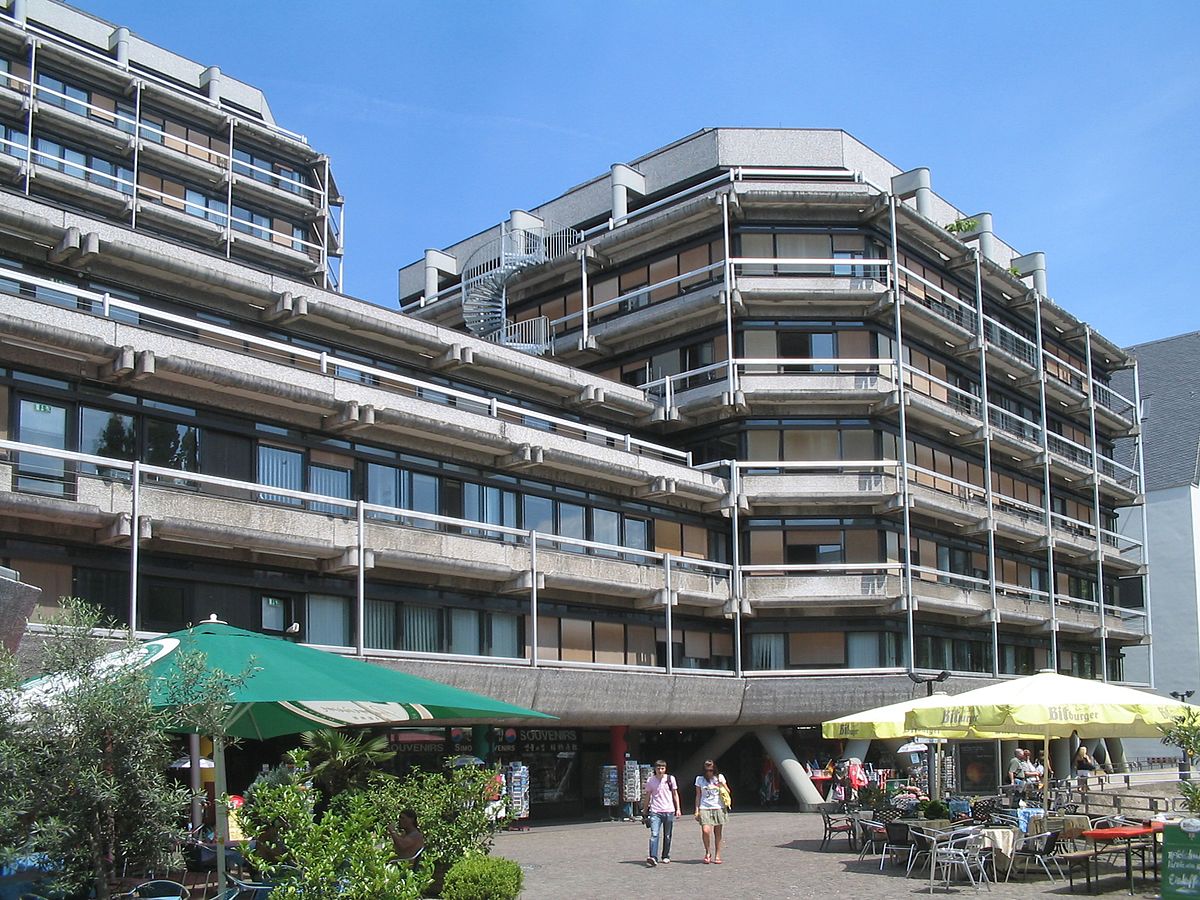
Here’s a picture of the Technisches Rathaus taken in July 2008 by L. Willms:

Some impressions of the new buildings:

Four buildings in the street called Markt or Krönungsweg

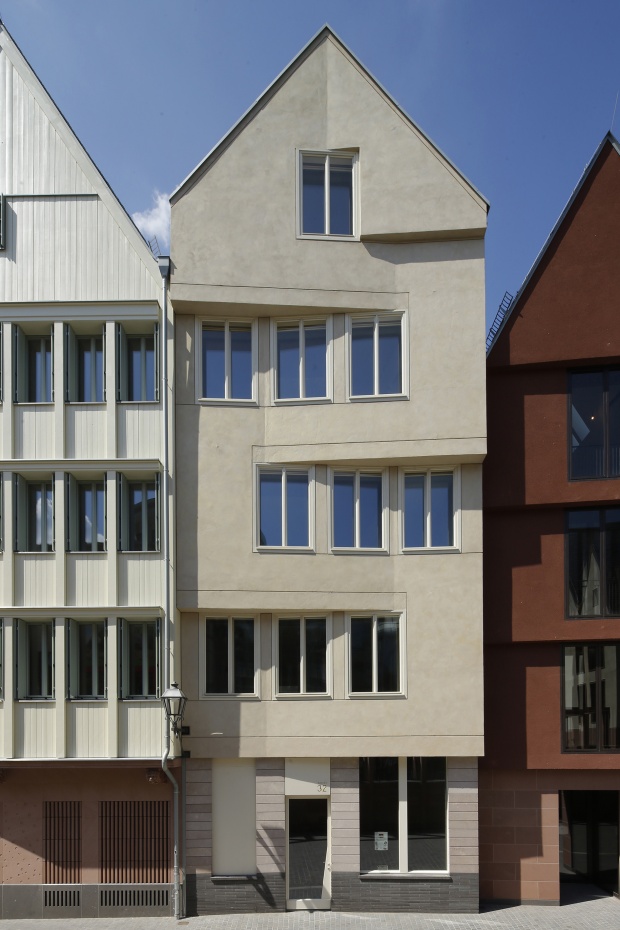
On the left is part of no. 32, Goldene Schachtel, a new building. Then the dark red Altes Kaufhaus, also new. The following two buildings are both reconstructions: the pale blue Würzgarten and the pharmacy Schlegel, which forms the end of the Hühnermarkt.

This is just to show the combination of reconstructed and new buildings. There are better pictures online, For instance, here is the Goldene Schachtel from Matthias Alexander (Hg.): Die Neue Altstadt Frankfurt am Main, Societäts Verlag – playing with the use of overhanging storeys.

Rebuilding Frankfurt’s Old Centre

Here is a map of the district on which you can see which building are reconstructions and which are new.

Detail of the Goldene Waage, the most elaborately restored building, to be a café.

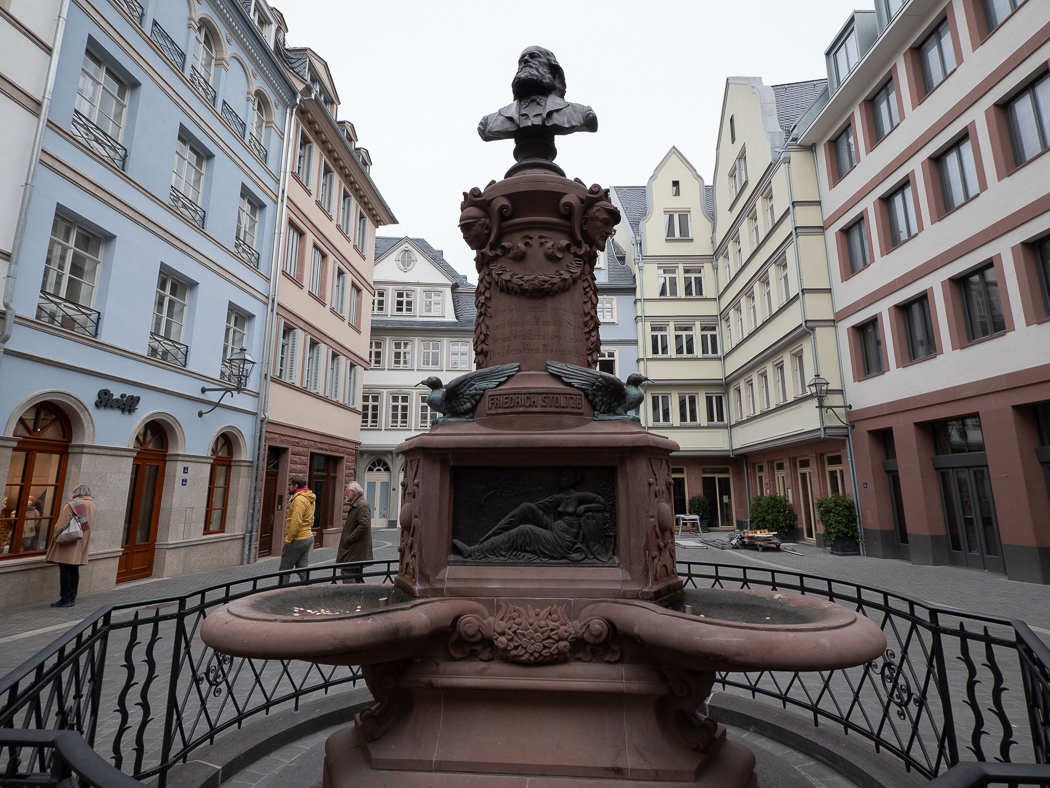
Hühnermarkt with fountain to Friedrich Stoltze, a dialect poet whose museum has not yet opened.

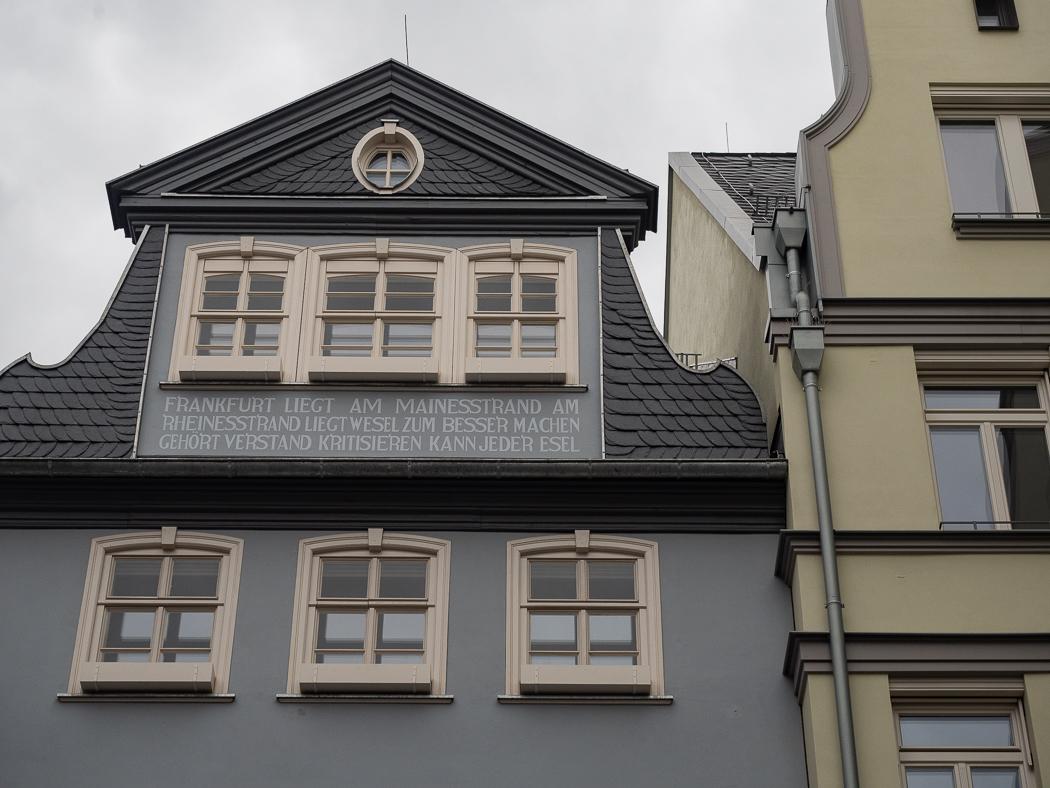
A mysterious text on the house Zur Flechte:

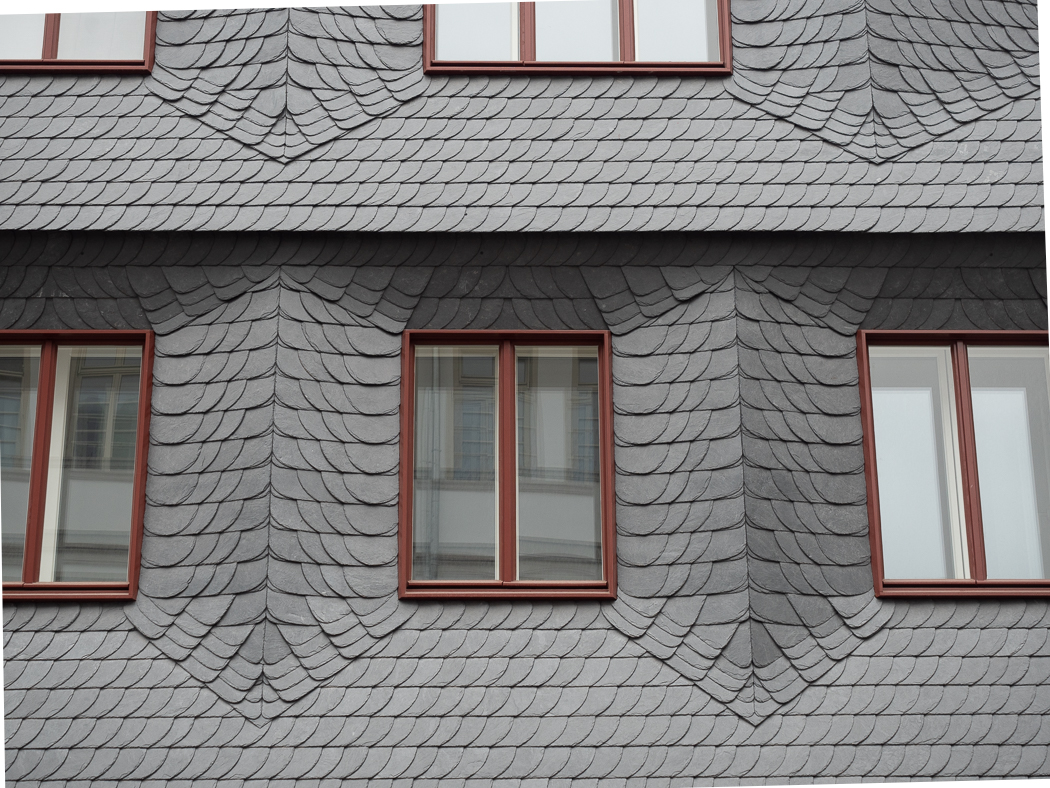
Slate – section of the jeweller’s shop Neues Paradies – slate in Old German style.

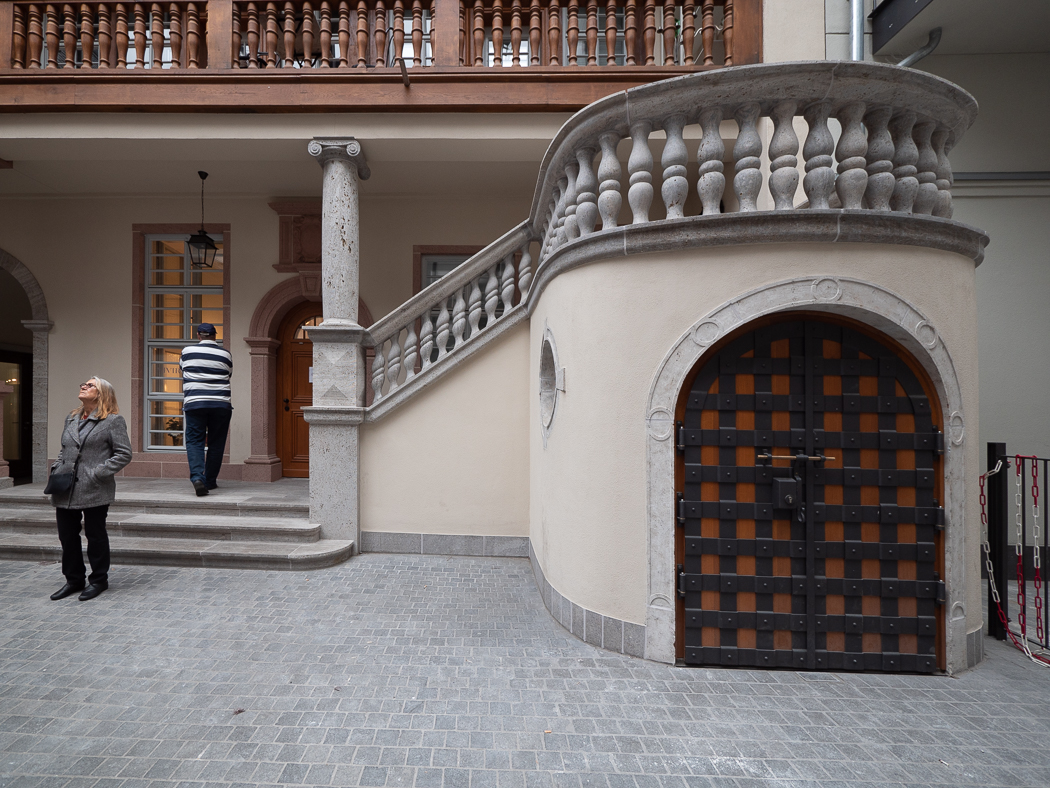
Soapstone columns behind Goldenes Lämmchen building

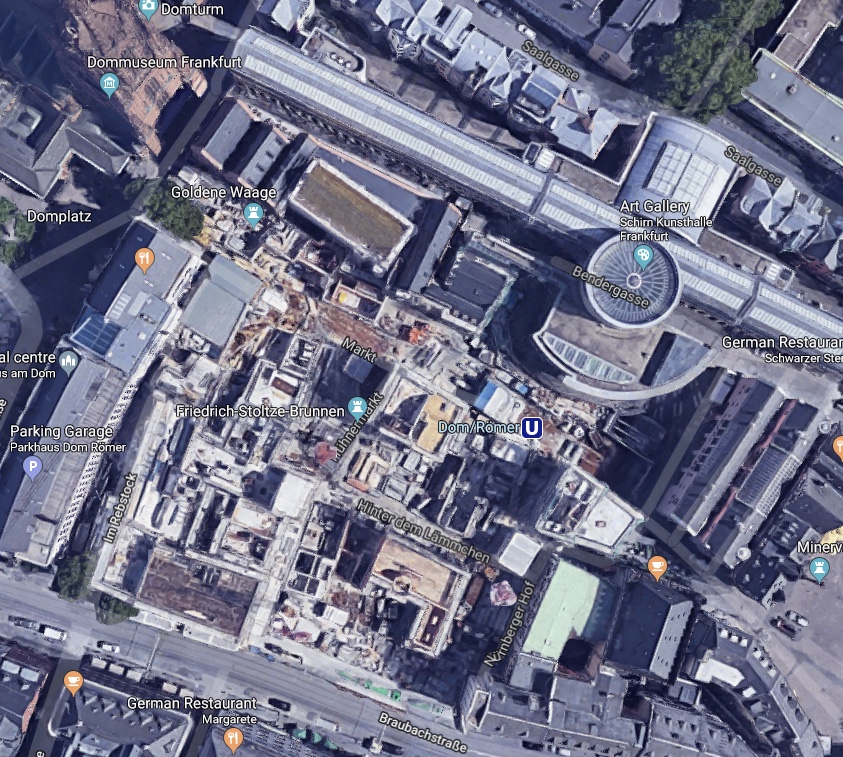
And here is a current screenshot of Google Maps showing building still going on. This has been completed now (although shopkeepers are still doing the final work inside) – Google Maps is obviously a bit out of date, so look forward to the next version.

Brexit-Übergangsgesetz – Transitional Brexit Act

The German Federal Foreign Ministry has prepared a ministry draft of a potential Transitional Brexit Acdt (Brexit-Übergangsgesetz) – the title alone presents a translation problem. There is an explanation on the website in both German and English.

This Referentenentwurf is something prepared by the relevant section of the ministry but not yet adopted by the German government as a bill. So something may happen after the summer holidays.

The part of interest to British citizens who want to take German citizenship suggests that within the transitional period In addition, there is to be a regulation in favour of British nationals who apply for German citizenship during the transition period.

Solange das Vereinigte Königreich noch EU-Mitglied ist oder im Übergangszeitraum wie ein solches behandelt wird, muss für die Einbürgerung die britische Staatsangehörigkeit nicht aufgeben werden. Dabei kommt es aber nicht auf den Tag der Antragstellung, sondern auf den Tag der Entscheidung über die Einbürgerung an. Längere Bearbeitungszeiten könnten also zu Lasten britischer Einbürgerungsbewerber gehen. Um dies zu vermeiden, bestimmt der Referentenentwurf, dass bei Antragstellung vor Ablauf des Übergangszeitraums die britische Staatsangehörigkeit beibehalten werden kann.


As long as the United Kingdom is still a member of the EU or is treated as such during the transition period, British nationals applying for German citizenship will not have to give up their British citizenship. However, the pertinent date will be not the date on which the application was submitted, but the date on which a decision on citizenship is taken. In other words, the lengthy period needed to process applications could be to the detriment of British applicants. To avoid this, the ministry draft states that if an application is submitted before the end of the transition period, British citizenship can be retained.

I find this a bit confusing. I don’t know how long it currently takes for a person to be granted German citizenship (and as long as the UK is still in the EU, therefore to have concurrent German and British citizenship), but it looks as if the date of application is to be conclusive. If the bill becomes law in its current form!

The draft itself reads

Zu § 3

Die Einbürgerung in den deutschen Staatsverband setzt grundsätzlich die Aufgabe oder den Verlust der bisherigen Staatsangehörigkeit voraus, es sei denn, der Einbürgerungs- bewerber besitzt die Staatsangehörigkeit eines Mitgliedstaates der Europäischen Union oder der Schweiz (§ 12 Absatz 2 StAG). Solange das Vereinigte Königreich Mitglied der Europäischen Union ist oder in dem Übergangszeitraum als Mitgliedstaat der Europäi- schen Union gilt, werden britische Einbürgerungsbewerber daher mit fortbestehender britischer Staatsagehörigkeit eingebürgert. Dabei kommt es nach allgemeinen verfahrens- rechtlichen Grundsätzen auf den Tag der Einbürgerung an, nicht auf den Tag der Antragstellung. Um zu vermeiden, dass längere Bearbeitungszeiten zu Lasten der britischen Einbürgerungsbewerber gehen, wird in dieser ergänzenden Übergangsregelung be- stimmt, dass bei Antragstellung vor Ablauf des Übergangszeitraums die Beibehaltung der britischen Staatsangehörigkeit hingenommen wird, wenn zu diesem Zeitpunkt die weiteren Einbürgerungsvoraussetzungen bereits erfüllt waren.

In other news, there was a lot of excitement in the press last week when the UK government, on July 12, published a Brexit white paper translated poorly into various languages.

Brexit: British government’s botched German translation of Chequers white paper met with ridicule

That’s all well and good, and certainly the UK does not do much for foreign languages nowadays, but it isn’t the first time such documents have been translated poorly, in whatever country they originated. Apparently the ITI wrote a letter to Dominic Raab but the CIoL didn’t.

I even found a Wiki site Find translation errors in the UK government’s Brexit white paper.

That really says something about how social media are encouraging us to waste our time. What about discussing the content of the white paper, people?

Amerikaner/black and white cookies

I always thought Amerikaner were a German thing and wondered where they got their name from, but it turns out they are a New York cookie (via smitten kitchen).


(Image by Ben Orwoll, public domain)

Amerikaner certainly used to be made with a form of ammonium carbonate called Hirschhornsalz (Salt of Hartshorn/baker’s ammonia) in German. This is widely sold in Germany, especially at this time of year. I saw it being used by London Eats, who posts Christmas cookies from abroad at this time of year:  Fedtebrød.

If you don’t want to make do with baking powder or bicarbonate of soda, the German Deli sells Hirschhornsalz, and also potash and Lebkuchen spice.

German Döner Kebab

German Döner Kebab shops are apparently everywhere.

Of course, it is a German thing. I think this is ‘Mile End coming soon’.

If you want to find out what meat they use, you have to click on the Location tab, which gives a choice of UK, UAE, Qatar, Oman, Egypt, Sweden and Bahrain.

For the UK, you get Chicken, Beef or Mix. In Germany it was virtually always Turkey, sometimes beef if you were lucky.

Where’s the lamb? I think it’s because Germans don’t like it.

German courts holding commercial cases in English

The subject of German judges holding cases in English has raised its ugly head again and is not likely to go away. I’ve mentioned it several times, from 2010 on.

Courts in Paris and Amsterdam as well as Frankfurt would like to take over the international commercial cases so often held in London. Apparently after Brexit UK decisions won’t be automatically effective in the EU and this will slow things down.

Frankfurt am Main Landgericht (Regional Court) has announced this week that from January it will have an English-speaking commercial chamber. From Legal Tribune Online (in German!):

Gerichtsstandort Frankfurt Eng­lisch­spra­chige Kammer für Han­dels­sa­chen ab 2018

Das Landgericht (LG) Frankfurt am Main will ab Januar 2018 eine englischsprachige Kammer für Handelssachen einrichten. Wie das LG am Donnerstag mitteilte, soll Frankfurt damit als Gerichtsstandort gestärkt werden. “Unternehmen sollen die Möglichkeit erhalten, nach ihrer Wahl die Verhandlung auf Englisch durchzuführen”, sagte der Gerichtspräsident Wilhelm Wolf.

I’m not going to analyse this at length, but it is fun reading some of the comments on articles quoted here.

Here is something in English from Bloomberg:

Paris, Frankfurt Try to Grab Lucrative Legal Action From London

“London is stepping into the shadows,” says Roman Poseck, president of the appeals court in Frankfurt, where officials plan to have an English-language panel in place by January. “Frankfurt wants a piece of the pie.”

(Is this what’s known as a mixed metaphor?)

This is all early November 2017 stuff. It was being discussed in March though.

Here is my earlier report on a colleague’s description of the first court hearing in English:

First German court hearing in English

I remember coming to the conclusion that the judges understood each other despite using English, not because of it.

The problem for me, of course, is the language, and above all the gulf between what some judges think is fluent English and what some translators and interpreters think. Especially when it comes to talking about one’s own or a different legal system in a foreign language.