Comparative Law for Legal Translators – first look

This is a first look – not a review, because I haven’t read the whole book.

Comparative Law for Legal Translators, by Guadalupe Soriano-Barabino, published by Peter Lang 2016 – also available as an e-book, PDF – volume 17 of New Trends in Translation Studies

This book is by one legal translation academic with shorter contributions from two others. Between them they cover the languages French, Spanish, Italian, German and English. It is part of a series published by Peter Lang called New Trends in Translation Studies – volume 17, in fact.

The title suggested to me that it is a book about comparative law intended for legal translators, but in fact it is a book intended for academics about how comparative law might help legal translators, and help train them, and it contains concrete examples of exercises. It is quite a short book but rather heavy going in parts, as one might expect when the intended audience are academics rather than practitioners. There is frequent quoting from Zweigert and Kötz, for example – an excellent book but not what I was expecting. I was expecting one author’s views, not opinions frequently buttressed with citations. That is not exactly what the introduction says, but it does say it’s addressed to translators-to-be, translator trainers and professional translators ‘who wish to develop their activity in the field of legal translation’.

Not only is the book addressed to a variety of readers, it also contains short chapters on seven legal systems. If I wanted to use this book for legal translation between German and English, I would want more on German law than sixteen pages starting with the historical evolution of the German legal system and then concentrating on sources of law, courts and the legal profession. (The introduction to comparative law also goes back to Plato).

The first of four parts establishes, with much theorization and quotation, that legal translators need to understand source and target legal systems. A taster (p. 21):

To sum up, comparative law and legal translation interact because the former becomes an instrument for the latter. The asymmetry between different legal concepts and systems is a challenge for the translator and comparative law can help translators first to understand and later to explain (and translate) the legal concepts of the source legal system into the target legal system. The actual translation (as a product) can be rendered through the application of different techniques and strategies, which are discussed in detail in Chapter 11.

The second and third parts consist mainly of short chapters on a number of legal systems, concentrating on sources of law and court hierarchies. These chapters are preceded by a discussion on how the major legal families/systems of the world may be classified, and then a few pages on the civil law and common law systems.

The fourth and final part is headed ‘Comparative Law for Legal Translators: From Theory to Practice’, and falls into two sections. Firstly, ‘Training Legal Translators’ is mainly a discussion of what translation competence means and how legal translation competence can be defined. It concludes that legal translators do not have also to be lawyers to be good translators. finally, ‘Legal Translation in the Classroom’ suggests concrete approaches.

First, there is a discussion of how to decide on terminological equivalents: translators need to know the difference between two legal systems in order to decide how similar two terms are – are they equivalents or not close enough? Finally, there are twenty-four suggested exercises of a variety of kinds for students. Students should be encouraged, for example, to look at texts in their source and target languages which are similar, that are different but have the same purpose, that don’t exist in the other language, that have a different structure. Students should rewrite texts in legalese in plain language (an excellent idea). They should look at the same terms that have different meanings, for example in English-language jurisdictions.

This isn’t a review as I haven’t read the whole of the book. I am more interested in practical legal translation and would recommend another book from the series, Legal Translation in Context, edited by Anabel Borja Albi and Fernando Prieto Ramos, a collection of chapters – the first, by Jan Engberg, is incidentally titled ‘Comparative Law for Translation’. There is also Legal Translation Explained, by Enrique Alcaraz and Brian Hughes, from the (originally) St. Jerome Publishing series Translation Practices Explained.
The Hidden Life of Trees

After I moved back to London in 2013 I attended a course on trees at the City Lit, I can now reveal. In five whole Sundays we were promised we could learn to recognize eight trees. I immediately saw the value to me. I had not thought much about trees till then, but I needed to get out walking and there are trees everywhere, so I thought it would be interesting to know something about them. And indeed I found the course quite fascinating. We used to go to Lincoln’s Inn Fields and pull leaves and flowers apart, and one member of the class put the bits in a bag, and the following week we had to identify them again. It was good that the course wasn’t restricted to Our Native Trees, because from gingkos to Tibetan cherries to unusual types of magnolia, London is full of immigrant vegetation.

I highly recommend the teacher, Letta Jones, who holds courses elsewhere. Her website www.lettajones.co.uk will not always be quite up to date, but I think an email should get a list of courses and walks.

At the time I got some books on trees. I must say that there is no one guide to identifying trees that covers everything, and they vary in the way they help identification. You have to put time into recognizing twigs and buds and leaves and bark.

But then there are other, more discursive books on trees. And this is where the story reaches the present day. I had read a bit of the German bestseller Das Geheime Leben der Bäume by Peter Wohlleben, and much to my surprise I heard a German talking about trees to Jo Good on BBC Radio London last week, and sure enough it was he! At the time of writing the clip can still be heard as part of Prue Leith and the Barking Hour at about 1.05 (who knew one could pronounce Wohlleben like vol-au-vent?). It seems that the book has just been published in English, by a Canadian publisher, translator unnamed, as The Hidden Life of Trees. I suppose Canada is the place for lumber. Anyway, Wohlleben was passing through London and is obviously selling his book.

On air, Wohlleben was a bit sniffy about non-native trees. He had obviously practised his tree English, but he didn’t know the word pollarding. Jo Good seemed obsessed by an allegedly particularly lonely plane tree outside The Dorchester (that tree is included in The Great Trees of London and was planted in the 1930s, it says. book, website). Other callers referred to the plane tree in Cheapside, but seemingly believed it is the oldest tree in London and survived the Great Fire of London. In other words, the programme wasn’t very informative.

When I started reading the German book last year it did occur to me it might be worth translating, because there are quite a number of books about trees in English and quite a readership – but not a readership that puts them in the top ten best-selling books. One explanation is that Wohlleben tells stories and gives trees feelings.

Wohlleben was a forester for 20 years, learning how to manage wood. Later he found himself conducting nature walks and making provision for woodland burials and began to see trees differently. He retired as a forester (giving up his civil service career) and it looks as if he has published a book every year since then – see his German Wikipedia entry. But it was with Das geheime Leben der Bäume that he hit the really big time. Funnily enough, Colin Tudge’s book The Secret Life of Trees covers a lot of the same ground and got great reviews in 2005. So Wohlleben’s book had to be given a different name in translation. I read most of Tudge and found it a good read full of memorable detail, but eventually there was so much memorable detail and I was remembering so little of it that I seem to have stopped at page 252. I think this was because of the six chapters on six different tree families all over the world – the last chapter I managed was ‘From Handkerchief Trees to Teak:The Daisy-like Eudicots’.

The thing about Wohlleben is that he is a great popularizer and anthropomorphist. Both authors’ books have their references to scientific articles – I can’t help thinking Wohlleben was influenced by Tudge, not in style or detail but in the idea of writing a book on this subject, but he doesn’t cite him.

An article by Christoph Schröder in Die Zeit

Im Duktus des Märchens entwirft Wohlleben das Bild eines bestens durchorganisierten sozialen Systems, in dem zwar einerseits das Recht des Stärkeren gilt, andererseits aber der Schwächere niemals allein gelassen, sondern aufgefangen und mitgetragen wird. So beseelt wie bei Wohlleben war der Wald selbst bei den Romantikern nicht. Man spricht miteinander, liebt sich, erzieht sich und hilft sich gegenseitig mit Mahlzeiten aus, wenn Not am Stamm ist.

Kobolde haben schlechte Karten
Kann es in aufgepeitschten und unruhigen Zeiten etwas Tröstlicheres geben als den Entwurf eines funktionierenden gesellschaftlichen Gefüges, das in gegenseitiger Achtung und in Solidarität und Generationengerechtigkeit lebt? Das ist der Wohlleben-Wald: ein nur von außen, durch den Menschen bedrohter utopischer Raum, in dem es keine Schuld gibt.

In the FAZ Bäume sind so tolle Lebewesen, Melanie Mühl also considers why Wohlleben’s book has been a bestseller for months: he has been practising how to explain trees to people for years, and people want stories and feelings.

Seit zwanzig Jahren führt Peter Wohlleben Menschen durch den Wald, zeigt, erklärt, erzählt. Zwanzig Jahre Marktforschung darüber, welchen Ton er anschlagen muss, damit die Wissensvermittlung funktioniert. Bei der trockenen Wissenschaftssprache jedenfalls, da schalten die meisten sofort ab. Menschen wollen Geschichten. Und Gefühle. Wohllebens rhetorische Vermenschlichungsstrategie ist lange erprobt.

In Wahrheit gibt Wohlleben den Deutschen nicht ihren Wald zurück. Er erklärt ihnen den Baum, damit sie den Wald besser verstehen. Er fragt nicht, wie die Romantiker und die Yogamattenausroller, was der Wald für unser Seelenheil tun kann, sondern was wir für den Wald tun können.

„Ich umarme keine Bäume, und ich spreche auch nicht mit ihnen“, sagt Wohlleben.

It will be interesting to see if the book is as successful in English as it is in German.

As a footnote, Christiane Bergfeld’s blog Übersetzung und Literatur, doch nicht nur has recently been taken over by tree photos.

Colin Tudge, The Secret Life of Trees. How they live and why they matter, 2005.

Oliver Rackham, Woodlands. 2006.

Oliver Rackham, Obituary :

He was also a gifted linguist, reading Latin verse for relaxation. During a field course on the Croatian island of Rab he sat next to the local priest on a bus and questioned him closely in Latin about the management of the local woods.

Peter A. Thomas, Trees. Their Natural History.

British military manual for Germany selling well in translation

The Bodleian Library reprinted Instructions for British Servicemen in Germany, 1944 a couple of xears ago (there are others, and if you buy it from there don’t forget to look at their bookish Christmas cards). I missed this, and also the bilingual version now doing so well in Germany, which itself appeared over two years ago:
Christian Kracht und Helge Malchow (Hrsgs.): “Leitfaden für britische Soldaten in Deutschland 1944” (Kiepenheuer und Witsch) (via Denis Scheck, Druckfrisch).

The result is a remarkable booklet, often unintentionally humorous and sometimes crudely stereotypical, it reads by turns like a travel guide (advising on the excellence of German sausages and beer – ‘one of the pleasantest in Europe’) and a crash course in psychological warfare. It is very much a document of the period, revealing as much about British wartime attitudes towards Germany as it does about British hopes and fears.

‘If you have to give orders to German civilians, give them in a firm, military manner. The German civilian is used to it and expects it.’

There seem to be a whole series of hese books, including one on German invasion plans for the British Isles.

There’s even a German Wikipedia page, and the bilingual version is available for Kindle.

It looks as if the translator was Helge Malchow.

Dietl/Lorenz EN>DE published

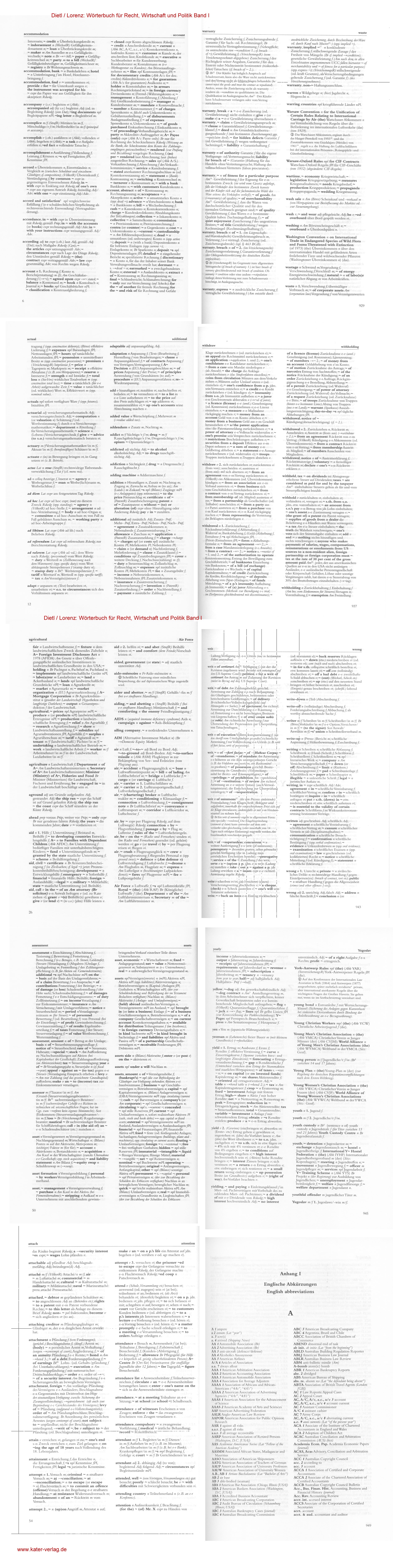
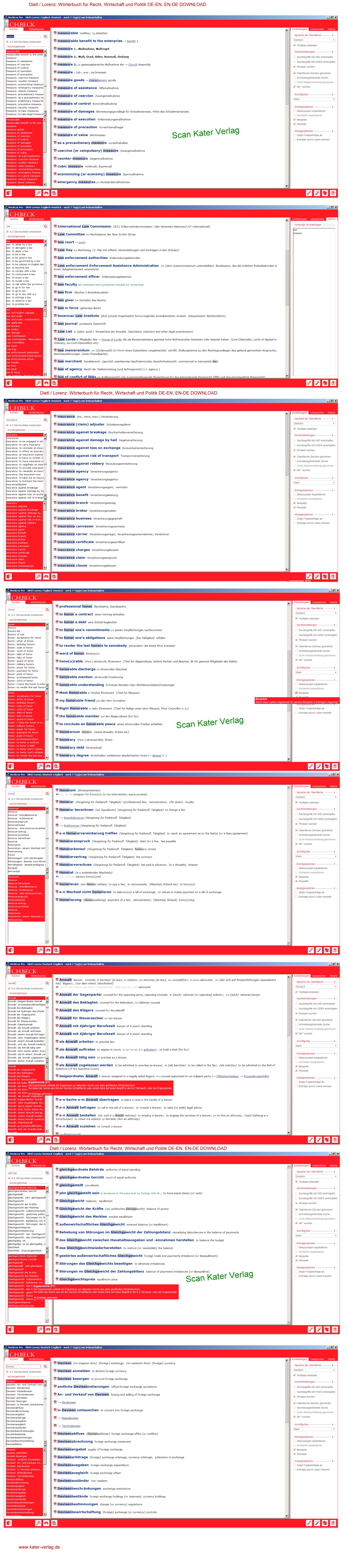
I noticed that the new English-German volume of the Dietl/Lorenz law dictionary has appeared. Professor Egon Lorenz is still in charge. The German-English volume is announced for 2017.

Dietl/Lorenz: Wörterbuch Recht, Wirtschaft & Politik Band 1: Englisch-Deutsch

LATER NOTE: More details in an email from Hans Kotzur of Kater Verlag:

es freut mich, diese Neuauflage anbieten zu können, an der seit einigen Jahren gearbeitet wird.
Der Lexikograf Dr. Kettler tritt in die Fußspuren seiner Vorgänger und hat den Umfang des ‘Dietl/Lorenz’ auf 100.000 Begriffe ausgeweitet.
Neben der Zuordnung der Terme zu den jeweiligen Geschlechtern wurde die neue deutsche Rechtschreibung nachgeführt und jeder Begriffe lexikologisch überarbeitet.
Eine Neuauflage rechtfertigt man vor allem durch inhaltliche Erneuerung und Ergänzungen. So wurden der Rechtsentwicklung Rechnung getragen und neue technische Begriffe eingeführt.
Dies betrifft zum Beispiel den Bereich IT / Computer, Compliance, und viele andere mehr.
Der Wortschatz zum Thema Banken und deren Produkte wurde erweitert. Stichwort: Basel III.
Die Vertiefung der Wirtschaftsbeziehungen mit den Vereinigten Saaten von Amerika durch die Auflösung der Deutschland AG mit der Einflussnahme der Beteiligungsgesellschaften und Fonds (vulgo Heuschrecken) fand Niederschlag.
Die Neuordnung der deutschen Immobilienlandschaft durch Veräußerung der immensen Bestände an Immobilienverwaltungsgesellschaften fand entsprechend Raum im Wörterbuch.
Nicht zuletzt die Veränderungen im Rechtsgefüge, die durch EU-Bürgschaften, IWF-Garantien und supranationale dem parlamentarischen Recht nicht unterworfene Körperschaften geprägt werden, wurden nachvollzogen.
Ceta und TTIP werfen Schatten voraus, auf die ein Wörterbuch wie der Dietl / Lorenz reagieren muss.
Bleibt noch ein umfangreiches Abkürzungsverzeichnis mit ca 6.000 Einträgen und die Ausweisung britischer sowie amerikanischer Schreibweise um das Invest in dieses Meisterwerk der englisch/ deutschen Wörterbücher zu begründen.

Angeboten wird der Wortschatz als Buch Englisch / Deutsch. Artikelnummer: 4000 Preis: 169.- Euro
Warenkorb: https://www.kater-verlag.de/fachwoerterbuecher-recht-jura/Dietl—Lorenz–Woerterbuch-fuer-Recht–Wirtschaft-und-Politik-Band-I-Englisch—Deutsch-EN-DE.html
KaterScan: https://www.kater-verlag.de/images/inhalt/i4000.jpg
——————————

In Kürze wird der Wortschatz als Download Deutsch / Englisch und Englisch / Deutsch angeboten werden. Artikelnummer für Vorbestellungen 4290 Preis: 315.- Euro
https://www.kater-verlag.de/fachwoerterbuecher-recht-jura/Dietl—Lorenz–Woerterbuch-fuer-Recht–Wirtschaft-und-Politik-DE-EN–EN-DE-DOWNLOAD.html
KaterScan: https://www.kater-verlag.de/images/inhalt/i4290.jpg
——————————

Vorbesitzer der CD-Version erhalten ein Update gegen Nachweis unter Artikelnummer: 4310 für Vorbestellungen Preis: 129.- Euro
https://www.kater-verlag.de/fachwoerterbuecher-recht-jura/Dietl—Lorenz–Woerterbuch-fuer-Recht–Wirtschaft-und-Politik-DE-EN–EN-DE–Update-DOWNLOAD.html
KaterScan: https://www.kater-verlag.de/images/inhalt/i4310.jpg
——————————

Kunden der IDS-Mietlösung von Acolada kommen bereits heute in den Genuss der elektronischen Version des Dietl/ Lorenz. Artikelnummer: 4296
https://www.kater-verlag.de/fachwoerterbuecher-recht-jura/Dietl—Lorenz–Woerterbuch-fuer-Recht–Wirtschaft-und-Politik-DE-EN–EN-DE-ONLINE.html

——————————

Für das Jahr 2017 erwarten wir die vollständig überarbeitete Buchauflage Deutsch/ Englisch.

Ingeborg-Bachmann-Preis won by Sharon Dodua Atoo

The bizarre Ingeborg Bachmann prize for literature has been won by Sharon Dodua Atoo, a black Germanist, mother and activist who has lived in Berlin for 24 years – see Philip Oltermann article in the Guardian. A couple of years ago the texts of the candidates were translated into English, but not this time. The reading, discussion and text, and a video about the author, can be found on the Klagenfurt prize website. She normally writes in English.
Here is more from Sharon Dodua Atoo’s website.

Complete poems of Du Fu published in translation

Steve Owen has translated the complete poems of Du Fu (1400-odd) and they are published together with the original Chinese, the Harvard Gazette reports: Translating Nine Pounds of Poetry.

What’s more, the complete work is available in an open access version free online in PDFs.

As Du Fu might have written if he’d been writing English:

Meng of the Granaries Section Comes on Foot to Give This Old Man Full Pots of New Ale and Bean Sauce

Chu shores gave passage to autumn clogs,
as my folding chair faced the evening fields.
Having strained the lees, you separated the liquid from the dregs,
the pot of bean sauce spills over as you carry it.
One will add fragrant flavor when I dine on coarse meal,
as for the other, when friends come we will get drunk.
How can one avoid ordinary things in managing life? —
please tell my rustic wife how to make these.