I have added a photo to my last post to show how ubiquitous Dr. Oetker products now are here.
Here’s another mystifying photo from Tesco:

An advertisement for human rights:

And one in Stratford station:


I have added a photo to my last post to show how ubiquitous Dr. Oetker products now are here.
Here’s another mystifying photo from Tesco:
An advertisement for human rights:
And one in Stratford station:
Grundsätzlich can have two completely different meanings – see the quote from Philip Slotkin below.
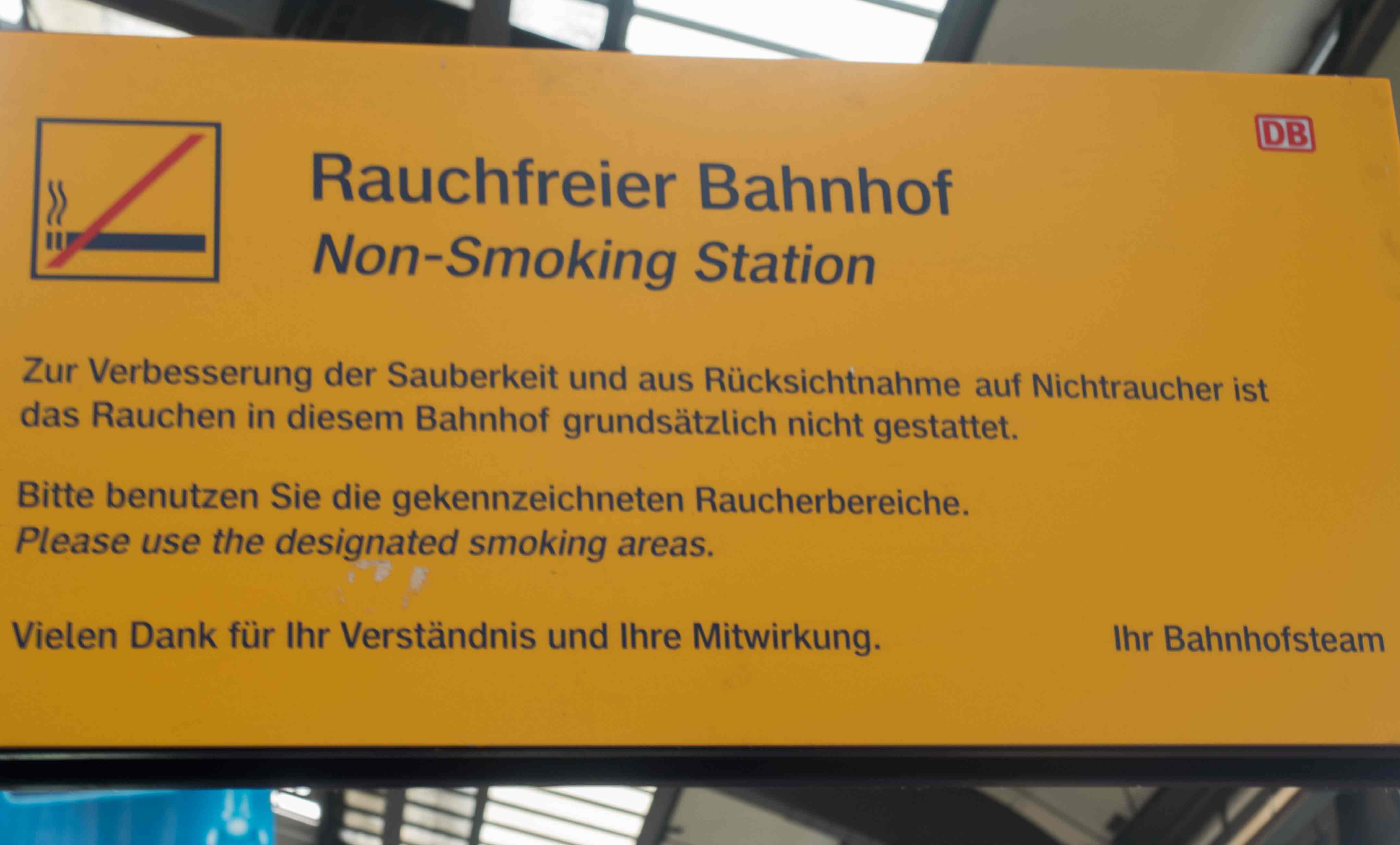
This sign at Berlin Hauptbahnhof (formerly Anhalter Bahnhof) shows the problem of translating the word grundsätzlich into English.
This sentence is one of those that are not translated into English on the sign – no wonder!
Zur Verbesserung der Sauberkeit und aus Rücksichtnahme auf Nichtraucher ist das Rauchen in diesem Bahnhof grundsätzlich nicht gestattet.
(To keep the station clean and in consideration for non-smokers, smoking is in principle/as a general rule/absolutely not permitted.)
But it goes on to say
Bitte benutzen Sie die gekennzeichneten Raucherbereiche.
Please use the designated smoking areas.
It therefore appears that grundsätzlich here means ‘in general’ or ‘with a few exceptions’.
The sign doesn’t define what kind of Mitwirkung is envisaged and who constitutes Ihr Bahnhofsteam.
Actually grundsätzlich sometimes means ‘on the whole’ and sometimes ‘with no exceptions’.
A few years ago, Philip Slotkin wrote an article for Netzblatt, the publication of the ITI German Network, about awkward words, and here is what he wrote about grundsätzlich:
grundsätzlich
This is an interesting one because it can convey two almost diametrically opposite ideas: “always (with no exceptions ever)” or “in principle (normally, but with the possibility of exceptions)”. Sometimes the word, sonorous and important though it sounds, is best deliberately omitted: muss auch der beim EPA zugelassene und in die entsprechende Liste eingetragene Vertreter grundsätzlich eine von dem Anmelder oder den Anmeldern, für die er handeln soll, unterzeichnete Vollmachtserklärung einreichen: “even professional representatives who are included in the EPO’s list must submit a declaration of authorisation signed by the applicant or applicants on whose behalf they are to act” (omitted; the meaning is “always, without exception”).
But:
Das EPA kann grundsätzlich von jedem PCT-Staat als IPEA angegeben werden: “It is in principle open to any PCT State to specify the EPO as IPEA.” (That is, a PCT state does not have to do this.)
As Philip says, it is worth considering omitting the word altogether. But clients won’t always accept this. The number of times I’ve written ‘in principle’ in a translation and it sounded weird – but if the German text uses this silly word, it creates problems for the translator.
LATER NOTE: I’ve just had a similar problem with generell, and one suggestion which might also work for grundsätzlich is to translate it as ‘unless otherwise specified’.
The last time graffiti were removed from the East Side Gallery (in 2009), they put a film over it so the next time it would be easier to remove. I suppose it will no longer read Middlesbrough F.C. – Save Our Steel. These were taken on October 26 2015.

You can see a picture of the current clean-up on the Guardian site. It shows a cleaner version of the Trabi picture than mine, with the temporary fence in front, here being looked at by two very elegant Chinese persons who I failed to photograph from the front:

“It is a sisyphean task to keep it clean,” said Adalbert Maria Klees, the district’s chief technician, whose job it is to remove the graffiti. Standing in front of one of the most famous murals – Birgit Kinder’s painting of an East German Trabant car appearing to burst through the wall – as it is rubbed in a pungent brown graffiti remover by a worker, he said: “This looked even worse this morning. Full of ‘I love yous’ and ‘I was heres’ in every language under the sun.”
The Trabant and around a quarter of the other murals have already been placed behind a temporary metal fence …
Klees admitted the unease he and others feel about erecting another barrier in front of a barrier that was designed to prevent East Germans from escaping the GDR. “It is absurd to be protecting the Berlin Wall, of all things, with a fence,” he said.
Flood of faces of people coming through the wall – the artist said he was there at the time and noticed the people did not look happy:

Mauerspringer (Wall Jumper).

The Berliner Morgenpost reports today that from now on there will be a fence keeping people 1.3 m away from the wall, with signs in various languages explaining the need to protect the works of art:
Berlin. Vor den Resten der Berliner Mauer wird eine 80 bis 90 Zentimeter hohe Absperrung errichtet. Das Geländer solle Menschen davon abhalten, die East Side Gallery zu beschmieren, sagte Bezirksamtssprecher Sascha Langenbach am Donnerstag. Hinweisschilder in verschiedenen Sprachen sollen demnach zusätzlich darüber aufklären, dass die Kunstwerke darauf schützenswert seien. Berliner und Touristen sollen laut dem Sprecher künftig einen “Respektabstand” von 1,30 Meter zur Mauer halten.


Jack of Kent has a post on turnip ghosts today. Apparently the Scots have swede and turnip lanterns too (tumshie lanterns), not just the Swiss (see Wikipedia in Alemannisch).
I do miss German markets:




This reminds me that I once had a neighbour who was trained as a curtain saleswoman (Gardinenkauffrau) and frightened me with tales of how to pin net curtains precisely.