Deleted posts

I have added a few posts since October 2013, for example on Der Fall Collini, Frankfurter Küche, the use of Servus in Munich schools, and Pearly Kings and Queens.

Unfortunately these have all been lost as they were added before my blog was completely  registered with Hostinger in the UK. I will replace them in some form or another shortly.

LATER NOTE: The posts have been saved since Herr Rau – see comment – was indeed able to retrieve the posts from his feedreader. This possibility had never occurred to me or to my provider. So the posts will gradually be incorporated.

Kangaroo court

Boris Johnson called the House of Commons Privileges Committee a kangaroo court. In fact, the term seems to be frequently used. It wasn’t part of my vocabulary and I wondered what it had to do with kangaroos. Apparently the origin is not certain, but it may have to do with leaping over the official route of something, or of an impromptu court moving from place to place.

Here is the Oxford English Dictionary on the term:

kangaroo court  n. originally U.S. an improperly constituted court having no legal standing, e.g. one held by strikers, mutineers, prisoners, etc.

1853   ‘P. Paxton’Stray Yankee in Texas 205   By a unanimous vote, Judge G—— was elected to the bench and the ‘Mestang’ or ‘Kangaroo Court’ regularly organized.
1895   Harper’s Mag. Apr. 718/2   The most interesting of these impromptu clubs is the one called in the vernacular the ‘Kangaroo Court’. It is found almost entirely in county jails.
1931   ‘D. Stiff’Milk & Honey Route 209   Kangaroo court, mock court held in jail for the purpose of forcing new prisoners to divide their money.
1935   A. J. PollockUnderworld Speaks 66/1   Kangaroo Court, a jail tribunal comprised of inmates which collects money from prisoners awaiting trial to supply the needy with tobacco, food and a few luxuries—its decision regarding disputes is final.
1966   Times 14 Mar. 10/1   Shop stewards at Theale are to meet tomorrow to consider paying back the sums levied by a kangaroo court.
1971   Times 20 Jan. 15/3   Citizens who live in the riotous areas [of N. Ireland] deserve protection from..kangaroo courts.
1973   C. MullardBlack Brit.iii. vii. 81   Such practices are surely more like those of a kangaroo court than those that the Race Relations Board should encourage.
Note the term mustang court in the first citation.That’s about animals too. There were not many kangaroos in the USA but according to Wikipedia there were a lot of Australians in California in the gold rush.

Miscellaneous

A number of bits of news.

  1. An article in the Law Gazette on April 19 2022: Official court judgments database goes live
    https://www.lawgazette.co.uk/law/official-court-judgments-database-goes-live/5112223.article

I haven’t had occasion to use this yet. It’s worth looking at the comments to see its possible limitations. Till now, we have been very happy to use BAILII, but it’s good to have an official initiative and I think the two may complement each other. Note on the BAILII website there are links to other collections.

2. New German phonetic alphabet: https://www.n-tv.de/panorama/Weg-mit-den-Nazi-Bezuegen-DIN-veroeffentlicht-neue-Buchstabiertafel-article23330727.html

Stuttgart hat es nicht geschafft, auch Augsburg blieb auf der Strecke. Und Bremen ist als einziges Bundesland nicht dabei. Buchstabiert wird künftig von A wie Aachen bis Z wie Zwickau.

Wikipedia has a table showing Switzerland and Austria too. It doesn’t worry me that the towns are all in Germany rather than Switzerland and Austria, as long as they’re comprehensible on the phone. At one time the table contained D for David (older Germans are often suspicious about the name David), N for Nathan and Z for Zechariah. The Nazis replaced these with Dora, Nordpol and Zeppelin, but they are now Düsseldorf, Nürnberg and Zwickau.

https://www.bbc.co.uk/news/world-europe-55186459

https://de.wikipedia.org/wiki/Buchstabiertafel

3. I dare hardly dip a toe into the problem of making German gender-neutral. Someone posted a shot of a page of this book on Twitter: Wie schreibe ich divers? Wie spreche ich gendergerecht? Ein Praxis-Handbuch zu Gender und Sprache, by Lann Hornscheidt and Ja’n Sammla (whether the authors’ names are as they appeared on their birth certificates it doesn’t say). Here’s a quote from an amazon review:

Wenn es nach Hornscheidt und Sammla geht, gehe ich zukünftig nicht mit meiner Mutter, sondern mit meinens Meema zur Familienfeier. Dort treffe ich nicht meinen Opa und eine Tante, sondern meinex Opmex und ens Tonkel. – Was hier aussieht als wäre eine Katze über die Tastatur gelaufen, wird so wirklich und ernsthaft vorgeschlagen. (S.95 Tabelle 1) Sprache wird hier, um eine andere Rezension zu zitieren, “wie Knetmasse” behandelt, die sich nach Belieben verformen lässt. Ein lächerlicher und irgendwo schon fast bemitleidenswerter Ansatz an der völlig falschen Stelle.

Wir haben uns jedenfalls köstlich amüsiert, wie hier doch allen Ernstes erwartet wird, dass man die “böse Hexe” in einem Märchen zur “sehr weisen Person” umformuliert.

Tweet with screenshot

Marc Prior has created a website, gendern.eu, with an article on the problem of feminine/masculine, which considers the possibility of generic neuter.

5. Professor Dr. Tinka Reichmann of Leipzig University has linked some diagrams of the German court system with translations into various languages. There doesn’t seem to be anything new here though.

We used to have diagrams, now outdated, from a book on German law for schools, in which the number of judges was indicated by little human figures in various numbers, which seemed easier to look at. I would be confused by one of these diagrams in English alone and wonder what the significance of panels vs. chambers was.

This and that

I have almost given up this blog, but here are a few legal/translation points while I am passing through.

Divorce vocabulary

This week English law at last provided a possibility of no-fault divorce. Previously the only way to get a divorce relatively promptly involved spouses accusing each other of behaviour of various kinds (‘unreasonable behaviour’, meaning behaviour the other spouse could not reasonably be expected to live with). (No-fault divorce is possible in Scotland though).

New divorce laws will come into force from 06 April 2022

So just to make things more interesting for translators, some of the vocabulary has changed. A divorce petition becomes an application, a petitioner an applicant, a decree nisi a conditional order and a divorce decree a divorce order.

Thanks to Laura Elvin for pointing that out.

Beziehungsweise / bzw.

I don’t think I’ve written much about this, but it is a problem to translate.

Without warming up the long discussion on translators’ forums, I would like to quote what a colleague read in a German Patent Office examination report:

“Das Bindewort beziehungsweise (bzw.) ist nicht zur Schaffung zweifelsfreier Rechte geeignet, da es als und, oder oder auch als und/oder verstanden werden kann.”

I love this. I like the bit where they say “… da es als und, oder oder auch als und/oder verstanden werden kann.”
So there is a difference between “und, oder” and “und/oder”.
They could have written “…da es als und, oder bzw. als und/oder verstanden werden kann”, couldn’t they?

Speeding fines based on income

Juliette Scott in her blog From Words to Deeds finds it odd that speeding fines in Finland are based on income.

But it isn’t so odd. In Germany too, and no doubt in other countries outside the UK, the amount of the fine varies between the rich and the poor. So you get a number of points, called Tagessätze, and what a point is worth depends on your income. It makes sense to me.

There used to be problems translating the word Tagessätze. It seemed poor grammar to call it daily rates. I now write daily units. This is because the term was used when the system was briefly introduced in the UK. The problem arises if you write in the papers the exact sum the rich person has to pay, rather than the number of units or the percentage of income used. I suppose that the average newspaper reader is not aware how much richer some people are than others.

This is all so long ago that I’ve forgotten the details. In fact I note that in 2021 and presumably 2022 too, the most egregious speeding fines were related to income. Speeding fines 2021.

Notarial string, thread or yarn

The Pencil Talk blog has a new post on notarial string. I wrote about this in December 2004! (Links are unlikely to work now). Which reminds me that this blog is coming up for a birthday in April, if it survives that long.

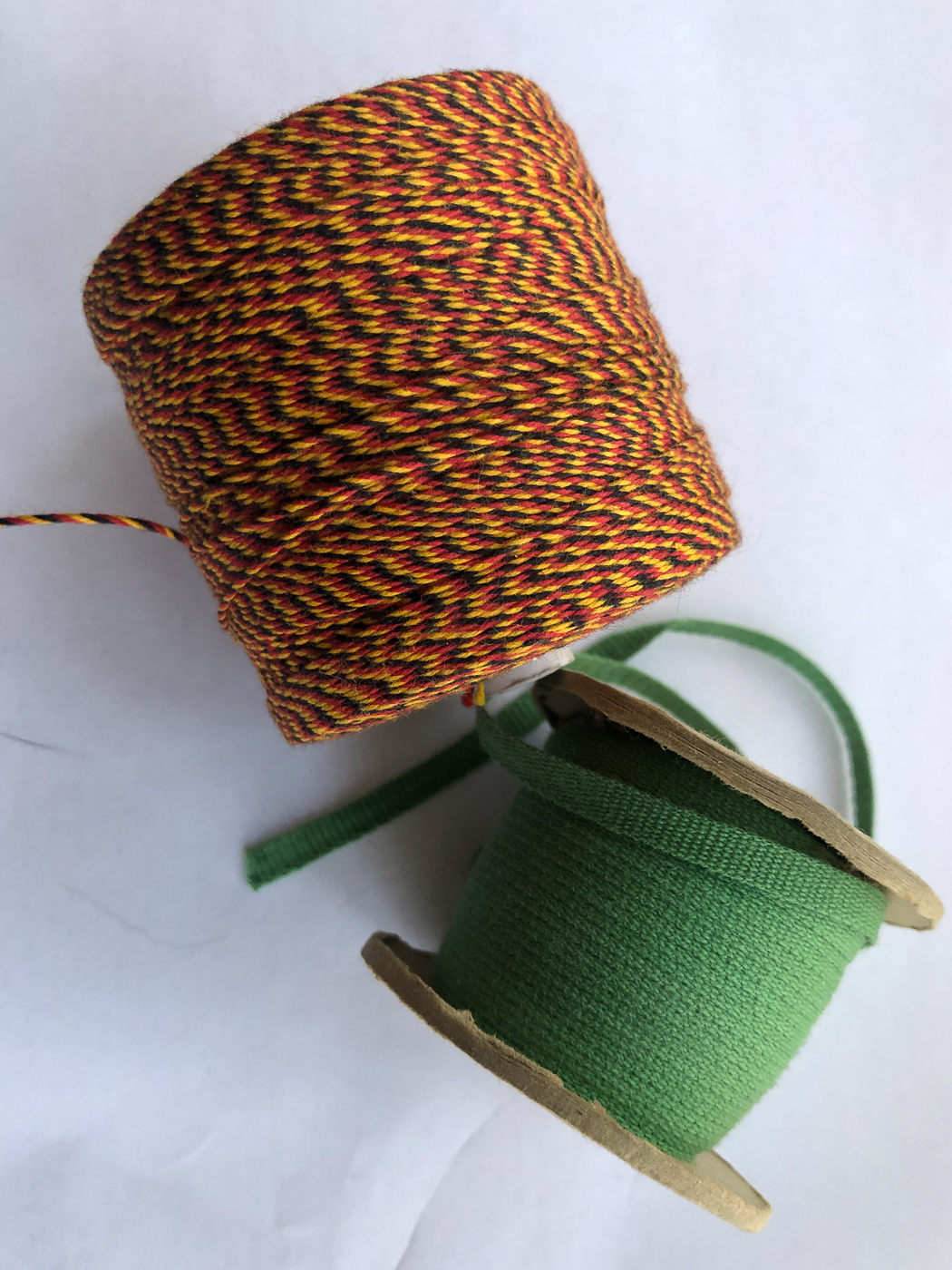
Pencil Talk has some great photos of notarial string and seals. As it says, each German Land has a different-coloured string, and there is a federal one too. Useful links there, for instance to a list of all colours of string.

Here is a picture of what I found – some green English ribbon and some Federal German notarial string.

There’s a link to an article on treasury tags in the Bleistift blog.

I think English notaries public use ribbon, as barristers do. The ribbon may be green, and for barristers pink, but it’s entered the language as ‘red tape’.

Translators in Germany sometimes use notarial string, but then they argue about whether they are allowed to or not.

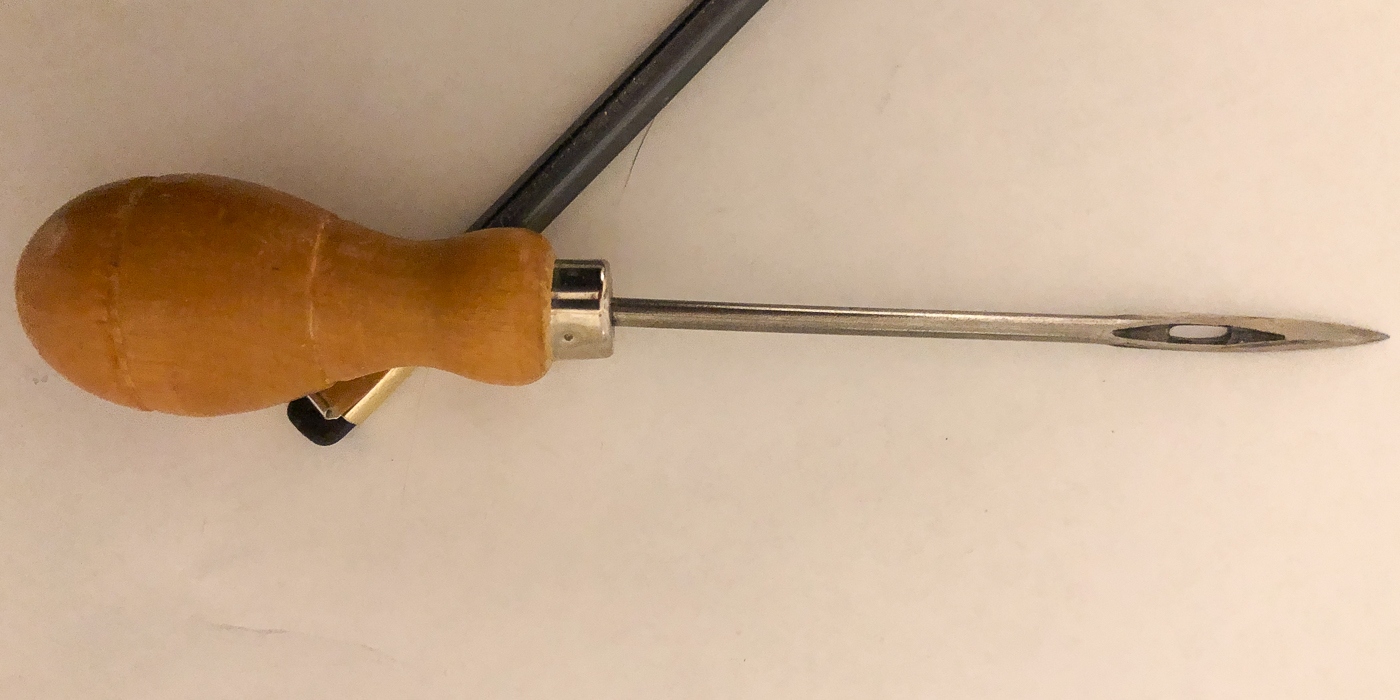
Edited to add a picture of a bodger lookalike.

What I knew as a bodger, which punches a single hole in the corner of a bundle of papers, ready to take the treasury tag, did not have a hole for thread.

It’s been pointed out to me in a comment on the Bleistift blog that bodger may be called awl or pricker. Awl seems to be right. Here’s one of many.