
Year-end notes

This blog is still alive, despite appearances.

At the moment I am aspiring to downsize, and I am looking through masses of old papers that I either throw away, keep or scan and save (the tidier way to forget about them). Unfortunately I really need to look at everything to make sure I don’t overlook something important.

So here is the beginning of a miscellany:

  1. This typewritten notice was in a folder marked ‘Personal’.

Sehr geehrter Kraftfahrer,

Sie parken o h n e B e r e c h t i g u n g auf einem PRIVATPARKPLATZ.

Wir teilen Ihnen mit, daß wir beim nächsten Verstoß den Halter des Fahrzeuges wegen HAUSFRIEDENSBRUCH bei der Staatsanwaltschaft anzeigen werden und weiterhin UNTERLASSUNGSKLAGE beim Amtsgericht Nürnberg wegen vorsätzlicher EIGENTUMSSTÖRUNG erheben werden.

Hochachtungsvoll

i.A. (signature)
für den Eigentümer

Nürnberg, den 9.9.88

Goodness, I thought to myself, this German behaviour would shock some of the residents of Cranham and Upminster who are always discussing parking tickets on Facebook.

But then I remembered: I went with students to watch a trial at the Landgericht in Nuremberg (that’s the building where the war crimes trials took place) and one of them could only find a parking place a bit outside the others. He saw no signs indicating parking was forbidden, but when he went back to his car he found this notice on it. I think it was only the next day that he went to complain at the court and explain how careful he’d been. It turned out that there was a running gag between public prosecutors and lawyers and the former had thought my student was a lawyer. As soon as they realized their mistake, the ticket was withdrawn.

2. An old ad for accounting software called Account-Ability. Picture of Reagan, as a puppet. US heading: ‘With Account-Ability anyone can do your accounts.’ German heading: ‘Wir wissen nicht, was dieser freundliche Politiker empfiehlt…’
Dictionary of differences Austrian and German law

Wörterbuch rechtsterminologischer Unterschiede Österreich–Deutschland (Österreichisches Deutsch – Sprache der Gegenwart, Band 16) von Rudolf Muhr (Autor), Marlene Peinhopf (Autor)

This book contains 2000 Austrian legal terms with their German equivalents and much more. There are English and French translations too. You can look inside the book at amazon. 

The German-law equivalent is given if there is one. 43 Austrian terms and 492 German terms have no equivalent in the other legal system. 

For example: for Abfertigung we find it is a statutory term – the German equivalent is Abfindung, the English severance pay and the French indemnité(s) de licenciement. There are definitions for both the Austrian and German terms. Where a term doesn’t exactly exist in German law, there  is still a note explaining the situation in more detail. 

I’ve only skimmed the book so far. the use of English translations is of great interest. My eye fell on Landesgericht – circuit court (UK) / regional court, and Landbutter: country butter – I’m not too sure about those, but most of the English looks good.

There are other books in the series, in particular Heidemarie Markhardt’s Wörterbuch der österreichischen Rechts-, Wirtschafts- und Verwaltungsterminologie – see earlier post.

MORE DETAILS ADDED THE NEXT DAY

I have now had a closer first look at the dictionary. It arises from work on Austrian German and ‘Bundesdeutsch’ in the EU after Markhardt, whose work on Austrian German for the EU was up to 2007. It is also to be seen as an attempt to show how terminology work can be constructed in pluricentral languages such as German, where two legal systems are based on the same language, within the EU. That is the case also for English, French, Greek, Dutch, Portuguese, Swedish and Spanish. The first version of the dictionary was produced between 2007 and 2010, with the support of the Austrian government. About 1000 of the terms later entered IATE. The project was fully revised between 2014 and 2015. 

The emphasis of the dictionary is Austrian law, and therefore the German legal terms which have no equivalent in Austrian law have not been treated in detail. 

The English is described as based on English and Commonwealth law and was reviewed by Carmen Prodinger (Canberrra/Klagenfurt), hence I think the ‘circuit court’. 

The dictionary contains full details of the terminological entries, which contain definitions, sources, equivalents and in fact much more information than we usually get in a legal dictionary. At the back there is an alphabetical list in table form of German legal concepts with their Austrian counterparts, followed by a list of all the Austrian terms which lack a German equivalent. 

I think the dictionary will be extremely useful. It does contain some food vocabulary, not a big percentage though. 

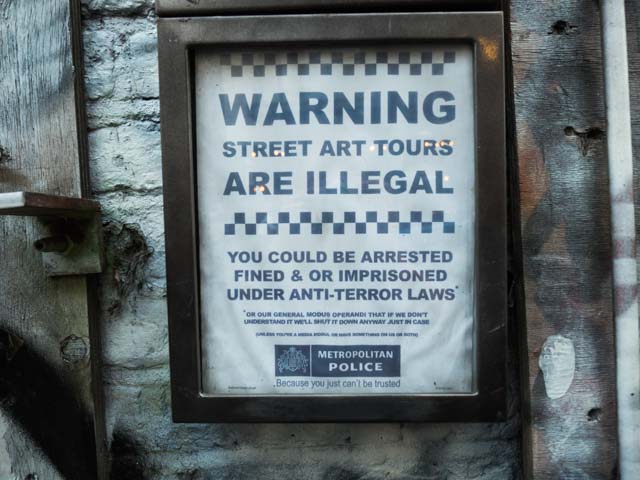
Anti-terror laws hit street art

In Sclater Street:

WARNING
STREET ART TOURS ARE ILLEGAL
YOU COULD BE ARRESTED FINED & OR IMPRISONED
UNDER ANTI-TERROR LAWS*

*OR OUR GENERAL MODUS OPERANDI THAT
IF WE DON’T UNDERSTAND IT WE’LL SHUT IT DOWN ANYWAY
JUST IN CASE

(UNLESS YOU’RE A MEDIA MOGUL OR HAVE SOMETHING ON US OR BOTH)

METROPOLITAN POLICE
Because you just can’t be trusted

Die badische Aktenheftung

Strafakte.de reports on die badische Aktenheftung as something historical. I have heard about this before and I suspect it’s still partially alive. In Baden, a special method of binding documents and bundles of documents has been in use since at least 1801 and they are sticking to it. Some more in Wikipedia, and more pictures. You need a special hole punch and also a bodkin/bodger to create tiny holes.


Von Hungchaka – Eigenes Werk, CC BY 3.0,

There was a famous case in 1970 when the court in Baden tried to refuse files returned from Cologne without the right binding.

At the bottom of this page you can see three types of binding:
Württembergische Büschel (rechts), badische Oberrandheftung (oben links) und preußische Fadenheftung (unten links)

Württemberg pink, Baden orange and Prussia buff (Prussia used to cover a lot of Germany).

This made me think how many local peculiarities live on in various parts of Germany – when you learn about the law you would think a lot of it is uniform. And 1801 or earlier does somewhat predate the existence of Germany as a country.

When I was training I learnt how to sew documents using green tape. These things are so much harder to photocopy that I wonder how often it is still done. But you can find information online so it is not quite dead yet.

Sewing together a legal document, from the Legal Secretary Journal.

A YouTube video in which Maria shows how to bind legal documents – interestingly classified as Comedy.