Translators and Interpreters/Übersetzer und Dolmetscher

Translators write and interpreters speak. This simple difference is often ignored in the press – usually by calling interpreters translators.

An amicus brief to the U.S. Supreme Court goes into the distinction in detail. Its main subject is that interpreting costs are easier for courts to administer than are interpreting costs. The case is Louichi Taniguchi v. Kan Pacific Saipan, Ltd. and the brief is by NAJIT, the National Association of Judiciary Interpreters and Translators as Amicus Curiae in Support of Petitioner. A PDF can be downloaded from NAJIT’s website as amicusbrief.pdf (36 pages).

At its most basic level, the distinction between interpreters and translators is simple: Interpreters speak, while translators write. As a result, interpreters must possess different skills from those of translators. Interpreters must have the “analytical skills, mental dexterity” and “exceptional memory” necessary to interpret spoken words from one language into another in real time. The act of translating a document from one language to another, however, is a more research-oriented, meticulous process.

There is more – a lot – including descriptions of what interpreting and translation involve.

Translators must know how to discover and convey a communication’s nuance. And whereas interpreters render communications from one language to another almost instantaneously, “[t]ranslators have time to reflect and craft their output.” Gonzalez, et al., at 295; see Liu, 6 Interpreting at 9–20. Indeed, a common saying among language professionals is that a translation is never finished, it is merely abandoned.

Another document online relates to interprets in Austrlian courts.

Interpreter Policies, Practices and Protocols in Australian Courts and Tribunals. A National Survey, by Professor Sandra Hale, University of New South Wales. It can be downloaded from Professor Hale’s web page (97 pages).

A good impression of interpreting in Germany, between French and German, is given by Caroline Elias’s Dolmetscher-Weblog (in German – here is a related site in French). In the post Schriftliches she shows two examples of her consecutive interpreting notes. These are in French, because she’s interpreting into French here. More information in the following entry, Zu den Notizen… and in the earlier entry Notizentechnik.

BMI/Ein deutsches Wort?

When Germans talk in German about Body Mass Index, they always pronounce it Mahss, like the German word for measure or litre of beer. I have found this odd, but it occurred to me that they aren’t actually saying the English word (mass like German Masse), but have converted it into a new German term with a slightly different origin.

Nikolaus

Appropriate for the date, but I think I’ve seen a better one of these in Barcelona.

Meanwhile, the Rathaus is lit up for Christmas. I wonder about the very bright window surround – did they run out of the new dim EU bulbs, or did they forget?

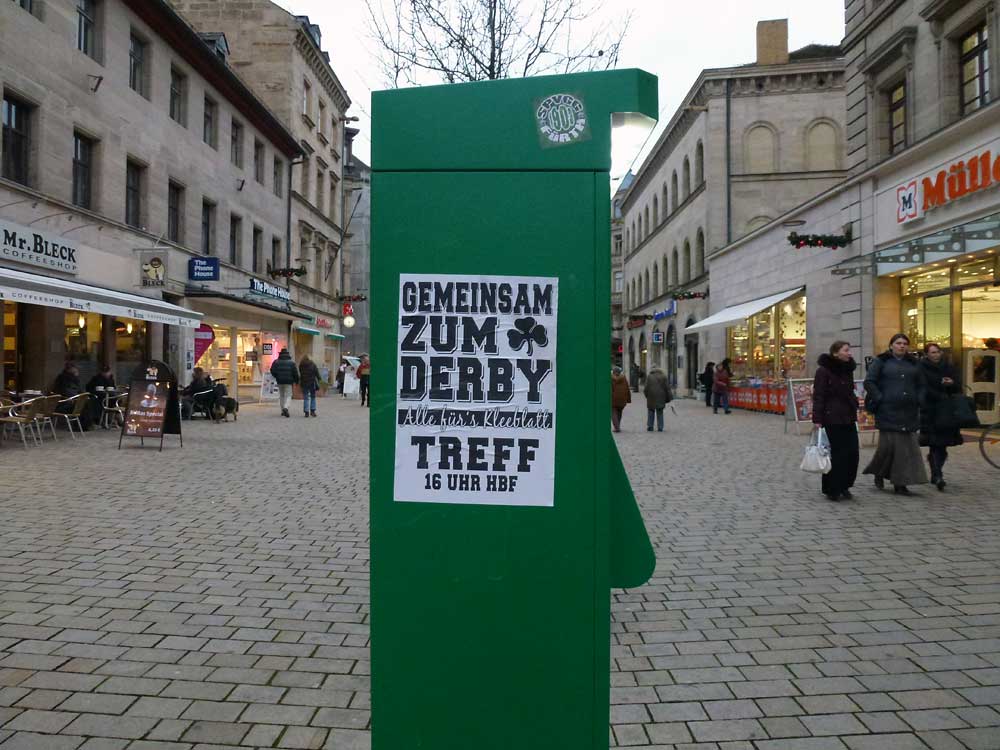
Green machine/Grün kehrt wieder in die Füzo ein

I was excited to see this green public transport ticket machine. The last one was carefully painted bronze by restorers. One hopes the city council haven’t got enough money to desecrate this one. For the restoring, see this earlier photo. The peculiar oval rubbish bins have been rebronzed.

This is a new machine, of course. They now accept credit cards, where previously they were trying to get people to have a particular kind of paycard called Geldkarte.

I am intrigued by the possibility of using headphones when using it. But it’s probably for the people using braille.

My excitement waned slightly when I read a brochure explaining the new ticket fare system. I put it aside to read another time. I am dreading its being translated into English. The VGN website has not updated the English page (which gives the impression that you have to be unmarried to use a TagesTicket Solo:

Getting around on your own

Singles will find the “TagesTicket Solo” indispensable. For only 4,20 € you can enjoy whole-day travel in Nürnberg-Fürth-Stein.

Purchase of a ticket on Saturday qualifies you for free Sunday-travel as well. This means that you enjoy additional free travel on Sunday without paying one cent extra.

Liet International/Eurovision für Minderheitensprachen

Sorry to be so late on this – the competition was held on November 19 and was won by a Dutch Frisian:

Young Frisian singer-songwriter Janna Eijer from the village of Jobbegea has won the eight edition of songcontest Liet International. Janna Eijer impressed the jury in the packed Teatro Nuovo Giovanni da Udine with the song ‘Ien klap’. The Coffeeshock Company, a Croatian band from Burgenland in Austria won the public award. It is the very first time that a Frisian contestant wins Liet International.

Liet International is the big international song contest for contemporary songs in European minority languages. Alongside Frisian, the other contestants in Udine came from Ireland, Austria (Burgenland Croats), Val Badia (Ladinians), Scotland, Karelia in Russia, Udmurt in Russia, Friulian in Italy, Switzerland, Norwegian Sápmi, and the Basque Country and Asturias in Spain. Janna Eijer was sent to Udine as the winner of the Frisian song contest Liet earlier this year. She was the only soloist of the twelve contestants. At Liet International songs were in Irish, Croatian, Gaelic, Sápmi, Ladinian, Vepsian (Karelia), Ladinian (South Tyrol), Udmurtian (a Finno-Ugric language in Russia), Friulian, Rumantsch (Switzerland), Basque and Asturian.

Is the Romansh singer really called Rezia Ladina, or is that a pseudonym?

In this competition, songs must be in one of the minority languages, not (unlike in the Eurovision Song Contest) in English. Still, the site has English translations of the lyrics. you can hear at least some of the songs on YouTube.

You! Basque-speaker!
become a megaphone
explodes the basque language with shouts
thousand borders, thousand tones!

Why have I never heard of this competition? It would surely be just as much fun on TV as the Eurovision one.

Found in this article on Romansh (containing the curious and apparently US term a singing tilt).