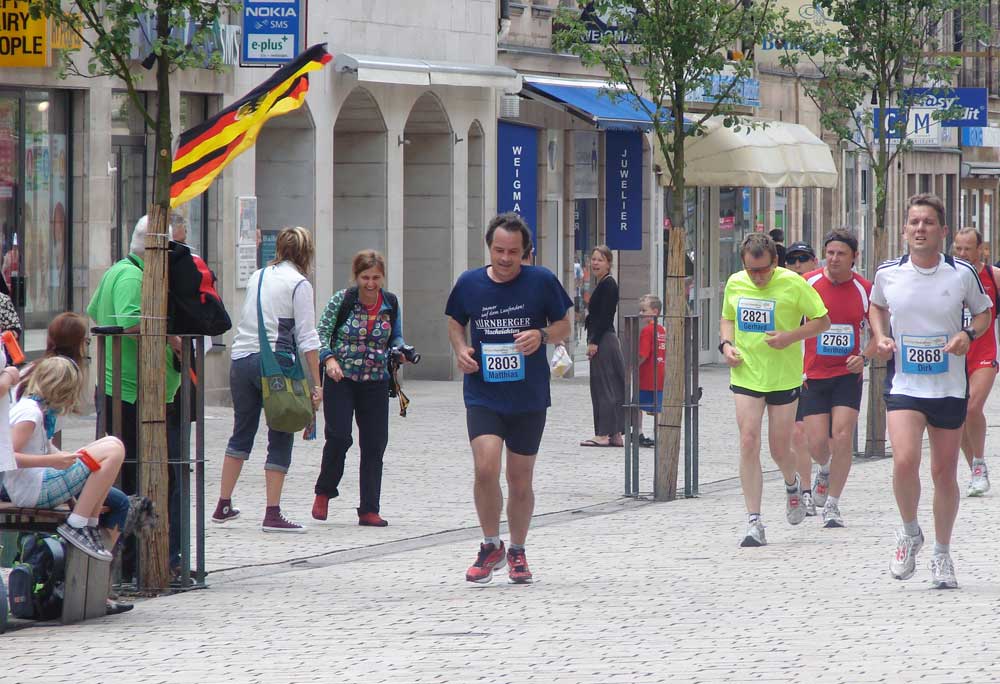
Now the World Cup has started, there are lots of opportunities to see it on big screens in public. For instance, one could see it at the Spar-Da-Bank-Arena (I love the names of German banks) in Tucherstraße in Fürth.
And just as frequent is the use of the new German term public viewing.
And almost as frequent as that is the chorus of voices crying out that public viewing means seeing the body of a famous person before it is interred/cremated/whatever. For instance, there was a Michael Jackson public viewing, and it wasn’t a rock concert.
Anatol Stefanowitsch has complained about this before, and now repeats his view. (I do wish it was still called Bremer Sprachblog – Wissenslogs is such a collective name).
Nun greifen dankenswerterweise andere meinen Beitrag auf. Stefan Wallasch zitiert ihn auf 11FREUNDE.de und zeigt außerdem, wie man sich, wenn man mir nicht glauben will, mit einer schnellen Google-Suche selbst davon überzeugen kann, dass öffentliche Aufbahrungen von Leichen für die Verwendung des Wortes public viewing keine herausragende Rolle spielt.
Volker Weber took this up and joined the throngs of Germans claiming that this is a pseudo-anglicism, by conducting a small poll among commenters.
And (German) Wikipedia has an entry to this effect – one of its sources is a BBC page, but if you look at that page it says ‘sent in by Matt’, so it isn’t even a BBC journalist (not that that would be worth much).
So we have here an English term that is strongly believed by Germans to be Denglisch, a pseudo-English word. I suppose we are stuck with that.
Some sense comes from the football translator Stuart Dykes, according to whom the term was introduced by FIFA for the 2006 World Cup, which happened to be in Germany. He thinks that before 2006, public screening would have been the term. The German Wikipedia article mentions this too:
Public Viewing in größerem Umfang gibt es seit der Fußball-Weltmeisterschaft 2006, bei der auch dieser Begriff im deutschen Sprachgebrauch etabliert wurde. Im englischen Sprachraum bezeichnet der Begriff im Allgemeinen die öffentliche Präsentation einer Sache[3][4] (to view bedeutet etwas anschauen, besichtigen, inspizieren; public bedeutet öffentlich) bzw. einen Tag der offenen Tür sowie die öffentliche Aufbahrung eines Toten.[5] Seit der Fußball-Weltmeisterschaft 2006 wird die Formulierung jedoch gelegentlich auch im Englischen von internationalen Verbänden und Medien in Bezug auf die Übertragung von Sportveranstaltungen auf Großbildwänden verwendet.[6][7]
(Public viewing has been popular since the 2006 World Cup, which was when the term entered German usage. In English, the term usually means the public presentation of a thing … an open day, or the public viewing of a corpse. However, since the 2006 World Cup, the term is sometimes used in English by international associations and media meaning showing sports events on big screens).
My conclusion is, like Stefanowitsch’s, that this is a combination of an adjective and a noun that has various possible meanings, that viewing a body is only one of them (possibly the best-known usage in the USA) and that this new use, if it is new, is perfectly legitimate. (The German term Body Bag for a handbag that fits close to the body – rather than the US term of a bag used for transporting the body of a soldier back home – is less flexible).
What I wonder is how common public viewing of a body is in the USA. I started researching it. It is definitely on US sites that it refers to funeral parlours. I don’t know how often this term is used, though. A monarch or head of state would be referred to as ‘lying in state’. And a private person would presumably not have ‘public’ viewing – or would they?
Brief researches on UK funeral directors’ sites revealed ‘viewing the body’. I got distracted on the website of Eric F. Box Funeral Directors Ltd (nomen est omen?), ‘Celebrating lives with meaningful funerals’. There is a great deal of interesting information there:
Promession is an ecological burial, which is a new alternative to traditional burial or cremation. The process involves the body being frozen in liquid nitrogen, which is then turned into powder through the use of ultrasonic vibrations. The body is buried in a biodegradable box in a shallow grave to allow for a quicker decomposition than traditional burials.
‘Cremation products’ include cremation jewellery, firework displays, memorial space flights, ashes into vinyl, huggable urns and eternal reefs. But I digress.
This does prove that one of the things people get most angry about, at least on the internet, is language. And a common Google search seems to be “public viewing” Leichenschau – it gets 16,200 ghits. As has been pointed out to me – thanks, Willi! – Leichenschau is not the right term – it should be Aufbahrung.
LATER NOTE: From OED:
Viewing: The action of beholding or observing; examination or inspection; spec. (a) (U.S.) The action of taking a last look at the body of a dead person before the funeral; a time during which visitors may so view a body; (b) the activity of watching television; an instance or period of this.