Kai

Wayne and Colleen Rooney have called their son Kai Wayne Rooney. The Guardian finds the name exotic:

At first glance the Rooney’s choice of the name Kai might seem to be another footballing exoticism. In Japanese it means “big water” and in Hawaiian “the ocean”. In Maori it means “to eat” which could draw some predictable ribbing given his father’s famously sturdy build.

In fact Kai is an increasingly popular name for children of both sexes: it came 68th in the Office for National Statistics top 100 names for 2008.

The Daily Mirror is even more confused.

* It’s possible, although not likely, that Wayne and Colleen named their firstborn after Natasha Kai, a female US footballer who plays for Sky Blue FC as well as the USA national soccer team.

* Kai is a kind of throat singing practiced in the Altai Republic, Russia.

Can it have been that common German name? Still, who’s to guess where it came from and how they’ll pronounce it.

‘Ravens’/’Raben’

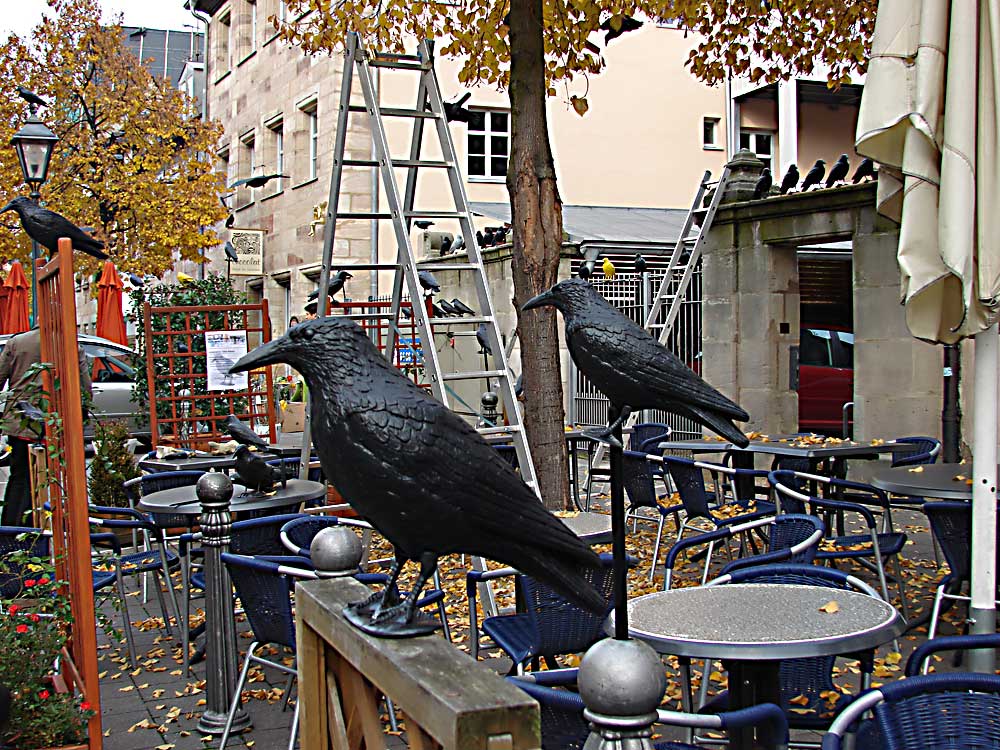
This is Gustavstraße, the oldest part of Fürth, where the buildings are all different heights. Fortunately this project, to hang up one thousand plastic ‘ravens’ to frighten the pigeons away, is apparently only going to be around for three weeks, I was relieved to hear.

Fürther Nachrichten story Raben gegen Tauben (German)

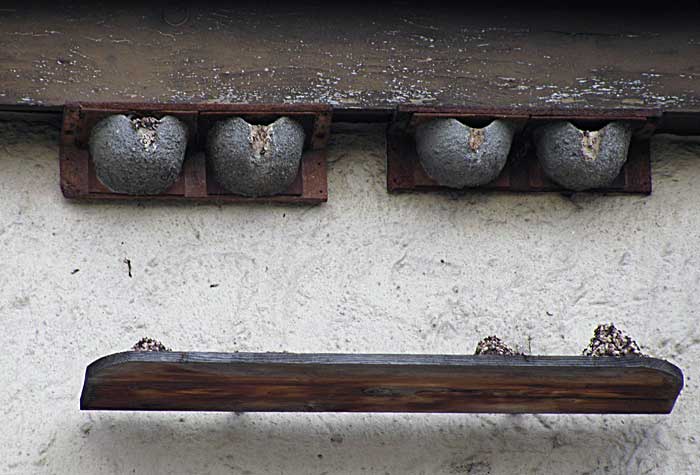
There have been peregrine falcons in Fürth, but I don’t know if they’re there this year. Another possibility is dummy egg nesting, but that would have to be done by the city.

LATER NOTE: I picked up two of these for a friend. They are very well made, with a sort of post diagonally through them, so they can be suspended from a hook at various heights or stand on their feet. I later discovered the same ravens, including the flying ones, are available cheaper from amazon.de, albeit not painted yellow. I suppose it is a work of art if you make over three euros on each one (less postage) just for putting your signature on it. I know artists’ signatures are worth a lot.

Legalese vs. Plain English/Juristensprache

Blade at Spada considers some legalese heavily criticized by the Campaign for Plain English and sheepishly confesses he understands it. So do I.

The Campaign for Plain English believes that it is possible to convey legal ideas in quotidian terminology, and cites the text below, one of m’learned friends’ finest, as an example of everything that is wrong about legal jargon. As a former lawyer Blade confesses, with some sheepishness, that it makes perfect sense to him, but he is going to reconsider the situation forthwith.

Meanwhile, the Tensor has found an error in his Ph.D. Diploma from the University of Washington, from which ‘the Year of Our Lord’ had been removed without the rest being adapted:

Given at Seattle, in the State of Washington, this twelfth day of June, two thousand and nine and of the University the one hundred and forty-ninth.

(Yes, I was able to guess what had been removed – but translators are used to that).

Translation glasses/Übersetzungsbrille

These glasses – not yet on the market – are intended to interpret what you hear and project it onto your retina so you can have a real-time conversation, at least if your languages are supported.

I can’t read Japanese, but this may be the source.

Here’s an article:

The NEC equipment comprises a script projector and microphone attached to the glasses, and a small computer that can be attached to the waist of a user. When two people with different mother tongues speak in their own languages, the projector displays expressions from both languages. NEC’s application of a technology to project images by casting light directly onto the retina is a world first. The retina transforms the optical information into a nerve signal, which is sent to the center of the brain via optic nerves.

I understand the last sentence as normal for vision.

Here’s the blog entry I got it from. It was tweeted by NOVALanguages of New York, who tweet masses of curious language links, so you may want to follow them.

I won’t be interested in this device. Being over sixty, I’ve already got too many aids, attachments and prostheses for other functions.

LATER NOTE: Google reveals more reports. The glasses are called Tele-Scouter. The halfbakery even reported it in 2003.