Speaking Gothic/Gotischer Sprachkurs
Reply



Fürther Nachrichten reports that one 77-year-old man is not prepared to sell his listed building, which is central to the shopping centre plans. He is a lawyer who was born there and doesn’t want to sell for personal reasons. He lives in Rothenburg ob der Tauber, another town where I doubt they will put a big shopping centre in the middle. (Can we contribute to his health insurance?) He apparently reacted the same way I did: how can they possibly consider integrating a previously public street into a private project?
(There’s a report in the Fürth section of the paper too, which isn’t online, as far as I can tell, and on p. 3 of the Fürth section there are reactions, including a short article on the Park Hotel and another on no. 12: it has belonged to a family for five generations).
This was common knowledge, I thought. The building in question, I seem to remember, is number twelve – yes, this is confirmed by the photo in the printed version of the paper (they’ve stopped putting photos online!) – these are my photos taken today:
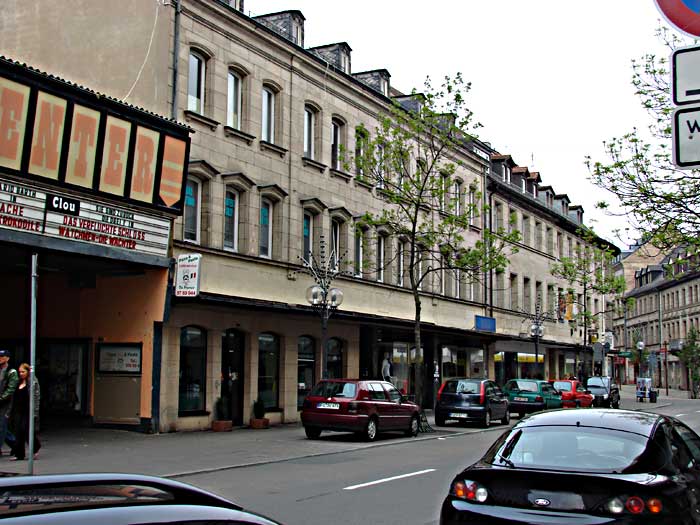
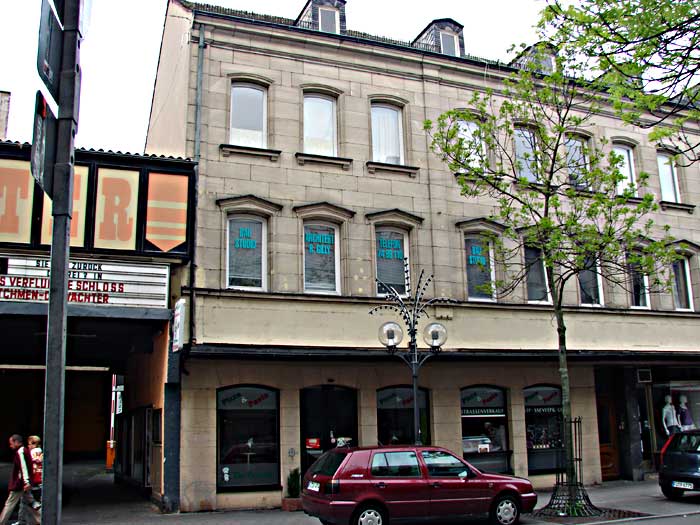
This is to the right of the cinema. It has a popular takeaway pizza shop , a clothes shop, a hairdresser and a nice jewellery shop on the ground floor, an architect on the first floor, and a Turkish organization somewhere inside. (Photos taken this morning).
The mayor said that if you had to choose one building that would hit the Neue Mitte where it really hurts, this would be it (‘Wenn man die Neue Mitte im Herzen treffen wollte, dann musste (müsste?) man sich dieses Gebäude aussuchen’).
It sounds to me as if the project is over. Sonae Sierra are prepared to discuss for the next four weeks or so whether another passageway is possible. It confirms what I gathered, that the size of the centre is vital to their plans, and they need to demolish this house to create enough space on that side of the street. I can’t imagine they will go along with the suggestions of a smaller-scale shopping centre.
There is also a commentary in the paper: Kein Grund zur Schwarzmalerei, and the Stadtheimatpfleger has already posted a PDF file on the subject.
I was wondering how to translate buchhalterisch runden, aka kaufmännisch runden.
I know what it means – it means rounding up or down, literally in the ‘accountants’ style’.
Here I do think I can rely on the German Wikipedia:
Das Kaufmännische Runden geschieht wie folgt:
* Ist die Ziffer an der ersten wegfallenden Dezimalstelle eine 0,1,2,3 oder 4, dann wird abgerundet.
* Ist die Ziffer an der ersten wegfallenden Dezimalstelle eine 5,6,7,8 oder 9, dann wird aufgerundet.Diese Rundungsregel wird durch die Norm DIN 1333 beschrieben. Das Runden wird so auch häufig in der Schule gelehrt.
The
English Wikipedia is self-described as unreliable, but says:
Round-to-even method
This method, also known as unbiased rounding, convergent rounding, statistician’s rounding, Dutch rounding, Gaussian rounding, or bankers’ rounding, exactly replicates the common method of rounding except when the digit(s) following the rounding digit starts with a five and has no non-zero digits after it.
Note that, according to this article, this is not identical to the ‘common method’. See the talk page for the dispute, and also three discussions on LEO. One suggestion there is ’round to nearest ($)’, but that is ambiguous.
This led to quite a discussion on two lists. One opinion is just to write ’round’. That doesn’t seem precise enough to me, in a contract, or, as was also suggested, in building specifications. But to define it precisely would take a lot of words. Others want to translate buchhalterisch or kaufmännisch literally. On top of that, it is apparently met most frequently in accounting, but that was not my context.
Ben Teague was one of the great stalwarts on FLEFO in CompuServe, which I joined in 1994 or thereabouts. He translated physics, but his great passion was amateur theatre. His wife Fran taught/teaches literature at the university. His website gives some impression of all this.
Now I learn from Michael Wahlster, via Twitter, that Ben was shot dead on Saturday, when he was standing outside the theatre with two other people, by the husband of one of them. Here’s an article on the shooting, and here another with more information about Ben and a photo.
Police said Marie Bruce, Tom Tanner and Ben Teague were all outside the community theater when Bruce’s estranged husband came by with two hand guns and open fired.
“Marie was the president of this organization for many, many years that acted and directed, (and) has two beautiful children,” said victim’s friend Steve Elliott-Gower. “(Tom), like Ben, he was always down at the theater helping build somebody else’s set. Ben Teague was the life and soul of the organization — very talented guy. He must have put in tens of thousands of hours building and designing sets.
I must admit I thought of him as old, but he was only one year older than me. He probably just did more! I am sorry I didn’t meet Ben. The same goes for another Flefoid, Alicia Gordon, who was only 53 when she died.
Further links: a personal account by Ben’s step-brother (since his 92-year-old father married Ben’s mother) and by the Austin Area Translators and Interpreters Association.