Lamspringe: an English abbey in Germany

wappen_lamspringe_gross.gif

Lamspringe: an English Abbey in Germany 1643-1803.
Edited by A. Cramer OSB, Saint Laurence Papers VII, Ampleforth 2004.
£24, direct from the Archivist, Ampleforth Abbey, York YO62 4EN: post free for sterling cheque with order. If you prefer to pay in Euros or US Dollars, please contact us by email.

I am not sure if this book is valuable to translators. It’s probably most interesting as part of the history of emigrés.

bq. The book is a solid work of scholarship, showing the learning traditional among the Benedictines, but not always able to surface.

I think I would have omitted that comma. The site of the village of Lamspringe mysteriously dates the Thirty Years’ War from 1618 to 1948, which gives a whole new meaning to Second World War.

bq. Der Dreißigjährige Krieg (1618-1948)
In den Wirren des 30jährigen Krieges hatten die Lamspringer viele Schrecknisse zu überstehen. Große Belastungen brachten häufige Einquartierungen. Nach der Schlacht bei Lutter am Barenberge 1626 besetzten versprengte Söldnergruppen den Ort, plünderten und brannten die Häuser nieder. Aus Furcht vor weiteren Überfällen versteckten sich die Ortsbewohner mit ihrer geringen Habe im Wald.

At all events, 21 monks and 12 boys and a monastery and school were ‘translated’ from Lamspringe to Ampleforth in 1803. (That site mentions coming from France in 1802, but no doubt this is lost in the mists of time). Before then, only English boys attended the Benedictine school in Germany.

Thanks to Ekkehard, who gave me this many years ago.

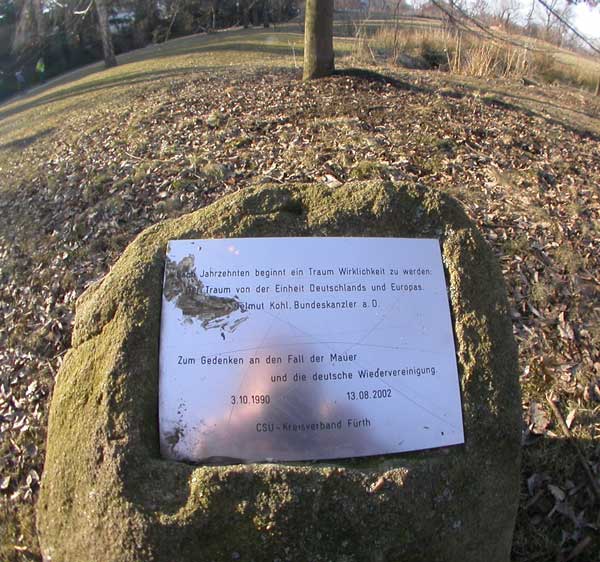
Monument/Gedenkstein

(Click picture to enlarge)

It was sunny yesterday – hard to imagine that now. Here is a self-portrait in the Stadtpark in early spring.

csuw.jpg

Not many people know this touching little monument donated by the local branch of the CSU, which is not old but has seen better days. In summer, it is surrounded by foliage.

Open source translation/US-Regierung lässt öffentlich übersetzen

According to the Boston Globe of March 18, the US government is putting Iraqi documents on the Web so the public can have a go at translating them.

bq. It’s the same ”open source” principle that drove the successful development of the Internet and of powerful free software like the Linux operating system. Instead of hiring a team of brilliant professionals to analyze Iraqi documents in secret, the open source systems will use hundreds of clever amateurs, who’ll publish their work for anyone to analyze and improve upon.

It sounds like Harry Potter fan translations but without the copyright problem.

bq. ”Workers control the means of production, but without all that tedious communism,” said Glenn Reynolds, a law professor at the University of Tennessee and author of ”An Army of Davids,” a book that shows how the Internet encourages public activism.

Well, he would say that, wouldn’t he? Apparently ‘conservative bloggers’ are behind this initiative, as it would bolster the case for war against Iraq.

Here is the Foreign Military Studies Office portal with the goods.

There are a lot of comments on Slashdot. One of them enquires whether the Amish have open source barn raisings. Another says this is equivalent to a voluntary tax upon bilinguals. Or this:

bq. I think they are forgetting that (for some deranged part of our society), creating Linux was fun. Will translating orders for toilet paper for the Iraqi National Guard mess hall be fun too? Only if you can write your translation as a perl poem!

(From Slashdot)

Timber framing/Fachwerk

It’s very frustrating when you’re translating a long text and you realize it has hundreds of references to timber framing and you don’t know enough to handle it fluently.

But things could be worse.

bq. “It’s frustrating if you’re a microbe that’s been wandering the Universe for a million years to then die striking the surface of Europa,” Dr Gladman mused.

(BBC News)

Kangaroo spotted in Austria

Bumper stickers and T-shirts say ‘No kangaroos in Austria’, but here you can see a lone kangaroo considering whether to cross a snowy road in Carinthia (shortly before being sedated and returned to its owner – Austrians who own kangaroos have to sign a declaration of secrecy).

Via Aktenvermerk