Waste incineration plant / Müllverbrennungsanlage

POC1_050923w.jpg

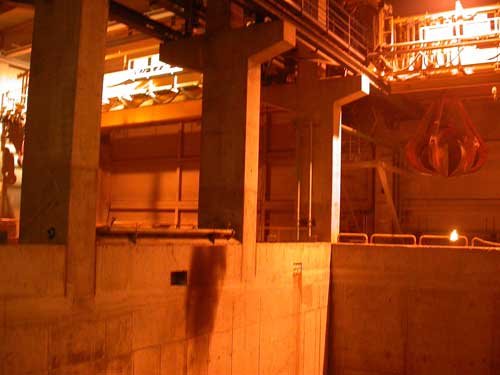
This waste incineration plant didn’t work properly.

Carbonisation process
The combination of pyrolysis and subsequent combustion is utilised in the carbonisation process. First of all the shredded waste is degassed in a rotating carbonisation drum at 450°C and separated into pyrolysis gas and solid pyrolysis residue. The pyrolysis gas is transferred directly to a further combustion chamber. The remaining pyrolysis residue is cooled and separated into fractions larger and smaller than 5 mm. The fine fraction consists almost exclusively of carbon which is crushed and injected into the combustion chamber with the pyrolysis gas. At temperatures of 1300°C, even the mineral residue melts. It granulates in a water bath and can be used later in the road construction sector. The only German plant of this kind to date is located in Fürth. It was shut down following an accident in summer 1998 and, on account of technical and other problems, will not be starting operation again. According to the company which developed the carbonisation process, these problems do not essentially cast doubt on the technology. However, the Federal Environmental Agency and the manufacturing firm no longer assume that this technology will be implemented in the short term in Germany.

And here (Galileo, bottom of page 24):

In Germany, an entire neighborhood in the town of Furth had to be evacuated in 1998 when gas leaked from the thermolysis plant. The incident prompted the Siemens Company to shelve its waste treatment business altogether.

POC4_050923w.jpg

But it makes a wonderful opera house, with first-class acoustics!

(See earlier entry)

Lawyer jokes / Witze über Anwälte

LOWERING THE BAR
Lawyer jokes and legal culture
Marc Galanter 430pp. | University of Wisconsin Press. $45; distributed in the UK by Eurospan. £32.95. | 0 299 21350 1

It’s obvious that many U.S. lawyer jokes aren’t specifically about the law, and Galanter apparently sets about researching their origins. Details from an article in the TLS:

bq. A certain sharpening in the jokes about lawyers came about when the profession
introduced hourly billing, from the 1960s onwards. Many of us will remember a billing joke, more than a century old, about the lawyer who demanded a fee “For waking up in the night and thinking about your case, $5”, later capped by the tale of a rival who charged “For crossing the street to talk to you, then discovering it wasn’t you at all, $125”. Galanter says that “Billing for thinking about the client while showering or engaging in other grooming activities is encouraged by many firms”.

Are there any German lawyer jokes? I think not. Lawyers are respected (although Galanter says the large number of jokes about lawyers also indicate a kind of respect). The topic is touched on in relation to the Netherlands:

bq. If this book is right, there are no lawyer jokes in Holland. “In civil law countries”, the author explains, “with their smaller number of lawyers and larger contingents of judges, lawyers do not seem to play an important part in the public imagination.” In the Netherlands they lack social influence. A Dutch sociologist is quoted as saying, “No need for jokes. The Dutch couldn’t care less”.

(Thanks very much to Isabella)

Request from a fellow-translator/Kollegenanfrage

Email:

bq. Sehr geehrte Frau Kollegin, sehr geehrter Herr Kollege,
ich bin ebenfalls als Dolmetscher und Übersetzer (staatl. gepr. und vereidigt PL/RUS) tätig.
Auf diesem Wege bitte ich Sie um ein Kollegenangebot für die Übersetzung von gerichtlichen Unterlagen (Haftbefehl, Gesetzestexte) aus dem Deutschen ins Englische.
Der Umfang der deutschen Texte beträgt 7 Seiten (ca. 216 Normzeilen á 55 Zeichen).
Die betreffenden Unterlagen liegen im Original vor und werden als PDF-Datei per Email an Sie gesandt. Die Übersetzung soll als Word-Datei und als zwei beglaubigte Ausdrucke geliefert werden.
Ich bitte um ein umgehendes Angebot per Email unter Angabe:
1) des Preises in EUR pro Normzeile (55 Zeichen),
2) der Bearbeitungszeit,
3) der eigenen Referenzen (Information über Ihre Fachausbildung, Vereidigung etc. und über bearbeitete Übersetzungen vergleichbarer Texte),
Mit kollegialem Gruß

Church and state in Germany /Kirche und Staat in Deutschland

Die Trennung von Kirche und Staat ist nicht so deutlich in Deutschland. Vor der Weimarer Republik waren sie nicht so richtig getrennt, und seitdem gab es keinen absoluten Bruch.

Kommers, in The Constitutional Jurisprudence of the Federal Republic of Germany:

bq. In practice, however, the established churches have continued to enjoy a preferred position in society as past institutional arrangements persist into the present. The church tax is such an arrangement, as is the provision of the Weimar Constitution (Article 137 [5]) carried over into the Basic Law, which treats the main churches as corporate bodies under public law.

(Is the choice of ‘corporate bodies’ rather than ‘corporations’ for Körperschaften an American thing?)

Recorded for my own information: Internationaler Bund der Konfessionslosen und Atheisten e.V. on Privileges of the Churches: English Deutsch
IBKA site (International League of Non-Religious and Atheists … (non-religious what?))

bq. The German judiciary displays ecclesiastical-clerical influences. The Concordat of the German Reich from 1933 and the state concordats (Länderkonkordate) define the relationship between state and church in Germany. They are contradictory to the principle of the separation of church and state. As rehards the Catholic sphere, areas they were entered into on the basis of canon law, the Corpus Iuris Canonici (CIC). Quite evidently, some court judgements were made according to ancient ecclesiastical law. This includes judgements in connection with the “blasphemy clause” (Section 166, German Penal Code), the abortion clause (Section 218, German Penal Code), judgements regarding school prayer and church tax as well as judgements of industrial tribunals under the so-called Right of Tendency clause [Tendenzschutzparagraph; Tendenzschutz means that in media, and in other companies, which besides their economic interests (primarily) pursue intellectual or philosophical objectives (= Tendenz), the rights of the works councils are restricted. The lawmaker justifies this restriction with the supposedly necessary protection of the civil rights and liberties (i.e. freedom of the press) of those, who pursue the intellectual and philosophical objectives of the company; the translator].

bq. In der bundesdeutschen Rechtsprechung sind kirchlich-klerikale Einflüsse nachzuweisen. Das Reichskonkordat von 1933 sowie Länderkonkordate bestimmen das Verhältnis von Staat und Kirche in Deutschland. Sie widersprechen dem Trennungsgrundsatz. Für den katholischen Bereich sind sie auf der Grundlage des kanonischen Rechts, des Corpus Iuris Canonici (CIC) abgeschlossen worden. Es gibt Gerichtsurteile, bei denen ganz offensichtlich nach altem Kirchenrecht verfahren wurde. Zu erwähnen sind Urteile im Zusammenhang mit dem “Gotteslästerungs-Paragraphen” (§ 166 StGB), dem Abtreibungs-Paragraphen (§ 218 StGB), Urteile zu Schulgebet und Kirchensteuer, und Arbeitsgerichtsurteile nach dem so genannten Tendenzschutzparagraphen.

Russians inspect land register/Russen besuchen Grundbuchamt

Russians from Tomsk visited the Norfolk County Registry of Deeds (near-ish Boston) to see how it’s done, reports the Daily News Transcript.

bq. Yelena Boltanova, a Tomsk State University law professor who was on the visit to Dedham, said her region didn’t open a land court until 1998.
Speaking to a reporter through a translator, she said the visit will help her professionally, so she can describe what she learned of the American system to her students. She said the visit will also help her region improve its still young land court system.
“This will help our experts in real estate draft new laws,” she said.

They spotted some weaknesses in the system at once:

bq. In explaining the local system, Norfolk County Land Court attorney Glen Buscher said in many of the older records, a property border was detailed by a scrivener, listing what bordered the property from each direction, such as a line of trees to the west or another property to the east.
“What happens if you cut down the trees?” asked one of the Russian visitors.

Here’s an article with some excellent illustrations explaining why digitizing the Index Map in the UK does not mean creating a cadastre. (Kataster in German Wikipedia)