Kriminalmuseum Rothenburg ob der Tauber

Das Museum wird kurz beschrieben im Blogreiter-Weblog aus Rothenburg ob der Tauber.

The museum of criminal justice in Rothenburg ob der Tauber describes itself in German, ‘English’ and Japanese (perhaps Professor Lenz knows what the Japanese is like?). In German, it says it is the most important law museum in the Federal Republic, while in English it says it is the only law museum in Europe.

Kriminalmuseum

You can go round the whole museum and everything is labelled in German, English and Japanese. And you can order the museum’s book on criminal justice through the ages in German, English and presumably Japanese too. Mine is quite old, but I presume it’s unchanged and still richly illustrated – particularly good on instruments of torture.

Bastuh.jpg

Baker`s Chair
for bakers who sold too small loaves of bread, which were too small [sic]

I found another law museum – the ABA Museum of Law in Chicago. It doesn’t look much like Rothenburg, where you can have yourself photographed in the stocks outside the building.

(Thanks to Blogreiter (German) for the reminder).

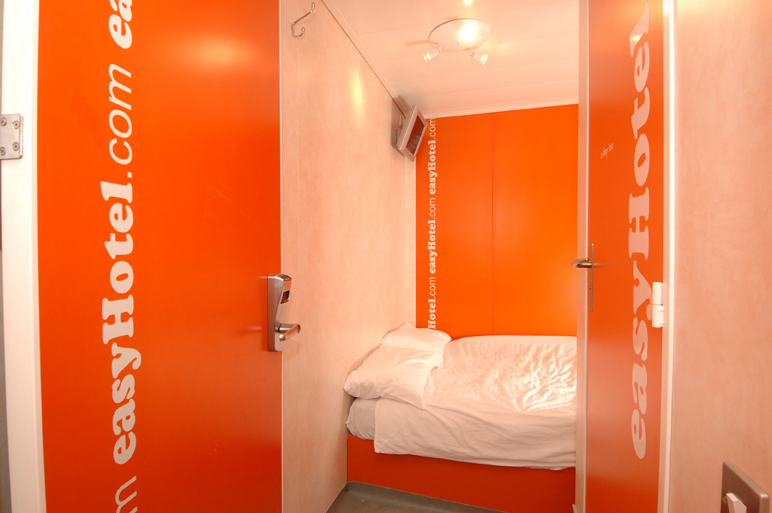
No room to swing a cat / Kapselhotel in London

eH_RmNoWindow1_LowRes.jpg

The Guardian reports that a Japanese-style capsule hotel has opened in London. It’s the easyHotel. The figure of £5 per night has been bandied about but is not correct:

bq. The rooms start from £20 a night and are booked on the easyHotel website in a similar way to budget airlines; rates vary with demand and how early or late a booking is made.

Some rooms even have a window.

Translating German corporate titles / Andere Länder, andere Titel

Im Handelsblatt schreibt Dr. Henning von Boehmer über die Schwierigkeit, deutsche Titel zu übersetzen. Er präsentiert auch ein “Übersetzungs-Tool” zur Übersetzung ins Amerikanische und Englische (sic), Französische, Italienische und Spanische.

Beispiel: Prokurist: American: Authorized Officer / Officer with Procurement
English: ditto
French: Fondé de Pouvoir
Italian: Institore
Spanish: Apoderado General

What is procurement?

The tool is a bit irritating because you have to click on your language for each term. A table would have been much nicer.

Here’s a similar but not identical list set out much more nicely.

(Via Richard Schneider’s news at Übersetzer-Portal)

Naming your poison

A translator on the pt mailing list (at Yahoo Groups) needs to translate into German a text in which two people argue about whether the drink egg cream contains eggs or cream. (This reminds me of asking the Turkish butcher ‘what are those?’ recently and being told ‘Lammeier’ – I wondered where the nest was). To quote Tony the Tour Guy:

bq. It isn’t made with eggs, or cream. This famous soda fountain concoction was a favorite for many of us, and is currently enjoying a comeback in many restaurants and diners. A mixture of milk, syrup and seltzer water, just how it got its name is one of those things nobody seems to know for sure.

So what would work in German? I could only think of Leberkäse, which is not a drink. It contains neither liver nor cheese, at least in Bavaria it doesn’t. This is reminiscent of the U.S. head cheese.

Suggestions included Alsterwasser, kalter Kaffee, and then a whole list of bizarre names (Blutgeschwür – Advokaat with a shot of cherry brandy, Tote Tante – North Frisian drink of hot cocoa with rum).

But I suppose most cocktails have names like that.

For microscope photos of cocktails, see here.

Bright line

Mark Liberman at Language Log establishes that the noun phrase ‘bright line’ and the adjective ‘bright-line’ are missing in most general English dictionaries:

bq. Here’s another common expression that’s not in the standard dictionaries: bright line, in the sense of “clear criterion of demarcation”.You won’t find it in the American Heritage Dictionary (fourth edition), Merriam-Webster’s Unabridged (third edition), Encarta, or the Oxford English Dictionary, but it’s widely used these days. Google has 193,000 hits for “bright line”, a substantial fraction of which seem to be instances of this expression. Searching today’s Google News brings up 104 examples, and Technorati finds 20 blog examples in the past three days.

As he says, you can work out the meaning from the Google examples.

The term is a U.S. one afaik. It’s in Black’s Law Dictionary, though only since the 7th ed., i.e. post-Garner. It’s in Merriam Webster’s Dictionary of Law. I can’t find it in Gifis (Barron’s) Law Dictionary, though. And I can’t find it in any bilingual law dictionaries.

bq. (Though Merriam-Webster’s Dictionary of Law, 1996 edition, has no entry for this term.)

Hmm.

Still, it can be found. German general dictionaries have a special rule of not allowing specialist terminology in. So the German equivalent of ‘bright line’, if there were one, might be found in a German law dictionary like Creifelds or Alpmann-Schmidt, but some verbs and adjectives with a specific use in legal texts won’t be found anywhere. To say nothing of Austrian and Swiss terminology that you can’t even find in Austrian and Swiss law dictionaries.

I have now found an entry in Garner’s Dictionary of Modern Legal Usage:

bq. bright-line rule = a judicial rule of decision that is simple and straightforward and that avoids or ignore the ambiguities or difficulties of the problems at hand. The phrase dates from the mid-20th century. The metaphor of a bright line is somewhat older than the phrase bright-line rule – e.g.: “The difficult part of this case comes with regard to … the activity of the Board of Temperance ….A bright line between that which brings conviction to one person and its influence on the body politic cannot be drawn.” Girard Trust Co. v. I.R.C., 122 F.2d 108, 110 (3d Cir. 1941)./”[T]he McCambridge majority opinion … agrees that the Kirby bright-line-rule is but a mere formalism ….” J.G.Trichter, Bright-Lining Away the Right to Counsel, Tex. Law., 6 Nov. 1989, at 26. Cf. hard and fast rule.

Renaming things / Bundesgrenzschutz heißt jetzt Bundespolizei

A statute to change a term in earlier statutes is apparently unable to summarize this in two paragraphs, but instead takes 23 pages to describe each individual change in every grammatical case.

Ein Artikel von Friedrich Kiechle, Vorsitzender Richter am Verwaltungsgericht Berlin, Umbenennung als Herkuleswerk, erschien in der FAZ am 27. Juli (für EUR 0,85 aus dem Archiv zu bekommen). Das Gesetz zur Umbenennung des Bundesgrenzschutzes in Bundespolizei hat eine Länge von 23 Seiten im Bundesgesetzblatt (hier als nicht-ausdruckbare-PDF-Datei zu finden):

bq. In … werden jeweils die Wörter ‘Der Bundesgrenzschutz’, ‘der Bundesgrenzschutz’, ‘Dem Bundesgrenzschutz’, ‘dem Bundesgrenzschutz’, ‘den Bundesgrenzschutz’, ‘vom Bundesgrenzschutz’, ‘des Bundesgrenzschutzes’, durch die Wörter ‘Die Bundespolizei’, ‘die Bundespolizei’, ‘Der Bundespolizei’, ‘die Bundespolizei’, ‘von der Bundespolizei’, ‘der Bundespolizei’, sowie jeweils das Wort ‘Er’, ‘er’, ‘seine’ durch das Wort ‘Sie’, ‘sie’, ‘ihre’ ersetzt.

Das wurde nicht immer so gehandhabt:

bq. Immerhin steht etwa bis zum heutigen Tag in Paragarph 23 des Bürgerlichen Gesetzbuches, daß “einem Vereine, der seinen Sitz nicht in einem Bundesstaate hat, … in Ermangelung besonderer reichsgesetzlicher Vorschriften Rechtsfähigkeit durch Beschluß des Bundesrats verliehen werden (kann)” – und nimmt damit auf Verfassungsinstitutionen des Kaiserreiches Bezug …