
EC Asparagus Directive/EG Spargel-Richtlinie

Here it is in German, with links to all other languages.

We don’t talk of translation here – all versions of the EU directives are original legal texts. But this is odd:

in Erwägung nachstehender Gründe:
(1) Spargel ist in Anhang I der Verordnung (EG) Nr. 2200/96 als eines der Erzeugnisse aufgeführt, für die Normen festzulegen sind.

Whereas:
(1) asparagus are among the products listed in Annex I to Regulation (EC) No 2200/96 for which standards must be adopted.

And again later:

The condition of the asparagus must be such as to enable them:

Asparagus is treated as a plural! But what about this?

Asparagus is graded into three classes defined below:

In fact, plural and singular use are mixed. This means that a number of lawyers drafting legislation for the EU are capable of writing a text without being consistent as to whether the main term is singular or plural. Why am I not surprised?

The OED has no illustrations of this, although others seem to want to count.

I see asparagus as a mass noun/uncountable. German has Spargel, but counts as Spargelstangen and Spargelköpfe.

And here’s some of the important bit:

Die Spargelstangen werden nach ihrer Färbung in vier Gruppen eingeteilt:
1. weißer Spargel;
2. violetter Spargel: der Spargelkopf muß eine rosa bis violettpurpurne und ein Teil der Spargelstange muß eine weiße Färbung aufweisen;
3. violett-grüner Spargel: Spargel mit teilweise violetter und grüner Färbung;
4. Grünspargel: der Spargelkopf und der größte Teil der Spargelstange müssen eine grüne Färbung aufweisen.
Diese Norm gilt nicht für Grünspargel und violett-grünen Spargel mit einem Durchmesser von weniger als 3 mm und für weißen und violetten Spargel mit einem Durchmesser von weniger als 8 mm, der in einheitlichen Bündeln oder Packstücken abgepackt ist.

Asparagus shoots are classified into four groups according to colour:
1. white asparagus;
2. violet asparagus, having tips of a colour between pink and violet or purple and a part of the shoot white;
3. violet/green asparagus, part of which is of violet and green colouring;
4. green asparagus having tips and most of the shoot green.
This standard does not apply to green and violet/green asparagus of less than 3 mm diameter and white and violet asparagus of less than 8 mm diameter, packed in uniform bundles or unit packages.
Mr Honey’s Dictionary/Winfried Honigs Wörterbuch

Sometimes, in bookshops in Erlangen and Nuremberg, I’ve seen CD-ROMs with a German-English economics dictionary by one Winfried Honig, who calls himself Mr Honey. He can be found by Google and investigated further.

One of his dictionaries is online as part of Project Gutenberg: Mr Honey’s First Business Dictionary (2001, 2002). Apparently his work has been fed into LEO too, so maybe this is superfluous. Apparently he taught at the Fachhochschule Nürnberg for 25 years.

In the 1970s Winfried Honig, known as Mr Honey, started compiling and
computerizing English/German dictionaries, partly to provide his
colleagues and students with samples of the language of business,
partly to collect convincing material for his State Department of
Education to illustrate the need for special dictionaries covering
the special language used in different branches of the industry.

In 1997 Mr Honey began to feed his wordlists into the LEO Online
Dictionary http://dict.leo.org of the Technische Universität München,
and in 2000 into the DicData Online Dictionary http://www.dicdata.de

While more than 500.000 daily visitors use the online versions,
CD-ROM versions are available, see: http://www.leo.org/dict/cd_en.html
http://www.dicdata.de http://mrhoney.purespace.de/latest.htm
Mr. Honey would be pleased to answer questions sent to
winfried.honig@online.de.
Permission granted to use the word-lists, on condition that links to
the sites of LEO, DICDATA and MR HONEY are maintained.
Mr Honey’s services are non-commercial to promote the language of
business both in English and in German.

Here’s a sample:
gezeichnetes Kapital subscribed capital
gezogene auf die eröffnende Bank drawn on the issuing bank
gilt als is deemed to be
girieren endorse
Girogläubiger creditor by endorsement
Girokonto (US) checking account
Girosystem cheque system
Gläubiger creditor
Gläubigerausschuss board of creditors
Gläubigerausschuss committee of creditors
gleich equal
gleichartig similar
gleiches Akkreditiv similar credit
gleichlautend in conformity
gleichlautende Abschrift true copy
Gliederung der Ausgaben classification of expenditures
Glücksspiel gambling
Glücksspiel game of chance
GmbH

Asparagus season/Spargelzeit

I’ve mentioned before that the Germans are so fixated on asparagus that they claw it out of the naked earth before it is even ready to eat.

In Expatica, David Gordon Smith tells it like it is. Supposing you didn’t know the word Spargel and saw the excitement of the Germans, what would you expect?

bq. In the absence of your dictionary you are reduced to speculation. Is it caviar? Truffles? Puffer fish? Whatever it is, it must be exotic and exciting and well worth the extravagant sums the restaurant is demanding. …

bq. On the edge of your seat, you watch your plate approach across the room. As it is tantalisingly lowered onto your table, you spot some boiled potatoes, a slice of ham, and then, immersed in a golden lake of Hollandaise sauce, a few sprigs of … asparagus? Your slavering jaw drops. This is what all the excitement is about? This is what they are charging EUR 13.90 for?

The season ends on June 24th (is there a Spargelgesetz?), but other things have short seasons too. I like fresh peas, and many people like strawberries, but the excitement is no comparison. I wonder if there is some genetic reason why asparagus is so popular here?

Here is a site with photos showing the obligatory Eastern European asparagus picker (there was a scare this year that the government might make unemployed German persons help out) and the rape of the asparagus bed.

British English being promulgated in New York

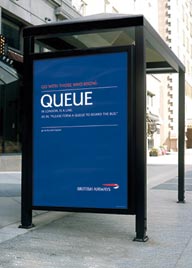
21794-queue-tmb.jpg

(Source)

British Airways has started an advertising campaign in New York to help accustom Americans to British expressions before they arrive in the UK:

bq. On billboards and bus shelters across Manhattan, “Brit-speak” can be heard loud and clear. Next to one of the city’s busiest roads a huge billboard says: “This traffic is ‘bonkers’! In London, ‘bonkers’ means ‘crazy’.” On a bus shelter in Greenwich Village a poster reads: “Avoid ‘legging it’ by taking the bus. In London, ‘leg it’ means ‘to run quickly’.”

BA also has a ‘Brit-Speak Dictionary’ online.

(Via Onze Taal)

It’s all very well for British Airways to talk. But I remember when BOAC and BEA merged to form the new British Airways in 1973, there was a letter to the Times (that’s the Times of London for those across the pond, and in those days it was a respectable paper) consisting of only two words:

bq. British Airways?

US class actions in German / US-Sammelklagen-Glossar auf Deutsch

TILP Rechtsanwälte vertreten deutschen Mandanten in US-Sammelklagen und haben auf ihren Webseiten ein Sammelklagen-Wörterbuch und eine Sammelklage-FAQ.

bq. Class Representative:
Repräsentant der Klägergruppe: Die Person, die in der Klage als der Kläger (die Person die anklagt) genannt wird und vom Gericht ernannt wurde, als rechtliche „adäquate“ Person die Interessen der Gruppe zu vertreten.

bq. Clear Sailing Agreement:
Nicht-Einmischungs-Abkommen: Eine Vereinbarung die zwischen den Anwälten beider Parteien während oder nach Vergleichsverhandlungen gemacht werden, wonach die Verteidigung zusagt, einem Honorar Antrag des Anwalts der Klägergruppe nicht zu widersprechen.

bq. Collusion:
Kollusion: Eine ungebührliche Vereinbarung, üblicherweise eine Absprache zwischen Kläger und Beklagten.

bq. Commonality:
Kommunalität: Eine gemeinsame materielle Tatsache oder rechtliche Frage aller potenziellen Klage-Mitglieder.

(Link gefunden bei der pt-Gruppe bei Yahoo.com, Dank an Martin)