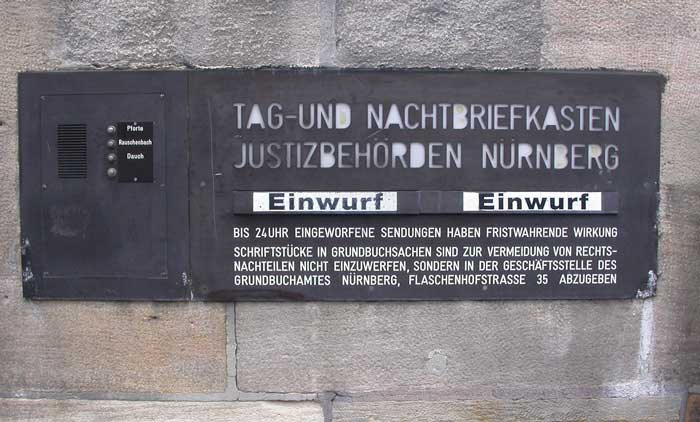
(Day and night letterbox, Nuremberg court authorities.
Letters posted here up to 24 hours (midnight) will be within the deadline for that date. Pleadings in Land Registry matters should not be posted here, to avoid legal prejudice, but handed in at the Land Registry office.)
‘Double interpretation’ continued
In response to a comment on the previous entry, I will add some more remarks: of course, the normal British name for the process should be relay interpreting, and the American equivalent relay interpretation. The term double interpretation or double interpreting seems odd. EU note here.
bq. Interpreters use relay interpreting when the language which is spoken in the meeting room is not covered by any of the colleages in the booth.
By connecting to one of the other booths where the language in question is covered, the interpreters can translate for their customers.
Example:
In a meeting where Greek is covered in the German and the Dutch booth only, all the other booths will listen in to one of these booths (“take relay” in interpreter jargon) and be able translate into their respective mothertongues.
Of course, as was pointed out in the case itself, ‘commercial’ relay interpreting is not the same thing as relay interpreting in a criminal court.
The case transcript is interesting because it does consider all these issues and it indicates that the judges gave intelligent consideration to the problem. The situation was that an 11-year-old Bosnian Romany girl was charged with attempted pickpocketing (magistrates’ court). The magistrate was a stipendiary magistrate, i.e. a qualified lawyer sitting alone, like a German Einzelrichter – since 1999 the term has been changed to district judge. There are no qualified Bosnian Romany interpreters in the UK! There was one interpreter, Donald Kenrick, who appears to be a Romany interpreter, but not of the right dialect, and the magistrate said the trial could go ahead.
The girl (despite being unable to communicate in Esperanto, see other comment on last entry) challenged this. A challenge went to the Administrative Court, which used to be called the Divisional Court of the Queen’s Bench Division of the High Court, the nearest England and Wales has to an administrative court system.
Here’s the case reference:
METROPOLITAN STIPENDIARY MAGISTRATE EX PARTE “J”, R v. [1999] EWHC Admin 671 (12th July, 1999)
Such applications for judicial review (that has a different meaning in England from the U.S. meaning) are in the name of the Queen (R for Regina). The neutral citation uses EWHC to mean the High Court of England and Wales.
The case against one of the co-accused was dropped for language reasons. The magistrate wrote:
bq. “The Defence contended that Romany was the only language spoken and understood by the youth. The only interpreter was one who could translate English into Serbo Croat — a language discrete from Romany. By consent … a compromise was attempted whereby the evidence was given in English and a sworn interpreter translated that into Serbo Croat to a male who came with the youth and translated the Serbo Croat into — it is said — Romany.
bq. “The result was chaotic, it was slow and noisy, no-one knew if the translation was accurate or not or whether the youth understood the proceedings. I was sitting with two experienced Youth Court Justices and the three of us quickly resolved that the proceedings were unsatisfactory, irregular and possibly unlawful.
bq. “Accordingly the trial was aborted and I set in motion an argument as to the legality of what I shall call the double translation.”
(Ah! ‘…what I shall call the double translation”)
In the present case, the interpreter said that he and the girl had 90% mutual understanding, but only 80% mutual understanding of courtroom language. The magistrate ruled that the case could go ahead.
bq. ” Conclusions
“1. Bosnian Romany is a dialect of a discrete language classical Romany.
“2. The so called double interpretation is not lawful.
“3. Translation into a second language is not lawful.
“4. In a Youth Court, if the competent authorities fail to provide an interpreter in the mother tongue of the defendant, that is prima facie a breach of Article 6(3)(e) of the European Convention on Human Rights.
“5. Failure by the competent authority — here the Court — to provide an interpreter is an unfairness which is an abuse of process and would lead to a stay.
“Fortunately, I do not have to stay these proceedings as Dr Kenrick will translate. Had he or another not been available I would, as I have said, have ordered a stay.”
The court heard evidence from Rowland [sic – it should be ‘Roland’] Chesters, of the Institute of Linguists, whose evidence seems to have exerted great influence. It also considered case law. It quashed the magistrate’s decision:
bq. Let me return finally to the instant challenge. For the reasons given it is plain, and indeed agreed, that the magistrate’s order cannot stand. Accordingly, certiorari must go to quash it.
(The term certiorari has since been replaced by quashing order in England and Wales – it’s still used at the U.S. Supreme Court, of course).
The court did not go further – it did not order the proceedings to be abandoned, although it commented that their future was somewhat doubtful. The remarks about the lawfulness of ‘double interpretation’ were obiter dicta, that is, not part of the decision and not binding, but reflecting how the court might decide in future in a similar case.
The case is worth reading. This summary is to point out why the court thought relay interpreting was the best of a bad bunch. It doesn’t alter the fact that there are still, presumably, no competent Bosnian Romany interpreters in the country.
Finally, a note on Donald Kenrick (and Google reveals a number of other interesting sites):
bq. Donald Kenrick took a first-class honours degree in Arabic from London University, followed by a Master’s on the image of the Jew in Scandinavian literature, for which he was required to master all the nordic languages as well as Hebrew and Yiddish.
An enthusiast for the rights of small language groups, he was at one time active in the Cornish revivalist movement. An enthusiasm for Bulgarian folkdance led him to a job teaching in Bulgaria, where he came into contact with the Romani language, eventually completing a PhD on the Drindari dialect.
He has made a lasting contribution to Romani linguistics and was the first secretary of the WRC Language Commission in 1971. He also wrote with Gratton Puxon the first full-length study of the Romani holocaust, and served for a while as secretary of the early Gypsy Council. Later he worked voluntarily for the National Gypsy Education Council, and the Romany Guild.

Double interpretation case
A 2000 QBD case involved the question of double interpretation, that is, interpretation from English to Bosnian Romany by way of Serbo-Croat (if that’s still its name). Here is the complete summary from David Swarbrick’s superb site:
bq. Regina -v- West London Youth Court, Ex P J – QBD – 02 August 1999 – Criminal Practice
lip – When absolutely necessary, it was permissible for a court to allow and depend upon double translation for a defendant. A court offered either double translation or a translator who felt 80 per cent adequate in the language of the defendant. A translator must be impartial (never the appropriate adult), and qualified and fluent. The standards required at interview were also required at trial. There must be a natural understanding between the accused and his interpreter, and the next and the court.
[02 August 1999 – Times ]
The case itself is online at BAILII, the first portal to search for English law, but I found it easier to find by Google than at the BAILII site.
bq. 4. The possibility, therefore, arises of a process known as “double translation”: interpretation from one language into a second language, and then from the second language into a third language. The magistrate ruled that double interpretation can never be lawful. We are told other tribunals, from time to time, have ruled differently; views are divided. This question is, therefore, one of some general and growing importance and both sides invite the court to take this opportunity to provide guidance.
5. I recognise, of course, that such views we express will necessarily be obiter. Nevertheless, given that we have enjoyed the luxury of research and submission by two leading counsel on what is now an uncontested challenge, it would seem churlish to decline the invitation. I hope our observations may provide some assistance in the future.
Churlish indeed!
I’ve normally heard this process in writing called relay translation (e.g. getting a translation from Maltese to Latvian by way of English, for example).
The tip on the case came from Peter Tiersma – thanks to him. And look at Peter’s website on language and law and his book on legal language.
Singular use of ‘they’
The use of they or their as a singular is a frequent subject of discussion among translators into English and also on the Internet in general. It’s been used for centuries – the article quoted below says the first use in the OED is in the 14th century , but under their there is a 1420 reference (‘the sun and moon, each with their own light’). Usually discussions are exhausted in pointing out to critics that it is not an invention of the women’s movement (which apparently is sufficient to disqualify usage in many quarters). However, one sometimes hesitates to use it in written, especially formal written, English even where it would be the most elegant alternative.
The latest issue of Clarity gives a link to an article on the website of the Canberra Society of Editors on the use of they as a singular, particularly in legal texts.
The article quotes the ‘big three’ dictionaries (Random House 1987 is the third), none of which criticizes the usage. It is in favour of it, but points out one problem:
bq. There are some situations in which the use of they could lead to ambiguity, for example:
Where an applicant notifies the other residents, …………. must lodge a section 12 notice within 14 days.
To insert they in the blank here would not work if we want it to refer unequivocally to an applicant. Readers could quite legitimately and most probably would – interpret they in this sentence as referring to the other residents.
However, it doesn’t see this as an argument against the usage, but recommends redrafting.
Clarity says the author of this article is Robert Eagleson, whereas the site quotes a Simplification Task Force that produced the paper in 1995. It does quote work by Eagleson:
bq. In 1974 Robert Eagleson conducted a series of usage tests in Sydney to see how much support remained for he in a universal or indefinite context and how effective the efforts of teachers had been (‘Anyone for his’ in Working Papers in Language and Linguistics (1976) 4: 31-45).
The Clarity website does not have full copies of the journal, but it does have other materials. Thanks also to Robin Bonthrone for reminding me of this conference on clarity and legal language planned for 2005 in Boulogne-sur-Mer.
Translation weblogs TRANSLATION EXCHANGE.
Further to my last entry, Céline has posted on that thread two addresses of translation weblogs that are new to me.
One is a group blog called Translation Exchange, which began on April 16th as follows:
bq. This is intended as a forum for those interested in translation (and more generally, in world affairs) to post and comment upon relevant articles and information. Anything from political subterfuge to book reviews. Let’s just talk translation.
Unfortunately it doesn’t appear to have a newsfeed.
The other is Translator’s Note, by a translator in Japan, Zachary Braverman. It’s been running since November 2002.
LATER NOTE: Robin on Carob found the correct newsfeed for translation eXchange:
http://translationexchange.blogspot.com/atom.xml.
Translator’s diaries/Übersetzertagebücher
There was a thread on Translatorscafé yesterday started by someone looking for a freelance translator’s diary. Transblawg was mentioned, as were a number of others. There’s a nice photograph of Steve Maas of On-Time Updates there, too.
If anyone’s interested in translators’ weblogs, I have a set of links in the right-hand column. There are a couple of other translators’ weblogs out there too. Some are language/linguistics, some translation. I don’t know that any is exactly a diary. I think of a weblog as a log of what a person found on the Web, but Transblawg is not exactly that – more a log of what I was thinking about together with a few pictures and comments from day-to-day life.
But some of the translators’ weblogs are more diary-like.
A web search revealed an attempt at another translators’ site to gather diaries, but only one day from one diary had so far been offered.