Besucher aus Mainz, bevor sie das Spiel verloren.
Visitors from Mainz before they lost.
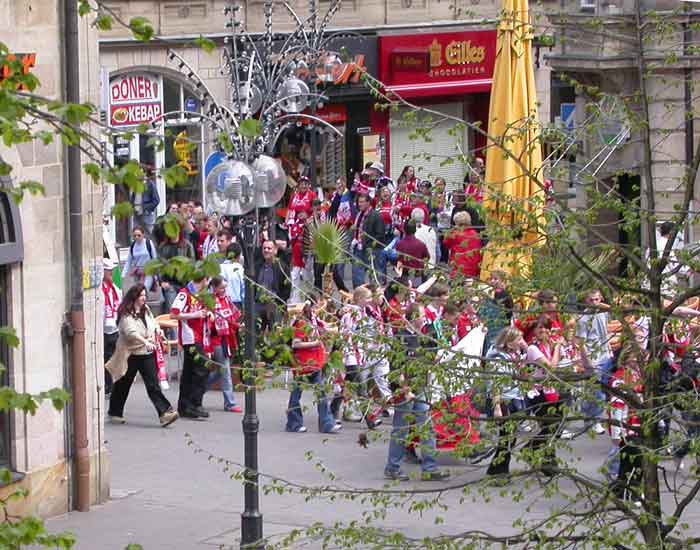


Besucher aus Mainz, bevor sie das Spiel verloren.
Visitors from Mainz before they lost.
According to the Fürther/Nürnberger Nachrichten, something called an ‘overfly’ is to be built to ease the traffic situation on the motorways around Nuremberg.
I am still trying to work out what this is. It cannot be a hoverfly (Schwebefliege)
and it can’t be a flyover (see the ‘temporary’ flyover at Gallows Corner in Romford that has long since ceased to be temporary).
They are widening one road and also rebuilding an autobahn junction, using this overfly, which is also called a ‘direct ramp’ (Direktrampe). This will take lorries from the A73 to the A6.
The more I think about it, the more I think it means ‘bypass’. But of course, the word ‘Bypass’ is already used in German in the medical sense, so perhaps they don’t realize it has a wider meaning. ‘Umgehungsstraße’ means a road bypassing a town, and this overfly is probably bypassing a motorway junction. It’s rather reminiscent of the German ‘Pullunder’ (something with shorter sleeves than a pullover?)
I found another Overfly, one that didn’t need to be built in Cologne. This is defined as (text from FDP site):
bq. Schließlich fordert die FDP-Fraktion, dass die Pläne zur Errichtung eines sogenannten Overflys, das ist ein Brückenbauwerk, das im Falle eines Ausbaus des Godorfer Hafens die Stadtteile Godorf und Sürth vor den entstehenden Verkehrsbelastungen durch Lkw schützen soll, aufrechterhalten werden.
bq. (…what is known as a overfly, a bridge structure – if the Godorf harbour were expanded, this is intended to protect the districts of Godorf and Sürth from the heavy lorry traffic that would develop…)
So this would mean a raised structure, a flyover, for lorries only.
Vor genau einem Jahr habe ich hier angefangen. Eigentlich nicht hier, sondern dort.
I started this weblog with another provider exactly one year ago. Time flies.
Ein Artikel von Carolina Villegas bei TransDirectory listet auf, wie freiberufliche Übersetzer ihr Büro nach Feng-Shui Prinzipien einrichten können.
On the TranslationDirectory site (see entry here yesterday) there is an article by Carolina Villegas on Feng Shui for the Freelance Translator, with a number of links to other sites. I will go through the points raised here as a kind of meme. How far is my office from the principles of feng shui?
1. Yes, my office is near the front of the flat, fairly close to the door. But I try to avoid receiving clients in my home office.
2. My desk is half-facing the entrance. I dont think too many surprises will come through that door without the doorbell being rung first, though. Two kittens did once come through the window, but thats on the other side.
3. I have still got the keyboard and mouse that came with this computer. Bad of me. Still, I’ve often had different ones in the past. But there is no glare from the monitor.
4. Keep your workspace clean and clutter-free.’ Hmm. ‘Keep the cords to your office equipment well hidden.’ Double hmm.
5. Lighting isnt too bad.
6. Directions. I suppose my office does face south. The windows are on the north though. The desk is NW. That seems wrong. I dont allow fresh flowers in. Nor plants on the desk they wouldnt like it. I have no crystals either. Have I got to have crystals? The art in the room has no mountains on it at all. No wild animals either. I have three dogs, two naked women, an ink blot, and Sigmund Freud with a white rabbit on the couch.
7. No crystals either.
8. Dont sleep in the same room where your computer is. Well, this isnt my bedroom, but sometimes the work is conducive to microsleeps at the very least.
9. Plants in the office yes, I have got a cactus. The others had to go. Have I got views of harmful elements from my window? I suspect a building site is a harmful element. Not sure that I will hang wind chimes though. Another sharp-leafed plant or two would be conceivable though. But Im always worried about this (see bottom two pictures).
Netbib weblog hat anscheinend nicht viel für Juristen übrig.
Spiegel Online has an article (in German) on strange plaintiffs – litigious people (Querulanten), at least some of them.
Netbib weblog gives the link, via Handakte WebLAWg, rather grudgingly:
bq. Der SPIEGEL macht sich wohlfeil über allerlei verwaltungsgerichtlich notorische Querulanten lustig (via Handakte) – dabei ist die Jurisprudenz doch das Problem, für dessen Lösung sie sich hält.
(smiley omitted)
bq. The SPIEGEL gets some cheap amusement out of all kinds of notorious litigious persons at administrative courts … but the law (I suppose they mean) is the problem as whose solution it regards itself.
Pardon? It’s not clear what this opinion is based on. A search in the archives reveals a few other snotty remarks about the law and also about things being anglozentrisch.
More snotty remarks about German law webloggers today. Digs at legal weblogs in Germany on 13th April and 6th April.
Perhaps this is just a private feud, but it doesn’t read like that.
LATER NOTE / SPÄTER HINZUGEFÜGT:
Ich muss mich korrigieren (siehe Kommentar): netbib weblog hat 8 Autoren und nur einer, kg, hat die Nachrichten geschrieben, die ich verlinke. Er/sie hat auch zu meinem Fürther Weblog mal gemeint “Fürth? Was ist das?”
I apologize to netbib weblog – a comment (in German) points out that there are 8 authors, and all the entries I found dismissive of lawyers (and of Fürth!) are by one of them, called kg. Apologies to the other seven – I didn’t find a description of the co-authorship anywhere on the site, but there are a lot of links so I probably overlooked it.
Schröder erwirkt einstweilige Verfügung gegen Kriminalroman
Landgericht Hamburg untersagt Verbreitung aufgrund Cover-Foto
According to Medienrecht News, Gerhard Schröder has obtained an order from the Hamburg Landgericht to prevent the cover and contents of a crime novel from being circulated. It shows Schröder in the sights of a gun, and refers to a Chancellor called Winzling (something like ‘Midget’). The publisher Betzel Verlag had this on the cover of ‘Das Ende des Kanzlers – Der finale Rettungsschuss” (The end of the Chancellor – the fatal shot). The author is a journalist using the pseudonym Reinhard Liebermann.
The site now shows a different head on the cover – the original cover has almost disappeared from the Internet too.