NO new edition of Oxford Dictionary of Law

LATER NOTE: This edition is the 2002 edition with a new cover. Moreover, the quotes from the TES and TLS given on the original cover are now both ascribed to the TES. Conclusion: a waste of money!

There is a 2003 edition of Elizabeth Martin’s Oxford Dictionary of Law. This is a relatively small paperback, price £9.99. In its first edition it was called Concise Oxford Dictionary of Law, but later they dropped the ‘concise’. As there’s no British equivalent to Black’s (USA, especially Garner’s 7th ed.) or Creifelds (Germany), I prefer this. There are other dictionaries of the same size, such as Mozley and Whitely or Curzon, which tend to have more and briefer entries. I should make a special reference to Chambers, because that has a surprisingly large number of entries on Scottish law.

Chimneys conceal mobile phone masts

chimneys1w.jpg

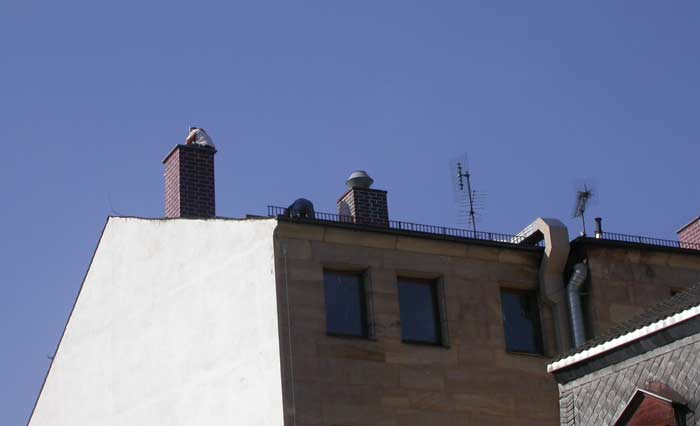
This isn’t Father Christmas, but a man inspecting a fake chimney concealing a mobile phone mast (see the large rectangular vertical pipe on the right next to the drainpipe). When I first saw these chimneys, I assumed they were meant to stop people complaining about the effects on their children’s brains.

chimneys2w.jpg

chmineys3w.jpg

However, I read recently that in areas with listed buildings, permission will be given only if the masts are disguised. I’m not sure whether to believe this. Here’s an article in German with more pictures, including this very building (scroll down to Suchbild), and here is a BBC news report in English.

bq. Dotted around Britain are fake chimney pots, fake flagpoles, fake drainpipes and fake signs all made of glass-reinforced plastic and concealing mobile antennas.

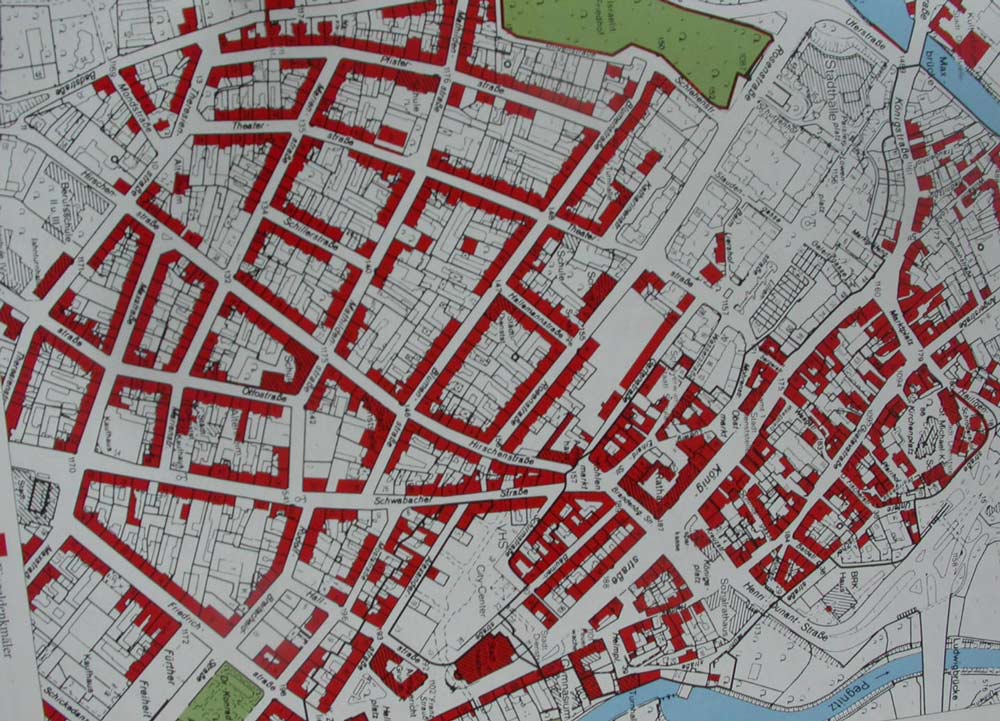
However, Fürth does have over 2000 listed buildings (some marked in red on the plan below).

(Click on all pictures to enlarge).

denkmalw.jpg

Pedrolo Catalan novel update

In July I mentioned Peter Griffin’s bilingual version of a novel – Tocats pel foc – Touched by Fire – by Manuel de Pedrolo.

Peter was obliged to buy it back from the publisher to stop it getting pulped. I can now post the following:

TRANSLATOR RANSOMS 490 COPIES FROM PUBLISHER,
GETS P.O. BOX AND SELLER’S PERMIT, SLASHES PRICE!

More details here.

The price is now $15 (within the USA, I suppose), plus sales tax in California.

ADDED LATER: The price of $15 including postage applies outside the USA too.

JVEG new draft: court payments for translators and interpreters in Germany

The Justizvergütungs- und -entschädigungsgesetz (JVEG), the Court Payment and Reimbursement Act, soon to be passed, will govern the payment of expert witnesses, interpreters and translators and the reimbursement of lay judges and expert witnesses. It’s an important topic but one I probably don’t know enough about – it doesn’t affect me directly (except on the rare occasions when a court asks me to supply a certified translation). See earlier entries here and here.

I believe the lawyers and expert witnesses are happier with the latest draft than the translators and interpreters are. The draft is available at www.bmj.bund.de: here is the press release of August 28th.

All this material is in German, but it isn’t of direct interest to anyone who doesn’t speak German. Now the BDÜ, the Bundesverband der Dolmetscher und Übersetzer e.V., with over 5,000 members, also on behalf of other translators’ associations in Germany: ADÜ Nord Assoziierte Dolmetscher und Übersetzer in Norddeutschland e.V.,
Hamburg,
ATICOM – Fachverband der Berufsübersetzer und Berufsdolmetscher e.V., Hattingen,
VVU Verband der allgemein beeidigten Verhandlungsdolmetscher und der öffentlich bestellten und beeidigten Urkundenübersetzer in Baden-Württemberg e.V., Stuttgart,
VbDÜ Verein öffentlich bestellter und beeidigter Dolmetscher und Übersetzer Bayern
e.V., München, and
Verein beeidigter Dolmetscher und Übersetzer Leipzig e.V., Leipzig,

together with about 2,000 members,
has put its comments on the latest draft online.

Although the draft is an improvement in some respects on the last, there are a large number of problems outstanding, such as the rate paid to interpreters (equivalent to the second-lowest rate for expert witnesses) and the payment per line to translators (EUR 1.25 at minimum, and the usual maximum of EUR 1.85 is not merely for ‘more difficult’ translations, but for ‘considerably more difficult’ ones. The previous payment of EUR 2 per page has gone (a strange old-fashioned kind of payment presuming a chancellery setting). Computer counting including spaces is to be accepted, but not in the case of Cyrillic and Greek font, although it is no secret that Cyrillic and Greek fonts can be counted too.

Another problem is the reference to how translators are paid if they come from a company (Unternehmung), since certified translators are individuals on the courts’ list, and many courts instead go straight to translation companies instead of looking for a certified translator. This is a big topic. Again, the draft assumes that there are circumstances when work for police will not be governed by the Act. And there are strict regulations reducing the income of interpreters: one of these is that if a job is cancelled at short notice, the interpreter will be paid for a maximum of one hour. Interpreters normally charge by the day, and they normally require a day’s payment for short-term cancellation, because they cannot get alternative work at short notice.

The new Act purports to treat interpreters and translators as professionals, to be paid for their services (the old Act had ‘Entschädigung’ – reimbursement – where the new draft has ‘Vergütung’ – payment). The BDÜ objects that it does not go far enough in treating translators and interpreters as professionals.

EDline and euros UPDATES ON GRIFFIN AND EUROS.

Language log reports a post by Victor Dewsbery on EDline about the prescribed use of ‘Euros’ instead of ‘euros’ within the EU (see my earlier entry). Language Log points out:

bq. Curiously, the morphology of other languages is not similarly defied: the French and Spanish get an ‘s’, the Finns get a singular partitive ‘a’, etc.

I ‘know’ Victor Dewsbery, a British DE>EN translator in Berlin, from other lists. I did not know of

Victor writes on EDline that the EU style guide has now changed its line, although it still links back to the earlier URL:

bq. Now it seems that somebody has seen the light.
The current style guide of the translation service at http://europa.eu.int/comm/translation/writing/style_guides/english/frame_ind
ex_en.htm (You may need to join the lines of this URL) unashamedly uses “euros”, without so much as a whisper of apology:
“Always use figures with units of measurement denoted by symbols or
abbreviations:
– EUR 50 or fifty euros”

Here’s a page with the new line.

And here’s a note on EDline:

bq. EDline provides the opportunity for online discussion of matters editorial and editorial business, and to provide prompt answers to vexing questions. At some stage everyone working with words has a question to which they cannot readily find the answer; EDline is the forum for posing that question.