Click to enlarge / Klicken, um zu vergrößern


Click to enlarge / Klicken, um zu vergrößern
I’ve never seen the series Law & Order, although apparently it is shown in Germany. But I am intrigued by this colouring book (you can print it out). Here’s a picture showing the long path between arraignment and trial (click to enlarge). From Bag & Baggage.

This was a mystery to me, because in England and Wales, arraignment is the stage of the criminal trial where the indictment is read out to the defendant, so it’s part of the trial. But in the USA, arraignment is
bq. an initial step in the criminal process wherein the defendant is formally charged with an offense, i.e. given a copy of the complaint… and informed of his constitutional rights…
The defendant is brought before court and told how he can plead, and he may plead (e.g. not guilty). But it is not the trial (Gifis, Law Dictionary)
Fürth hatte mal viele Sitzgelegenheiten in der Fußgängerzone. Sie kamen gut an.
Fürth hasn’t got the prettiest pedestrian zone I know, but it used to be rather civilized with lots of benches for people to sit.
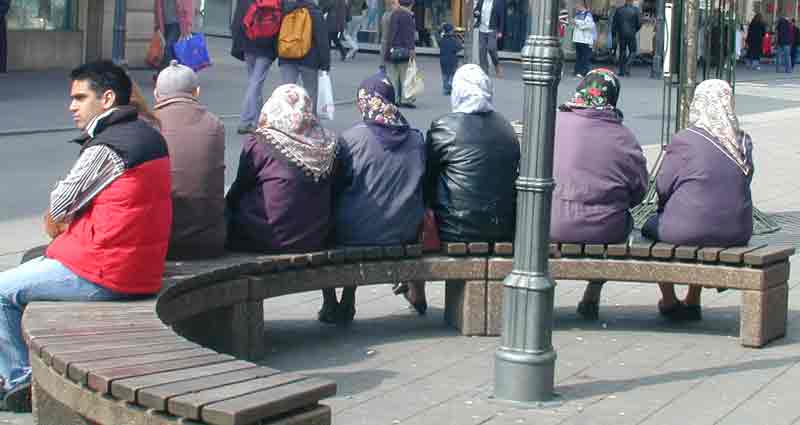
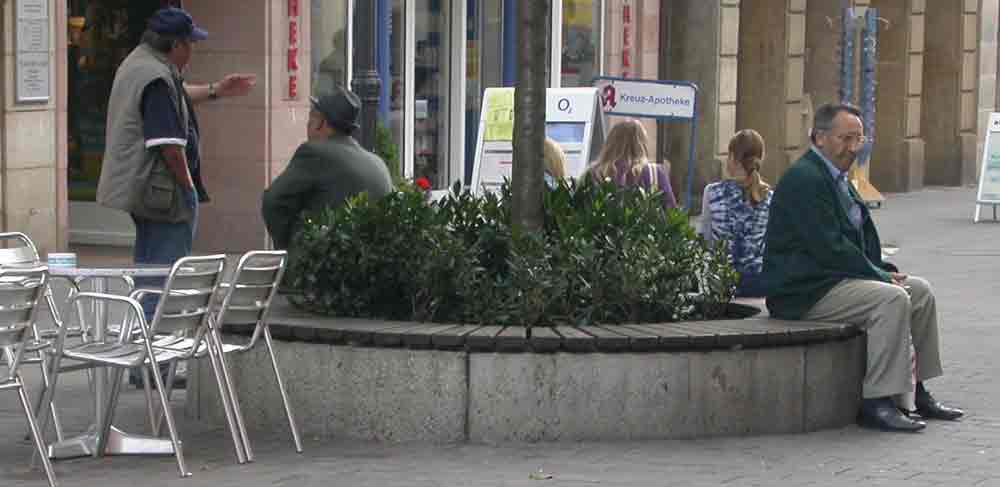
Mindestens die Hälfte hat die Stadt (under der CSU) aber vor zwei Jahren entfernt. Schilder mit durchgestrichenem Fußball erschienen auch.
Two years ago, the local government under the CSU removed at least half of these benches. They also put up signs with a crossed-out football.
Es wurde abends weniger Fußball gespielt. Der Lärm wurde aber nicht reduziert.
There was less football played, but the general noise level was unchanged.
Jetzt hat der Oberbürgermeister (jetzt SPD) “ganz unbürokratisch” (Zitat SPD-Unterschriftensammlerin) noch eine Bank entfernt. (Bilder hier, Site benutzt Frames).
Now the mayor (now SPD) has removed another bench “unbureaucratically” (according to a woman from the SPD collecting signatures). (Pictures here – site uses frames – English version available).
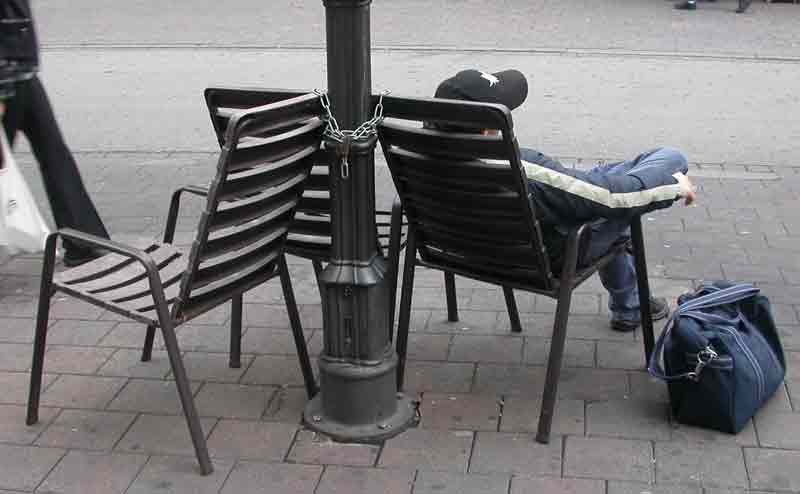
Die Grünen haben danach drei Stühle an eine Straßenlaterne gekettet.
The Green Party have now chained three chairs to a lamppost.
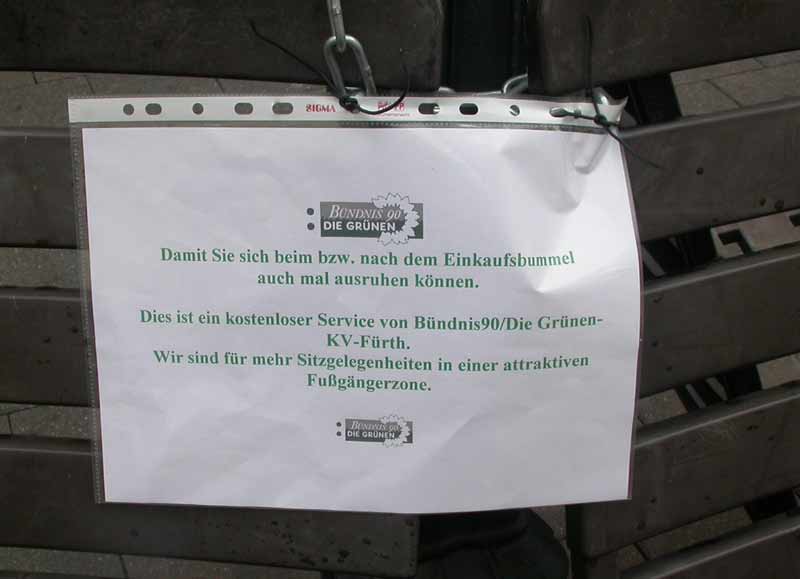
(Translation: So you can have a rest when youre shopping or afterwards.
This is a free service from Bündnis90/Die Grünen, local committee, Fürth
We support more seats in an attractive pedestrian zone.)
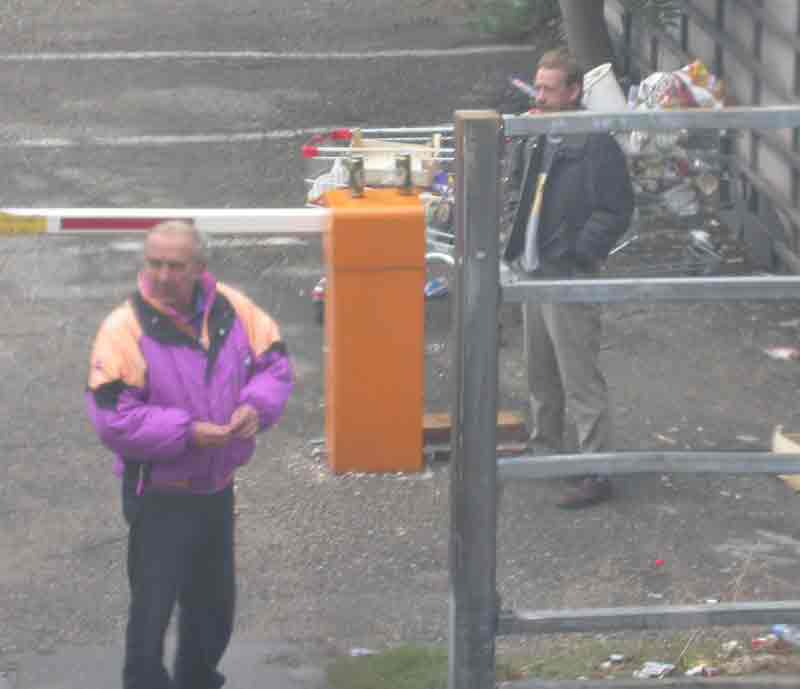
Die Biertrinker sind ganz unbürokratisch in den Parkplatz gezogen.
The beer drinkers have unbureaucratically moved into the car park.
I have already posted (here and here) that the German courts do not like to count spaces when they pay translators, and one of their arguments is that spaces are not meaningful. As I said, some translators say they will deliver a text without spaces.
Languagehat provides proof of the significance of spaces: no matter how jumbled the letters in a word are, as long as you break them up into words of the same length as the original, it’s fairly easy to follow:
‘Aoccdrnig to a rscheearch at an Elingsh uinervtisy, …’
The Süddeutsche Zeitung reports (as do many other papers) that Theo Müller is going to leave Germany for Switzerland, in order to avoid inheritance tax when he leaves his business to his children. The business is a family business, Müller Milch, that has done very well – it’s well known in Britain for Müllerice, Müllerlite and its TV advertising, slightly different from the German ads. To quote the English site:
bq. It’s a fair bet that when yogurt loving Ludwig Müller first established his little Bavarian village dairy back in 1896, he could scarcely have imagined the staggering success it was to become. For today his grandson, Theo, runs a business which last year turned over £625 million and employed 2,400 people.
It’s not only Germany that makes it expensive to leave a company to heirs. But Switzerland, Austria and Italy don’t charge inheritance tax in this situation.
The German inheritance tax system is being challenged in the courts as unconstitutional. If it is changed, it will be even harder on companies than it is today, when companies are treated more favourably than individuals.
Here’s an article in English about the owner of the Stollwerck chocolate company.
Delia Venables mentions a website at the University of Genoa Law Faculty called Legal Links in the Web. The project is supervised by Professor Maurizio Lupoi.
bq. It says that “a group of law students search the World Wide Web continuously for new sites and maintains the database in proper shape.” You can start with just about any country and then drill down to the main legal resources.
It is worth searching. I immediately found the Südtiroler Bürgernetz (having been translating some stuff from that area) and its law links. But there are also 182 taxation links. I have not spent long enough here to understand the organization of the site, but it looks as if there are internal links so you can reach links by more than one path.