Local elections in Bavaria

I won’t be posting much for the next week, in particular not for the next three days, and I haven’t taken up all the comments made recently (there’s even one on entry 204…)

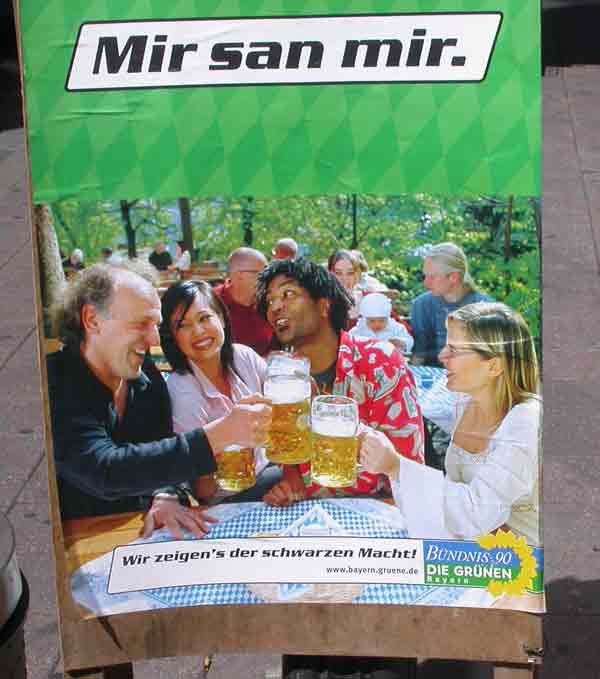
Meanwhile, the campaigns for the upcoming Bavarian elections are heating up. Here are two posters from the Green Party, while I wait for the general defacing of the more serious-looking posters.

greens1w.jpg

greens2w.jpg

Adams / Böttcher: Meaning of Liff / Sinn des Labenz

I had forgotten The Meaning of Liff / Der Sinn des Labenz, although I have them on the bookshelf. There are links at the Strong German Verbs website to them (mentioned recently).

Douglas Adams, after Hitchhiker’s Guide, wrote, with John Lloyd, The Meaning of Liff, a dictionary consisting of definitions lacking a word. To each of these definitions he attached a real, but underused, place name. The Deeper Meaning of Liff is an enlarged version:

Does the sensation of Tingrith make you yelp? Do you bend sympathetically when you see someone Ahenny? Can you deal with a Naugatuck without causing a Toronto? Will you suffer from Kettering this summer? Probably. You are almost certainly familiar with all these experiences, but just didn’t know that there are words for them. Well, in fact, there aren’t – or rather there weren’t, until Douglas Adams and John Lloyd decided to plug these egregious linguistic lacunae by getting a few beers and a notebook and sitting on the beach for a couple of weeks. They quickly realised that just as there are an awful lot of experiences that no one has a name for, so there are a lot of awful names if places you will never need to go to.


Sven Böttcher
translated the book into German, using German place names instead of British ones. There are websites where volunteers can add new terms to the English and German versions.

The German version is still in print, and it contains the full English version.

Here’s an example:

English: Dewlish (adj.) (Of the hand and feet.) Prunelike after an overlong bath.

German: Rosien (Adj.) Gleichzeitig feucht und verschrumpelt wirkend. Beschreibt das trockenobstartige Aussehen von Händen und Füßen nach einem zu langen Badenwannenaufenthalt.

Diplom-Jurist

Rainer Langenhan in Handakte WebLAWg has an entry on the Diplom-Jurist. The link to JuraWiki gives a list of German universities offering this qualification.
(While there, try out QuickTrans – mark a word and QuickTrans will call up a number of possibilities from LEO. Well, it didn’t like anhängig (pending) or bayernweit (throughout the whole of Bavaria), but for Entscheidung (decision) it produced:

bq. german-english translation of Entscheidung: adjudication, arbitration, decision
frank-deu-eng translation of Entscheidung: decision, findings, run (C)
ding-ger-eng translation of Entscheidung: adjudication, arbitration, decision, decision-making

Law students study for four or five years (?) and do the first state exam (Erstes Staatsexamen). After this they used to have no title, but some universities now let them call themselves Diplom-Jurist or Magister iuris.

These titles aren’t translatable, but the German terms could be alternated with a looser reference to ‘Diploma in Law’ and ‘Master of Law’, I offer tentatively. (Or laws? I used to think that it was just common-law, but there is a Magister Legum in German law, so maybe that’s OK).

Here are some other words for lawyers in Germany, offered without any translation at all!

Anwalt Rechtsanwalt Syndikus Jurist Richter Rechtspfleger Rechtsbeistand Notar Prozeßbevollmächtigter Advokat Rechtsberater Verteidiger Strafverteidiger Staatsanwalt Amtsanwalt Referendar Volljurist Assessor Wirtschaftsjurist
Fürsprech Fürsprecher
Winkeladvokat Gerichtsschreiber

ADÜ-Nord Infoblatt

The ADÜ-Nord, one of the German associations for translators and interpreters, has a lot of useful information (in German) on its website. The bulletin, Infoblatt, has just appeared. This and older issues (pre-2003 in the archives) can be downloaded.

Among the interesting items in this issue are an article by a tax accountant on how Gewerbesteuer (trade tax / local business tax) will affect translators if it is imposed, with some calculations to show the effects, and an article on the payment of interpreters by the Bremen courts. The Bremen courts take the view, apparently, that they can enter into framework / outline agreements (Rahmenverträge) with agencies undercutting the lowest statutory payment rate. Copies of correspondence are given. The practice of having a basic agreement of this kind is apparently spreading.

There is also a reprint of a review I wrote for the MDÜ, the journal of the BDÜ, of a book by Dieter Stummel, Standardvertragsmuster zu Handels- und Gesellschaftsrecht Deutsch-Englisch. They liked my last sentence so much they put it in bold. I believe Dieter Stummel works for Burger King in Munich. Without any sources or bibliography, he presents not-quite-perfect English versions of a huge range of contracts (but with no CD-ROM – perhaps just as well). People should be really really careful before relying on a book like this.

Another German translators’ and interpreters’s society, Aticom, has a list of new publications and some reviews (German).

And there’s a list of journals, both in print and online, for translators at Alexander von Obert’s Übersetzerportal.

Man forbidden to use word

Isabella Massardo reports that a man in Manchester has been forbidden by magistrates to use the word ‘Paki’ (i.e. Pakistani; quoting the Guardian and the Independent – BBC News has it too). Under the terms of an anti-social behaviour order, he will go to prison if he uses the word in public. This is the first such order of its kind, apparently. The Independent quotes Liberty, the human rights organiization, as describing this as bad law, because it is ‘almost impossible to enforce’ (presumably hard to monitor rather than to enforce).

The prosecutor was Manchester City Council. An anti-social behaviour order was new to me. It is also referred to as an ASBO. (It sounds like the opposite of what is intended – should it not be an Anti-Antisocial Behaviour Order?) There are some statistics here, from April 1, 1999, when they were first introduced – Greater Manchester certainly seems fond of them. And here is information from the Home Office.

Murder in the Italian Alps

Slashdot (who also gives a link to the original story of the finding of Ötzi) quotes Yahoo News on the discovery that Ötzi was killed in a fight lasting two days. DNA from four different people has been found on the body.

bq. Otzi’s naturally mummified body, the oldest found so far, became a worldwide sensation in 1991 after two Austrian mountain climbers saw it in a thawing glacier at 10,500 feet on the Hauslabjoch Alpine pass at the Italian/Austria border.

Tut, tut, Yahoo, not Austrians but a couple from Nuremberg. We inhabitants of Franconia must stand up for each other.

‘Alois Pirpamer, one of the climbers who found Otzi …’ – Hm, has the Fürther Nachrichten been telling lies? But no, BBC News in February 2002 (nice pictures) rescues us: ‘German hikers Erika and Helmut Simon describe the moment they discovered our best window on the Stone Age.’

At all events, with the ice in the Alps melting fast, there’s going to be a search for new bodies on Sunday. But whatever the limitation rules, if this was a murder, it predates the jurisdictions involved.

I thought there had been a court case relating to a finder’s reward.. The Simons were going to sue South Tyrol for 250,000 euros – they were offered first 5,000, then 28,000. And BerlinOnline some time ago gave the reason for the reluctance of the government of South Tyrol: with the ice thawing, they suspect more bodies will come to light and this won’t be the last such claim.

Finally, here is Ötzi’s new home.