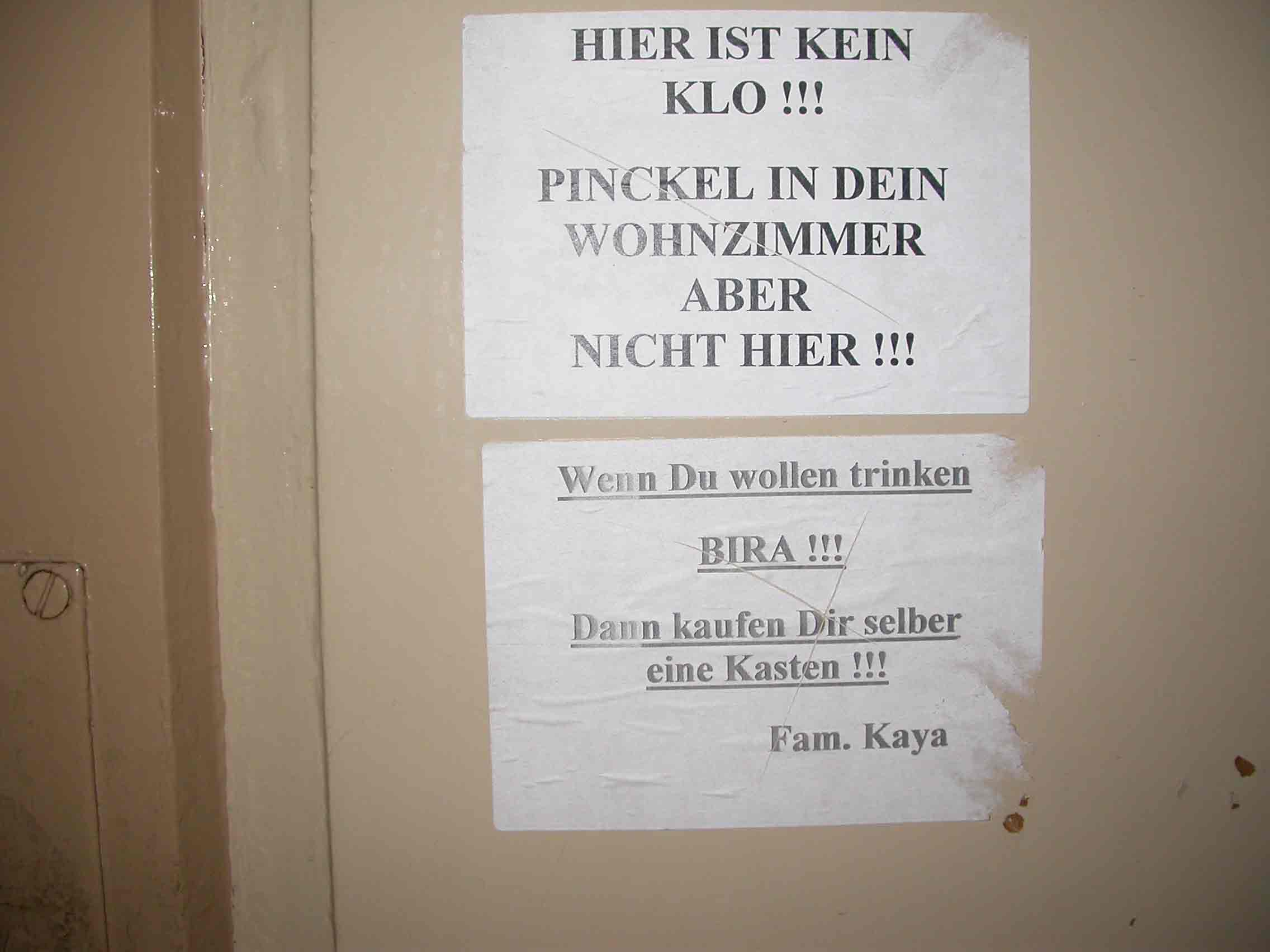
MT / MÜ Auschwitzlüge case

Professor Lenz mentioned a discussion of a German case:

bq. Today the Criminal Law Society of Japan held a workshop I attended. We discussed German law, the decision of the Federal Court of Justice of December 2000 that said Australian citizens need to obey German penal law when posting on a website in Australia, in English.

I thought there might be discussions of this case in English on the Web. I haven’t got time to translate it myself at the moment, but I did find a machine translation of it – machine translation is useful only to give a rough impression of a newspaper article or website, but a decision by the German Federal Court of Justice? Here is a quote, for the benefit of any lawyers who think they should jazz up their websites by the addition of machine translations into several languages:

bq. Guiding principle

bq. If a foreigner places to expressions written by him, which fulfill the facts of the incitement of the masses in the sense § to 130 exp. of the 1 or § 130 exp. the 3 StGB (“Auschwitzluege “, on a foreign server into the InterNet, which is
accessible to InterNet users in Germany, then a success belonging to the facts
steps (§ 9 exp. 1 3. Alternative StGB) in the inland, if these expressions are
concretely for the disturbance of the peace in the inland suitable. Continue reading

Neudeutsch/Denglish

German uses more and more English words, sometimes inevitably, sometimes irritatingly, sometimes both. Especially when it talks about computers. This is sometimes called Neudeutsch (in German) or Denglish (vocabulary list). But with the Americanization of the German law firms, and with international mergers, perhaps, there are more and more anglicisms in the law.

Perhaps it’s particularly rife in the glossy magazines for young lawyers, which appeared in Germany slightly later than in Britain, I think. Juve publishes a Handbuch Wirtschaftskanzleien (also in English: Handbook [sic] for US clients: German Commercial Law Firms) and also a periodical for law students looking for jobs with law firms called azur. Continue reading

Neudeutsch/Denglish

German uses more and more English words, sometimes inevitably, sometimes irritatingly, sometimes both. Especially when it talks about computers. This is sometimes called Neudeutsch (in German) or Denglish (vocabulary list). But with the Americanization of the German law firms, and with international mergers, perhaps, there are more and more anglicisms in the law.

Perhaps it’s particularly rife in the glossy magazines for young lawyers, which appeared in Germany slightly later than in Britain, I think. Juve publishes a Handbuch Wirtschaftskanzleien (also in English: Handbook [sic] for US clients: German Commercial Law Firms) and also a periodical for law students looking for jobs with law firms called azur. Continue reading

Structure of statutes/ Aufbau der Rechtsakte

The EU has diagrams with vocabulary on titles, subtitles, chapters etc. of legal instruments, in both English and German.
This applies only within the EU context. Outside that, the situation is much more complex.

Die EU hat Tabellen mit Wortschatz zu den Bestandteilen der Rechtsakte: Titel, Untertitel, Kapitel usw., auf Deutsch und Englisch.
Sie beziehen sich auf EU-Dokumente; außerhalb der EU ist die Situation komplizierter für Übersetzer. Continue reading

Structure of statutes/ Aufbau der Rechtsakte

The EU has diagrams with vocabulary on titles, subtitles, chapters etc. of legal instruments, in both English and German.
This applies only within the EU context. Outside that, the situation is much more complex.

Die EU hat Tabellen mit Wortschatz zu den Bestandteilen der Rechtsakte: Titel, Untertitel, Kapitel usw., auf Deutsch und Englisch.
Sie beziehen sich auf EU-Dokumente; außerhalb der EU ist die Situation komplizierter für Übersetzer. Continue reading

Human discourse in product reviews

Via Marshall Fuss in alt.coffee (on Usenet), an article in The Onion finds that the majority of human discourse now occurs in online product reviews.

‘Duke sociology professor and study head Dr. Allan Piersall’ said, inter alia:

bq. “Not only was I impressed by the large number of people expressing themselves through the written word, but I was amazed by the sophistication of the rhetoric,” Piersall said. “In the same review, I saw examples of parallel construction, metaphor, and tautology, as well as standard debate devices like propositions of policy and use of evidence—all to support the argument that the Krups 872-42 Bravo Plus Espresso Maker is not worth the money.”