
Plums, damsons, Zwetschgen and peaches

I know fruit and vegetable terminology is really confusing. We have a Polyglot Vegetarian, but where is the polyglot fruitarian?

For years I have known that Zwetschge is difficult to translate into English. The standard exemplar is sweet and can be eaten raw. It is commonly translated as damson because of its small size. But a damson is small and sour, and makes good jam. I suppose the best English translation is zwetsche (the G got lost, but it just indicates a diminutive). One also encounters damson plum, but I don’t know if that helps. And some people even throw the term prune into the mix.

But it seems I failed to define Zwetschge properly. I was thinking of taking some back to England for the neighbours, but I gradually realized that what I was seeing in the market as Zwetschgen were what I would call plums.

Yesterday at the market, at an organic veg stall with two types of Zwetschge, I was told that in everyday German, Pflaumen are round and Zwetschgen are oval!

Now I know that Californian plums are round, but Victoria plums are longish. But this is rubbish.

So no Zwetschgen for my neighbours in England. They would wonder why I was bringing plums all that way.

To be fair, I was told there are masses of different Zwetschgen.

Curiously, the Wikipedia entry for Pflaume does not link to plum, but to Prunus domestica. Perhaps that’s why Frau Albrecht was selling both Zwetschgen and Hauszwetschgen.

P. domestica ssp. domestica – common plums, zwetschge (including ssp. oeconomica)
P. domestica ssp. insititia – damsons and bullaces, krieche, kroosjes, perdrigon and other European varieties
P. domestica ssp. intermedia – egg plums (including Victoria plum)
P. domestica ssp. italica – gages (greengages, round plums etc.; including sspp. claudiana and rotunda)
P. domestica ssp. pomariorum – spilling
P. domestica ssp. prisca – zibarte
P. domestica ssp. syriaca – mirabelle plums

Zwetschge (Prunus domestica subsp. domestica)
Kriechen-Pflaume oder Hafer-Pflaume (Prunus domestica subsp. insititia)
Halbzwetsche (Prunus domestica subsp. intermedia)
Edel-Pflaume (Prunus domestica subsp. italica)
Spilling (Prunus domestica subsp. pomariorum)
Ziparte (Prunus domestica subsp. prisca)
Mirabelle (Prunus domestica subsp. syriaca)

In other news, I encountered the Roter Weinbergpfirsich.

It was sold as a Blutpfirsich.

Up to then I thought Weinbergpfirsich (vineyard peach) just referred to those flat peaches that have become so fashionable (Plattpfirsiche). But I was told that was not so – the term properly (if such a thing exists in fruit terminology) refers to old garden peaches that have furry skins and don’t keep well. I got some yellow ones too, but I have now eaten them, and I’ve converted the red ones into compote.
Leading decision/Grundsatzentscheidung

It’s been widely reported today that Haribo (which markets a sweet called Goldbär – gold bear) won in a case against Lindt Sprüngli, which has been introducing a gold-foil-wrapped bear for Christmas. The court in Cologne held that people would refer to the Lindt product as ‘gold bear’, thus diluting the mark into which Haribo has pumped huge amounts of money in advertising. (No, commenters, the court did not say that people could not tell the difference between a ‘gummy bear’ and a chocolate bear). Die Welt (German):

Denn die meisten Verbraucher werden laut Gericht den “Lindt Teddy” naheliegenderweise und ungezwungen als “Goldbären” bezeichnen – und eben nicht als Teddy”, “goldene Bärenfigur”, “goldfoliierten Bär” oder als “goldfarbenen Schokoladenteddybär”.

Haribo konnte auf die Umfrage eines unabhängigen Meinungsforschungsinstituts verweisen: 95 Prozent der Verbraucher würden die traditionsreiche Wort-Bildmarke “Goldbär” kennen.

The Local (English):

But the judges said that shoppers were likely to refer to the Lindt product as a “Gold Bear” because of its appearance and thus dilute the Haribo brand.

“Most consumers would not use descriptions such as ‘golden bear figure’, ‘gold foil-wrapped bear’ or ‘gold-coloured chocolate teddy bear’… but rather the closest description, particularly considering how well-known the other brand is: Gold Bear,” it said in a statement.

The decision isn’t final – Lindt will be appealing. It was commented that this particular point of law – whether a word mark can be diluted by the appearance of another mark – has not been decided by the highest courts (höchstrichterlich), or that there has not been a fundamental decision (Grundsatzentscheidung).

Die Welt:

Eine höchstrichterliche Rechtssprechung gebe es zu einer solchen Kollision nämlich noch nicht, erklärte das Kölner Landgericht.

The Local:

“What is special about the case is that there has been no high court ruling on the issue of a collision between a brand name and a three-dimensional product design,” it said.

That is very American. It’s common in the USA to refer to the Supreme Court as the ‘high court’.

I’m not sure if the highest court here would be the Bundesgerichtshof or the Bundespatentgericht. At all events, to call such a decision a ‘landmark decision’ would not be correct. What is meant is a binding decision – not that Germany has an official system of precedent, but in practice it seems like that. A landmark decision is one that makes the news in a big way.

LATER NOTE: Guardian article – with mug shots of the two bears.

The Lost German Slave Girl/Eine Deutsche als Sklavin in Louisiana?

Here is yet another gratuitous book report.

The Lost German Slave Girl. The Extraordinary True Story of Sally Miller and Her Fight for Freedom in Old New Orleans, by John Bailey, Atlantic Monthly Press 2003

This book was a present from my friend and fellow-translator Karen in Denver (thanks, Karen!). I read it quite a few weeks ago, so my report is rather vague now.

John Bailey is an Australian lawyer who has now turned to writing, and he discovered this story when he was researching the details of law relating to slavery in Louisiana. Sally Miller was the ‘lost German slave girl’, who won a case freeing her from slavery because a person who was Caucasian could not be a slave. It’s a fascinating story and it throws some light on the situation of slaves who could not be freed from slavery. There’s also a fair amount about the circumstances in which the Müller family from the Alsace emigrated to the USA, following years of pillaging by French troops, bad harvests and ice in summer (apparently resulting from volcanic eruptions in the West Indies, the Philippines and Indonesia from 1813-1816 – so tonight I will be watching the arte documentary on ‘The year without a summer’).

From an interview with John Bailey:

My plans unraveled, when one day, in the quiet corner of a law library on a university campus in Louisiana, as I struggled to bring some semblance of order to my unruly and ever expanding manuscript, I opened a volume of the Louisiana law reports for 1845. There I met Sally Miller, the Lost German Slave Girl. I was immediately enthralled by her story. By the end of the day, I had shoved my notes on lawyers, judges and politicians into my bag, and opening a fresh page in my diary, had began to jot down ideas for an entirely different project – this one, on the saga of Sally Miller’s bid for freedom.

One feature of the book is that while it cloaks the story in mystery – the witnesses in the trial are obviously long dead – at the same time it often knows exactly what the weather was like or what the main characters were thinking. This is part of the genre ‘bringing history to life’, I think. For a long time I was convinced that I was never going to know anything more about the truth or falsity of the story, but in fact more information was revealed at the end, which made the end of the book more satisfying than I had expected.

A bit of research on the Internet revealed that the story has been told before. Curiously, there is a 2007 American book on the subject, which looks similar to Bailey’s: The two lives of Sally Miller: a Case of Mistaken Racial Identity in Antebellum New Orleans, by Carol Wilson. You can read quite a bit of this on Google Books.

The Guardian on Germany/Die Guardian zu Deutschland

A bit late this link, but this week the Guardian has started examining some European countries, starting with Germany – see neweurope. More detail here.

There seem to be more articles every day. I noted in particular some articles on German literature, with more suggestions in the comments (Join the new World literature tour to Germany). Then one on the life of a German family:

Back home, Gerrit opens some lovely Hassaröder Pils beer, while Katleen, in a rare lapse of taste, drinks Beck’s. They put on a CD by a German R&B singer called Joy Denalane. To my ears, it sounds as authentically uninteresting as its English-language counterpartsz. “For me, one of the great things about the past year is that German-language music is becoming popular,” says Gerrit. Fair enough, but the current German top 10 is all in English, even when the songs are sung by Germans.

On the kitchen shelves, there’s a nostalgic East German cookbook, teeming with pictures of men in feather cuts at the wheels of Trabants, and recipes so stolid that subsisting on them would make you look more like Helmut Kohl than a member of the DDR’s gymnastic team.

There’s a hisory of German cinema in clips (including a very long clip, nearly two hours long, from Leni Riefenstahl’s ‘Olympia’ – presumably the whole film – Jesse Owens in first heat at just after 38 mins.), on the war against anglicisms
, on the piecing together of shredded Stasi documents in Zirndorf, and an at-a-glance guide to Germany. And a lot more.

Coming soon, for one week each: France, Spain and Poland.

Beerbikes banned/BierBikes in Düsseldorf verboten

Bierbikes hadn’t really registered with me until the city of Düsseldorf banned them recently and the order was confirmed by the Düsseldorf administrative court on October 6.

Meter für Meter schiebt sich das eigentümliche Gefährt über die Straße. An der Theke des “Bierbikes” ist die Stimmung prächtig, bei den genervten Autofahrern dahinter ist sie auf dem Tiefpunkt. Ob feuchtfröhlicher Junggesellenabschied oder umweltfreundliche Stadtrundfahrt: In immer mehr deutschen Städten rollen sogenannte Bier- oder Partybikes. Nun hat Düsseldorf die 16-Sitzer verboten: Kein Betrieb ohne Sondergenehmigung – und die werde nicht erteilt, so sieht es die Stadtverwaltung. Das Düsseldorfer Verwaltungsgericht gab ihr Recht (Az: 16 K 6710/09).

The judgment only affects Düsseldorf, and it is not yet final and non-appealable (rechtskräftig) there, so they can still be used. The idea is that one allegedly sober man steers the vehicle while up to sixteen sit along the sides, peddling – make that pedalling – and imbibing.

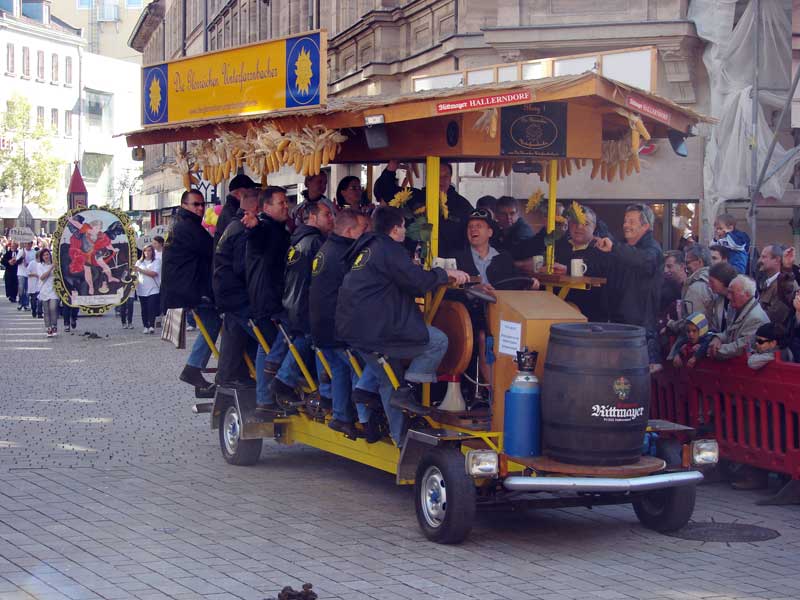
Here is a picture of one I took at the harvest festival procession yesterday (the following group represent the church of St. Michael):

The Guardian reported on the matter very promptly:

The bizarre contraptions hail from the Netherlands but are a particular hit in Germany, where they are offered to tourists in 34 different cities. Beer bikes, also known as “pedal pubs” or “mobile conference tables”, allow up to 16 drinkers to sit around a beer-barrel table, help themselves to on-tap beer, and listen to music while pedalling around the city. They are steered by a non-drinker employed by the operator. More than half of those who rent them are on stag parties.

The court in Düsseldorf issued the ban this morningafter complaints from other drivers about rowdiness. Complainants maintain that the bikes caused traffic jams, which intensified the longer a beer bike journey lasted – in effect, the more the revellers drank – and the more their pedal power tended to be reduced.