Court transcripts

How does stenotype work?
Here is a picture of a stenotype keyboard, and here is a definition of computer-aided transcription (CAT, which to me means computer-aided translation):

This is a stenotype machine producing paper notes. It simultaneously produces an electronic duplicate of what is contained on the paper notes. The electronic notes are fed directly into a computer that translates the notes into English. The reporter reviews and edits the translated material on the computer screen, then makes a direct printout of the transcript. The technology
greatly speeds the production of transcripts, while also making transcripts immediately available on disk for interested parties.

There is a picture of some steno machine output and description of it at this site for distance learning of court reporting.

Complete transcripts of court hearings are something you encounter in English and U.S. courts, but not in German courts. The O.J.Simpson trial showed a court where attorneys and judge saw the transcript on their computer screens almost in real time. And the Hutton Inquiry (investigating the death of David Kelly), as already mentioned, is using a lot of the latest technology.

The Times online (registration is free) has an article by Richard Susskind, who writes on IT matters, on the Hutton Enquiry technology.

It gives a link to www.livenote.com about transcriptions.

Lord Hutton and the eight legal teams have had continuous access to these transcripts and images of evidence in a court reminiscent of a Nasa control room, with 44 desktop flat screens and four large plasma screens.

The public has had remarkably open access to the transcripts and evidence through the inquiry’s website, designed and maintained by the Court Service and the Department for Constitutional Affairs … Since mid-August it has had, on average, 10,000 visitors a day.

Here is a transcript of Lord Hutton’s opening statement.

A few years ago it was hard to get transcripts. Now many are free at the www.bailii.org.uk site.
Here is a transcript of the case known as MacLibel, described as:

Transcribed from the stenotype notes of
Barnett Lenton & Company,
61 Carey Street, London WC2A 2JG
(Telephone 0171-405-2345)
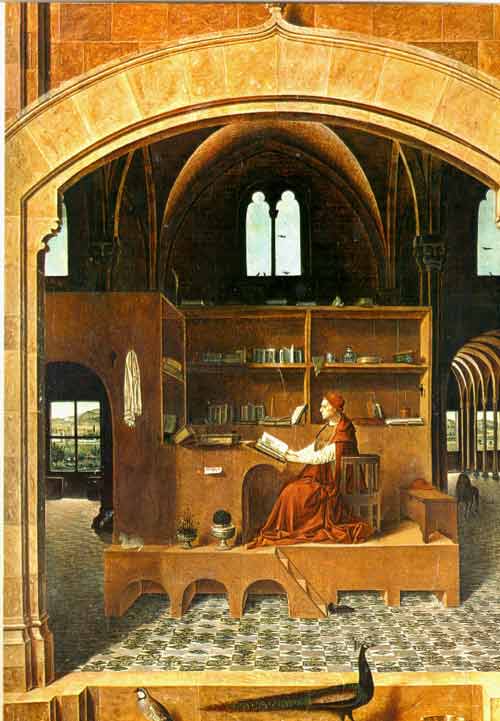
St. Jerome’s Day / St. Hieronymus

St.Jeromew.jpg

(Click to enlarge)
Painting by Antonello da Messina, Naples, 1460. Here’s an account of St. Jerome (Hieronymus) in German, and here in English. (At the latter site, the translators’ hall of fame seems thinly populated – only Jerome and Jean François Champollion, who deciphered the Rosetta Stone). I once had a copy of an old painting or woodcut showing Jerome making mousetraps, but I can’t find that.

U.S. Contracts Database

The Contracting and Organizations Research Institute at the University of Missouri has a searchable database of contracts:

bq. The CORI K-Base is a growing Knowledge Base of Contract information, featuring a library of executed contracts and contract forms for a wide array of transaction types and industries. Over 10,000 contracts can be accessed using our full-text search engine. First-time users must complete a free registration.

(Via LawSites). I haven’t investigated it any further. These databases can be useful if you’re translating a U.S. contract and you think there’s an error in it – then you search for the boilerplate and find similar examples, which usually throw light on what’s missing. Or alternatively, if you’re translating into American English, you can find standard boilerplate (I prefer not to adapt a translation too far to the target legal system, because it’s about German law, not English or American law, but where boilerplate is similar, I like to collect it). Google will also help if you enter apparently defective contract language – a clustering search engine will not be so useful here.

Open Day for Ancient Monuments / Tag des offenen Denkmals

This was on 21st September.
lochner1w.jpg
(all pictures: click to enlarge)

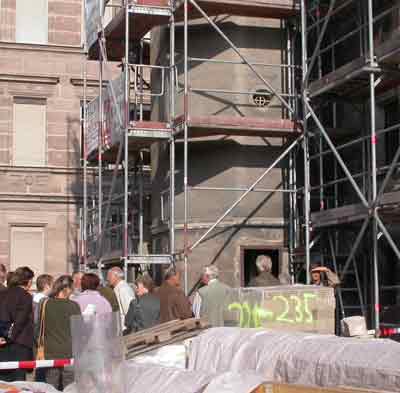
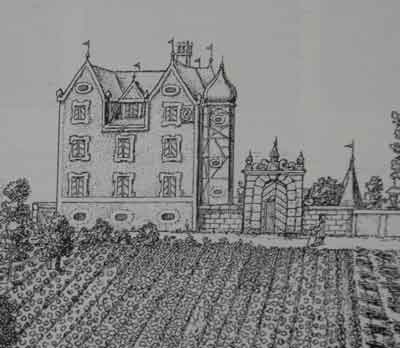
Das Lochnersche Gartenhaus – Daniel Lochner’s summer house (villa? manor house?)
When it was enlarged in 1700, it was surrounded by gardens and fields. Lochner was a priest who had two huge baroque gardens in Fürth. Now it’s surrounded by houses, but it is being restored (more like rebuilt).
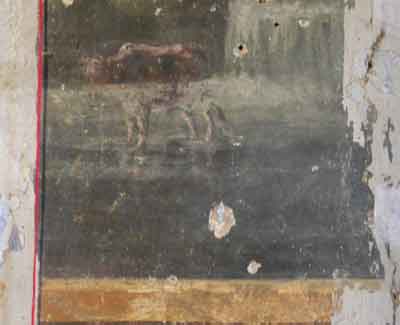
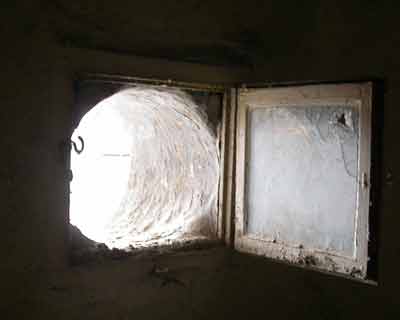
You can see the tower (onion dome to be replaced), one of the round tower windows from inside, and some wall painting from the second floor showing a cow (left) and a waterfall (right). In September 2004 it will be possible to see the walls after restoration.

lochner4w.jpg

coww.jpg

lukew.jpg
|

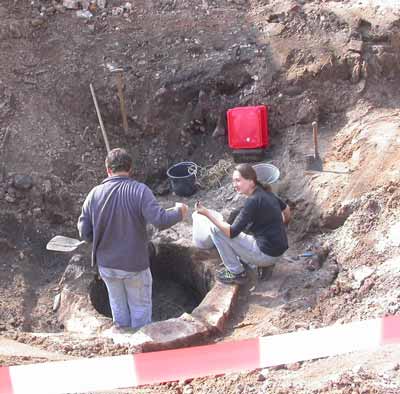
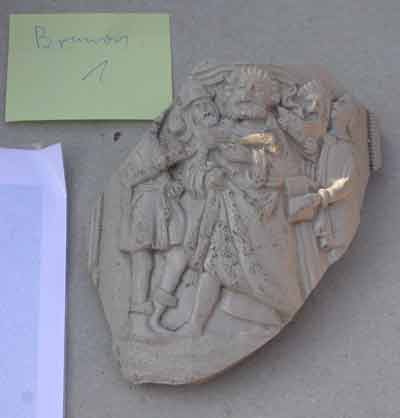
During excavations, the local archaeology group found two baroque wells. They were quickly investigated and some finds were shown in a glass case. After about ten days they were filled up again – the dig had reached an unpromising layer of sludge.

brunn3w.jpg

brunn1w.jpg

There is more (in German) at the site of the Altstadtverein.

The well is a Bodendenkmal. Romain’s law dictionary DE>EN has ancient monument found in the ground. It sounds a bit clumsy, but ancient monument is correct – the term normally refers to uninhabited structures and can include things like wells:

bq. By definition an ancient monument may be any building, structure or work (above or below ground), any cave or excavation, or the remains thereof; also included are sites comprising vehicles, vessels or aircraft. A schedule of such monuments is drawn up and maintained by the Secretary of State for the Environment.

Listed buildings tend to be inhabited. Other vocabulary: preservation order, conservation area, building preservation notice.

The German Länder (states) have Acts for the protection of ancient monuments (Denkmalschutzgesetze). They define Baudenkmäler (buildings), Bodendenkmäler (found in the ground), and bewegliche Denkmäler (hmm – movables).

And then there are Ensembles – can they be called ensembles in English? – groups of buildings that form a whole.

Colemanballs – sports commentators’ goofs

Re-reading this sentence from a September 26 entry:

And former Liverpool legend Ian Rush revealed a possibly flawed adaptation strategy at his new club Juventus when he bemoaned the fact that ‘living in Italy was like living in a foreign country’.

I thought to myself: Ian Rush could become a football (soccer) commentator. I was thinking of the Private Eye Colemanballs column, named after the BBC sports commentator David Coleman, who was famous for making slips. Colemanballs quotes don’t have to be by David Coleman, nor even by sports commentators. There were a number of little books of Colemanballs published.

Now, researching the subject on the Internet, I find a number of collections. A Wikipedia entry defines it, and reminds me of Yogi Berra, the U.S. equivalent. Wikipedia links to an entry on damaging quotations, which means Bushisms, Quayleisms and the like.

Here’s one Colemanballs collection. I’m not sure if there’s any copyright in these – really, Private Eye collected some of them. It begins:

“And here’s Moses Kiptanui – the 19 year old Kenyan, who turned 20 a few weeks ago” (David Coleman)
“Its a great advantage to be able to hurdle with both legs”
“And with an alphabetical irony, Nigeria follows New Zealand”
“There’s going to be a real ding-dong when the bell goes.”

And this one seems slightly out of place, but returns to the topic of British football players abroad:

“I was shocked when I was first introduced to the fans because they brought out a sheep, cut its head off and then smeared blood over my forehead” – Manchester United’s Ronnie Johnsen on life with Besiktas, Turkey