Inter alia links to a page on the Top Ten Best Court Website Awards. Nine sites are U.S., one is in Singapore.
Ten best law websites
Reply

Inter alia links to a page on the Top Ten Best Court Website Awards. Nine sites are U.S., one is in Singapore.
I was linked recently by a site called Wordlab, which has a number of programs to invent brand names and other names. It describes itself as ‘Free naming and branding resources’.
The masters of this site hide behind somewhat whimsical names themselves and described me as a schwarzenblawger. I was going to tell them I am Caucasian and don’t know Arnie, but I discovered this was just a combination of wordplay and unfamiliarity with the word blawg (= law blog).
As far as I can tell, the naming tools don’t allow user input, so naming is more of a game – but free. There is a board, on which for example someone wants suggestions for a name for a Punjabi Indian takeaway – among suggestions are the following: Papa Dom’s, The Ideal Naan, Golly Ghee, Tandoor Loving Care, My Bonnie Lassi, and Aloo To You. There are various other resources and excellent links. Obviously there are related paid services – for example, there is a link to Igor Naming and Branding Consultants, ‘co-founded by Wordlab’s very own Snark’.
Another link is to Nametrade, which has useful information on how to create names, such as a list of naming techniques.
Via this, the buzzkiller. net site shows ‘corporate PR speak’. Under Tabla Razza, for instance, there is a table showing Buzzword or phrase (e.g. zero-footprint), As In (We’re a zero-footprint company), What They’re Trying to Say (Our company rents space from a data center), and What They’re Really Saying (We’ve just discovered a cool new term to use when we admit that we can’t really afford to rent our own office.) There’s also a Hall of Shame and an (occasional) blog.
Geoffrey Nunberg’s site was also new to me, although I recognize a number of links. I knew his name and that he was a professor of linguistics – I see he has written a number of pieces on language and law, which I shall probably come back to.

I want one of these hats for Fasching/carnival. Mind you, there isn’t much tolerance here for unusual costumes.
In 1996, an art dealer phoned the director of the Berlin museum of archaeology and early history and offered him an object for 1.5 million DM. The photo showed something the museum eventually decided to buy, when they discovered it wasn’t a fake: the fourth golden cone or hat ever to be unearthed: Bronze age artifacts had been found in Avanton, Schifferstadt and Ezelsdorf. The site where the fourth hat was found is unknown – see the earlier entry on treasure trove law in Germany.
Since the 1996 discovery, it’s been possible to interpret these cones as the hats of some kind of priest or wizard, and the symbols on them relate to the sun cult. The hats are all of paper-thin gold and originally had brims. The exhibition at the Germanisches Nationalmuseum in Nuremberg unfortunately finished yesterday, so this link may not remain: it has pictures of all four cones.
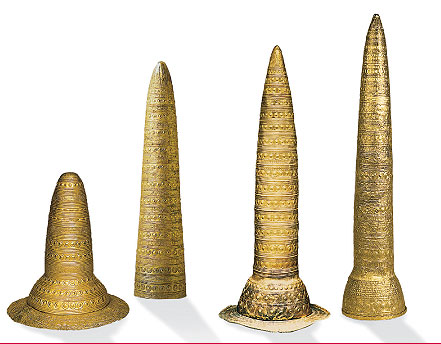
And here is an article in German about them, and an English-language press release from the museum.
The exhibition was in a darkened room with a spiral path leading onwards and upwards to the four cones. There was a video showing reconstructions of Bronze Age life, and bizarre improvisions on the lur (German Lure), a mysterious Bronze Age horn-like instrument played by one Joachim Schween, a musical archaeologist who appropriately lives in Hameln (Hamelin). An excellent exhibition.
Picture of the lure and small audio clip of fruitier tones than Professor Schween produced.
Bronze Age links
Phluzein, an archaeology blog that doesn’t even touch on this subject but looks interesting.
A couple of days ago Enigmatic Mermaid published a photograph headed ‘A Tribute to the Linear Accelerator’. The photo shows a huge thing like an overgrown mobile phone in Alice Through the Looking Glass. Enig says this is what she translates about most of the time. This picture is haunting me. I know other technical translators who have also become experts in some complex program or piece of equipment. Fascinating.
I just received a new dictionary list for 2003/2004 from Kater Verlag. However, the list can be consulted just as well online. Especially for anyone outside Germany, who may not even want to order from Kater Verlag, the great thing about the list online is that you can see a couple of pages of each dictionary. You select the book you are interested in and click on Entscheidungshilfe (decision help). Here should be a two-page spread from the monolingual German police dictionary. I will look here again when the new Gelbrich and Reinwaldt architecture dictionary (Bauwesen) DE>EN appears, and I can see how much it’s changed from the first edition, which I am very pleased with.
Grant and Cutler in London will send a page or two as a fax, however. Another dictionary seller is La Maison du Dictionnaire in France.
Whats the position of treasure trove in German law? Its a bit strange. There are rules in the Civil Code relating to Schatzfund (section 984).
Wird eine Sache, die so lange verborgen gelegen hat, daß der Eigentümer nicht mehr zu ermitteln ist (Schatz), entdeckt und infolge der Entdeckung in Besitz genommen, so wird das Eigentum zur Hälfte von dem Entdecker, zur Hälfte von dem Eigentümer der Sache erworben, in welcher der Schatz verborgen war.
If a thing is discovered which has remained hidden so long that the owner can no longer be ascertained (treasure), and it is taken in to [sic] possession as a result of the discovery, one half of the ownership is acquired by the discoverer, and the other half by the owner of the property in which the treasure was hidden.
The definition here is very broad. It is just necessary for something to have been hidden (as opposed to lost) for it to be treasure trove. I suppose no-one would take legal action if they find a secret chewing gum cache, though. The division into two halves goes back to Emperor Hadrian.
However, this Civil Code section is rarely applied, because there is something in Land law called Schatzregal, and the Länder also have rules governing the kind of treasure that ends up in museums – I suppose because cultural and educational affairs and thus museums are the matter of the Länder.
Schatzregal has nothing to do with bookcases, as I used to think. There are two words Regal in German, with different etymologies. One means a bookcase, and the other means a sovereign right, usually with some economic value, originally a right of the king or local rules and later a right of the state. This word is related to the English adjective regal. The big Muret-Sanders (Langenscheidt) dictionary translates it as regale, regality, royal prerogative, royalty. Walker’s Oxford Companion to Law says that treasure trove belongs ‘by prerogative right’ to the Crown. The OED doesn’t confirm this meaning of regale; it’s just possible that ‘regalities’ would work, but I think ‘prerogative’ is more widely known. Apparently in the 13th-c. Sachsenspiegel, every treasure that lies deeper in the earth than a plough reaches belongs to the king (see a useful review of a book on the topic, in German, with links).
If something is defined as a Kulturdenkmal (historical monument, but this includes movable property), then Land law will govern. It varies in its definitions and in its results. I have the impression that Schatzregal does not apply in Bavaria and that in Länder where it does apply, treasure trove goes to the Land government without compensation.