Christmas markets

There is an interesting Christmas market in the old town in Fürth, but it hasn’t started yet.

altstadtww.jpg

However, the Nuremberg Christkindlsmarkt (Christchild market) did open on Friday. It can be seen here (German and English). It starts with a teenage schoolgirl dressed up as a sort of angel, called the Christkind but rather too old for swaddling clothes, reciting a rather weak speech about the Christmas spirit. (Why not have a boy for once?). She doesn’t have to go to school for the next few weeks but has various official duties. Here is an excerpt in German and translation from the website (translation NOT by me!):

bq. In jedem Jahr, vier Wochen vor der Zeit,
Da man den Christbaum schmückt und sich aufs Feiern freut,
Ersteht auf diesem Platz, der Ahn hat´s schon gekannt,
Was Ihr hier seht, Christkindlesmarkt genannt.

bq. Dies Städtlein in der Stadt, aus Holz und Tuch gemacht,
So flüchtig, wie es scheint, in seiner kurzen Pracht,
Ist doch von Ewigkeit. Mein Markt bleibt immer jung,
Solang es Nürnberg gibt und die Erinnerung.

bq. In every year, four weeks before the time
When Christmas trees we decorate, and everyone awaits the feast,
Here on this square, just as of yore, this market does appear,
Which up and down the country they call Christmas Markt.
This little town is built from wood and canvas
Its splendour’s short, will soon be gone,
But yet it is eternal. My market is forever young,
As long as Nuremberg does exist, as long as you remember it.

The booths sell a restricted range of things: Christmas decorations, prune figures, mulled wine, toys. Apparently in the old days, many other things were sold, such as braces and shoelaces, but these were banned. I wonder if that was in 1933, which is the date when the Christkind’s Prologue and the market as it is today were created – part of the Third Reich propaganda of Nuremberg as the traditional city of German Christmas.

Meanwhile, there is a more everyday Christmas market in Fürth on the Fürther Freiheit. One presumably Christmassy touch is a pen with some sheep. They were soaking wet to the touch but didn’t seem disturbed by it.

220w.jpg

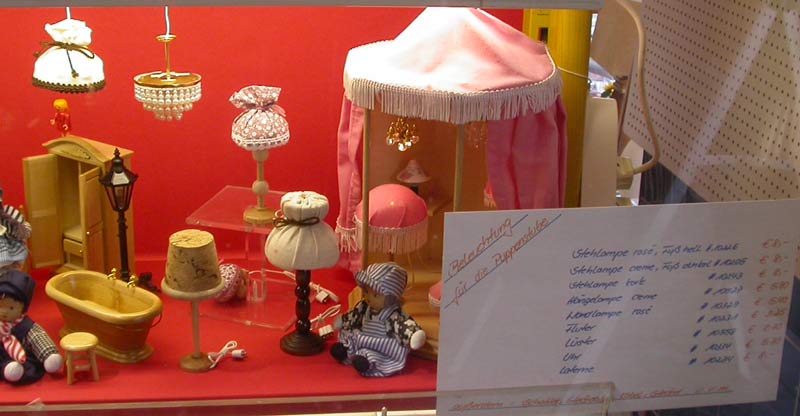
Electric lights for dolls’ houses

At Elektro Götz you can get electric lights for dolls’ houses that really work. I don’t know where you plug them in, though.

Elektro-Götz hat echte Elektro-Lampen für Puppenhäuser, allerdings braucht man noch eine Steckdose dazu.

dollshousew.jpg

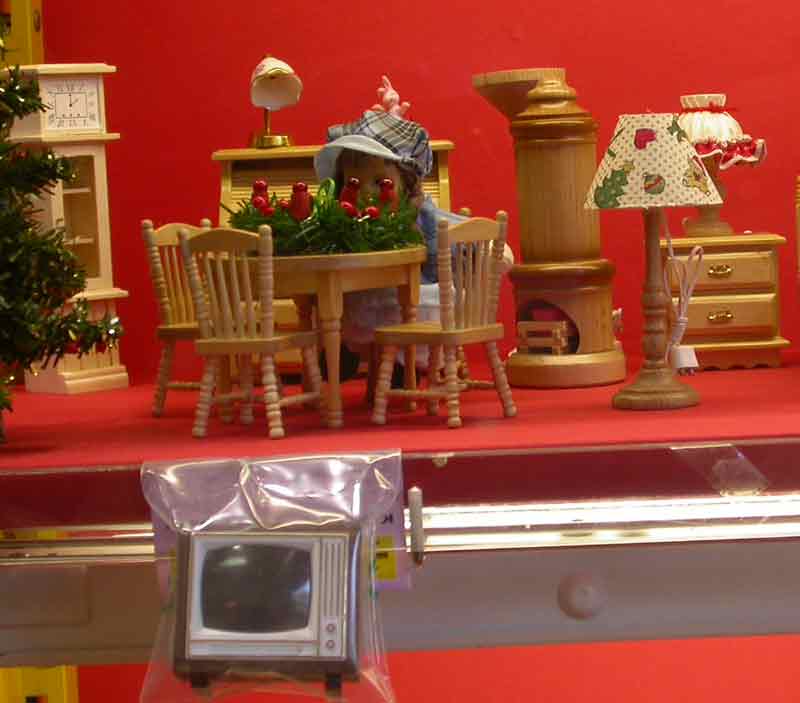
You can even get a TV, but I have a feeling it doesn’t work.
Der Fernseher funktioniert aber wahrscheinlich nicht.

tvw.jpg

An interpreter for the aborigines

bq. It was not without get regret, that I resolved on leaving the colony, because I had believed that my knowledge of the language and habits of the natives, acquired during my sojourning amongst them, might have led to my being employed by the local authorities during the rest of my life; but, when I reflected on the suspicion with which I was viewed by the most influential white men, and on the probable doubt the natives would entertain in my sincerity after having left them. I thought it best to retire to Van Diemen’s Land.

In 1802, when he was 20, William Buckley was sentenced to imprisonment for stealing a bolt of cloth. He escaped from imprisonment in Australia in 1803, and failing to find Sydney, he spent the next 33 years among the aborigines.

bq. In 1835 William Buckley appeared at the camp site of John Batman’s Port Phillip Association with a party of aboriginals who had told him about the sighting of a ship at Indented Heads.
He sat down. Waves of emotion swept over him. He felt weak and overwhelmed. How would he be received? He sweated with fear … He had his spears and hunting gear and wore possum skin clothing.
He had great difficulty being understood for he had forgotten his English language. Buckley could not understand their spoken English. He was offered bread. The word cleared a cloud from his brain. He understood further words. They tumbled over and over in his head as his native tongue came flooding back to him … The white men fed him and treated him with kindness. He showed them W.B. tattooed on his arm, and told them his story … [many inverted commas removed]

(from Australian Museums and Galleries Online by way of plep).
Here’s one of the pages, but the site is slow to load. Good contemporary illustrations. But it sounds as if Buckley had lost his A language…

Barman: passing the bar

I am a sucker for books like Scott Turow’s One L, as gripping as any thriller, on law school in the USA. So I finished Alex Wellen’s Barman recently.

Wellen doesn’t write about the first year of law school and the Socratic method – presumably One L and The Paper Chase have filled that slot.
He emphasizes that he studied at a ‘second-tier’ law school and concentrates on job searches, the bar exam and the first couple of years of employment in New York at an intellectual property firm (his first degree was in engineering). He has a weblog about tours to sell the book.

The book was a real page-turner most of the way through. The sections on job interviews (invidious questions you can only answer wrong, choosing what to wear) and the bar exam (with details of the kinds of question and the difficulties of answering) were the best for me, and the process of writing for law review, summer internship and starting work were informative. What I was less interested in was what seemed like a fair amount of fill-in: Wellen has a line in slapstick, extending to the behaviour of the washing machine on a backpacking holiday in Europe, and moving into a run-down New York loft entailing a spell of building labour before it was habitable.

I had heard of the Multistate Bar Exam (MBE) but never in detail. Wellen writes:

bq. In any jurisdiction across the United States, lighting a warehouse on fire would be considered arson, but under the law tested on the MBE, it wasn’t. This was the bar administrator’s attempt to level the playing field. By establishing a special set of laws, what I referred to as the “bar code,” nearly every law student … was theoretically on equal footing …
The bar code was an imaginary set of tens of thousands of outdated, antiquated laws that everyone needed to be familiar with for the single purpose of passing the bar. For most of us, the laws were inconsistent with anything we’d learned in school and would have no practical application when it came to practicing law.

That makes the book sound a lot drier than it is. You can read some at amazon.com. It’ll be off to ebay for mine soon though.

Another law book not so easy to classify that I need to re-read is Lawrence Joseph’s Lawyerland. What lawyers talk about when they talk about law. It’s a curious fly-on-the-wall look at, or rather listen to, New York lawyers.

Finally, the House of Butter reports a new genre: the Christian legal thriller.

bq. Charlotte based lawyer, Robert Whitlow, is working on his 5th Christian legal thriller. His last Life Support sold 35,000 copies and his 2001 novel, The Trial sold 90,000 copies.

Here’s the source:

bq. All his novels feature Southern lawyers grappling with faith and ethics. His overarching theme, he said, is that “God is real and wants to interact with us.”

Kafka would have been mystified. I wonder if I could create a genre of German legal thrillers where people with websites are targeted by lawyers suing them for not having an Impressum?

Problems of running a law blog in Germany

Decisions of the Nuremberg-Fürth Oberlandesgericht (higher regional court of appeal) in March 1999 and the Nuremberg-Fürth Landgericht (regional court of first instance) in May 2000 held that it was against the ethics of advertising for German lawyers to have guestbooks on their websites. The reason was because the majority of entries tended to be positive and therefore this was unfair to other lawyers.

It now seems that Udo Vetter, of the weblog law blog, may be sued by a colleague because he runs a weblog with a comments function and the weblog is linked to his firm’s website. He has published some correspondence on his blog.

Another Düsseldorf lawyer, Ute Rossenhövel, has now faxed Udo twice and mailed him once on this topic.

Here’s the law blog entry (German), and here is my translation of some extracts from the correspondence to date:

bq. 1. UR fax, October 31st
Dear colleague,
… On a first assessment, we have some misgivings as to whether your web-blog [sic] is compatible with lawyers’ advertising law. …
Of course we are aware that the law relating to lawyers’ advertising has been very much relaxed. We ourselves are always interested in finding and trying out new possibilities. What is more, the undersigned herself has recently begun to use Blogger on her site to publish occasional information.
We should therefore be extremely grateful if you could remove our doubts as to the permissibility of your web-blog …

bq. 2. UR fax, November 25th
… Regrettably, we have not yet received a reply to our letter of 31 October …
We have put the matter in our tickler file to be considered again on 1 December 2003 …

bq. 3. UV email, November 26th
…You ask for an opinion …
At present I am not in a position to do this, because a) I am working to over 100% capacity at the present and 2) online law is not my speciality. But if you wish, I can instruct a colleague in my firm … to prepare a report. …
However, we should clarify the scope of the opinion and the fee in advance.

bq. 4. UR email, November 26th
… What an unfortunate misunderstanding!
We are not referring to instructions on a question in the field of online law, in which my colleagues and I have been working for many years.
On the contrary, we request you to give us … your opinion to remove our misgivings on questions of professional ethics and advertising; we could, albeit extremely reluctantly, certainly have these clarified by the bar association or a court of law …But in the first instance we prefer open dialogue between colleagues.
We continue to look forward to your opinion by 1 December 2003.

bq. 5. UV email, November 26th
… What an unfortunate misunderstanding!
You may speak plainly if you want to send me a letter before action.
I look forward with confidence to any legal proceedings and will win them. But even a judgment against me would be worth the cost of your fees, because then we would have another good example of how the legal profession stands in its own way when dealing with new and useful media.
I am sure that our dispute and in particular your progressive (?) view, which does not really seem appropriate for a self-appointed online lawyer, will provide plenty of material for discussions in the blogger community and beyond. …