Translating into a foreign language
Reply

The Guardian reports that barristers will be able to take direct clients from next month.
This will only apply to simple cases, since barristers will not be allowed to do the preparatory work normally done by solicitors.
bq. Family and immigration work will be excluded, apart from child support appeals, and in criminal cases the scheme will be limited to advisory work and simpler appeals.
Ein Artikel von Prof. Dr. h.c. Ulrich Daum in MDÜ 2/2004 (auf Deutsch) bespricht den Turm von Babel und die Theorie, dass es früher nur eine Sprache gab:
bq. Der Bibel nach gab es am Anfang der Welt eine Sprache, es herrschte als Monoglossie. Jedenfalls für die Kontinente Europa und Asien wird diese Aussage durch Sprachforschungen gestützt, wonach die meisten Sprachen Europas, nämlich das Indogermanische oder Indoeuropäische, und die meisten Sprachen Asiens aus eine Urform, nämlich das Nostratische (auch Boreisch genannt) zurückgehen sollen.
Gleichzeitig wurde die Theorie des Nostratischen bei language hat verworfen. Es mag eine Ursprache gegeben haben, aber die menschliche Sprache geht etwa 100,000 Jahre zurück, und halbwegs vernünftig forschen können wir nur (!) die letzten 10,000 Jahre.
In the second edition of MDÜ, the journal of the German translators’ association BDÜ, there is an article (in German) by Prof. Dr. h.c. Ulrich Daum about the tower of Babel and the theory that there was originally one language. It mentions the belief that Indo-European and most Asian languages have a common root, Nostratic or Boreic.
language hat happened to link to a transcript of a TV programme that mentions this very topic.
There are related Language Log posts here and here.
And Giornale Nuovo shows four pictures of the Tower of Babel (original source the print magazine FMR).
Here’s a list of journals for translators, at www.uebersetzerportal.de.
The latest edition of Lebende Sprachen, 2004/2, has just appeared. I am curious about an article by Dirk Siepmann, Siegen, entitled ‘High-profile Translation from the Mother Tongue into the Foreign Language: Effective Translation Strategies and Implications for Translation Theory and Translator Training’.
Lebende Sprachen does not give details of its authors, but here is a link with more information.
One main object of the article is to set out in detail strategies for creating one’s own corpus from the Internet (using what Siepmann calls the deep or invisible web, although I’m not sure that everything he mentions is strictly the invisible web), for instance an architecture corpus that one can search to determine if tympan or tympanum is the right word. Various other strategies for checking one’s English are discussed at length. These strategies are, as Siepmann himself says, useful for native speakers as well as those working into a foreign language. He also discusses intelligent guessing and suspicion of dictionaries.
The article creates a probably unintended impression that the translator would look up every word. I hope the archictecture text would be translated by someone who already knew the word tympanum. These are just examples to show how terms or phrases, or their absence, can be researched.
Another aim of the article is to comment critically on the value of translation theory. Siepmann comments on research based on observing students translating, although students have little experience of translation. And studies of the behaviour of professional translators all ‘abstract away from actual translation problems in their search for higher-order generalities’.
Of course, the article touches on the question of whether one should translate out of one’s native language. My usual answer to that question is that I would expect better results from an experienced non-native specialist translator, for example a legal or technical translator, in his or her field, than from most non-specialist native translators. However, the article gives examples of architecture, an estate agent’s brochure, a power of attorney (DE>FR), and a piece from the Frankfurter Rundschau with a literary touch, among others. If one translator is to translate all these different kinds of texts into the foreign language with a heavy use of corpora, that translator should have a day job (for instance at the University of Siegen?), because the hourly rate is not going to be good!
Incidentally, there is some rather peremptory advice on the course of study a translator should undertake:
bq. The non-native who intends to translate into English should work thoroughly and methodically through such textbooks as Smith/Klein-Braley (1985), Friederich (1969) and Gallagher (1982) (preferably in this order, which reflects an ascending scale of difficulty).
(I have my doubts about Friederich, but I have never worked through it).
These ideas are based on the idea that contrastive linguistics is a key to translation:
bq. In the rare event, however, that the client commissions a translation whose function differs from that of the source text, contrastive linguistics and translation science must part company. The relevance of this latter type of translation situation has been somewhat overstated by translation theorists …
In legal translation, many translations have a different function from the original. They are intended to inform a client or be read in a library rather than be presented to a court or read out to a defendant. Some books, such as Sarkevic’s, concentrate on, say, bilingual legislation in Canada or Switzerland – for me, that is work done by lawyers, not translators, in that it involves double and simultaneous drafting. Translating EU materials into new languages is a slightly different case, but somewhat different from my daily work.
Siepmann’s English is excellent. I imagine his French is too. I looked at the German Vollmacht (power of attorney) translated into French:
bq. Sometimes, however, it is not necessary to have recourse to an entire corpus, as in the case of highly stereotyped text types such as powers of attorney, where the download of two or three sample texts will usually do the trick.
Ha! This is highly suspicious. We are translating one legal system into another. Parts of a power of attorney may work as boilerplate, but others may have to be expressed in a more roundabout way. This is the corpus / Internet search problem of legal translators: just finding a phrase that sounds right is not necessarily good.
I will quote the end of the translation:
bq. Weitergehende Rechte sind mit dieser Vollmacht nicht verbunden.
Aucun autre droit n’est accordé au titre de la présente.
Der deutsche Text ist nur als Grundlage der französischen Übersetzung zu sehen.
—
Bei Meinungsverschiedenheiten über deren Auslegung ist ausschließlich der französische Text maßgebend.
En cas de différend [typo?] sur l’interprétation de la présente, seul le texte français (et non pas le texte-source allemand) fera foi.
This is quite surprising. Personally, I have never translated anything that is binding only under the target-language legal system. My translations have always been explanations of the German law. This approaches practising law without a licence. Perhaps one could risk it with a simple power of attorney, but I would be wary.
There are some isolated words at the bottom: ‘Pouvoir (F) /Procuration (CH)’, possibly meant to be removed or to be placed elsewhere. Of course, if one were working from DE to FR in Switzerland, the ground might be safer.
P.S. Many translators get very angry at the idea of people translating into a non-native language. This is common knowledge. Unreasoned flaming in the comments will be deleted.
Das Weblog Underneath Their Robes (auf Englisch, aus den USA) sammelt und bespricht Belanglosigkeiten über US-Bundesrichter. Was frühstücken die Richter? Welches juristisches Gehirn befindet sich im geilsten Körper? Was für Autos bevorzugen die Richter?
Vielleicht könnten wir ähnliches aus Düsseldorf und anderswo auch erfahren?
As Notes from the (Legal) Underground says (in ‘A Blog That Makes Me Want to Say “Yuck!”‘), maybe we should read Underneath Their Robes now, before the author is dragged off to Guantanamo. Here is a list of promised topics:
bq. These upcoming reports from UTR provide a taste of what you can look forward to in future posts:
The Wheels of Justice: What do our nation’s judges drive? (Hint: Jaguars are surprisingly popular. Grrr!!!)
UTR Cribs: Inspired by MTV Cribs, UTR goes inside the halls of justice, with this exclusive report about the luxurious residences of the most well-heeled federal jurists.
Superhotties of the Federal Judiciary: “Mirror, mirror, on the wall, who is the fairest of them all?” Or, less poetically: Which legal minds have the best bodies? UTR is now accepting your nominations for the hottest women and men whose firm, toned butts occupy the Article III bench. Please send nominations to UTR by e-mail, preferably with photographs.
A Hunger for Justice: Judge Jerome Frank and his fellow legal realists thought that a case might get decided “based on what the judge had for breakfast.” So–what did the judge have for breakfast? What judges have idiosyncratic culinary tastes? Which judges are on diets–and which judges aren’t, but should be? Find out in UTR’s exploration of the care and feeding of Article III judges.
On June 6th, for example, there was an entry headed ‘Who wants to be a millionaire — AND a Supreme Court Justice?’
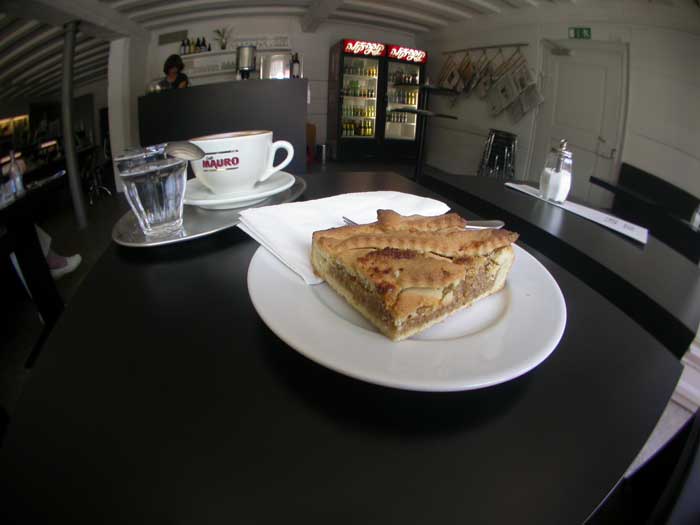
(Click to enlarge)
Cafeteria, Jüdisches Museum Franken in Fürth. Die Zitronentorte mit Füllung aus Mandeln und Zitronensaft ist ein alte Fürther Spezialität. Rezept beim Museum (klicken auf Fürth, Cafeteria, Fürther Zitronentorte).
Café in Jewish Museum in Fürth, with a good selection of papers and the Fürth lemon tart. Recipe in English here.
This is the café at the Jewish Museum in Fürth.