Legal translation in Wikipedia

I happened on the Wikipedia entry on legal translation:

bq. Only professional translators specialising in legal translation should translate legal documents and scholarly writings. The mistranslation of a passage in a contract, for example, could lead to lawsuits and loss of money.

Well, loss of money for some, gain of money for others.

bq. Translators of legal texts often consult law dictionaries, especially bilingual law dictionaries. Care should be taken, as some bilingual law dictionaries are of poor quality and their use may lead to mistranslation.

I’m not knocking the entries on legal translation and law dictionary. Just wondering why all the books they recommend are written by the same person.

Bible translation weblog

Wayne Leman’s Better Bibles Blog is about Bible translations and how to improve them. There are links to various resources and other blogs. It lists 22 versions of the Bible and readers can post their specific comments under each version. There are also some polls on language use. I haven’t seen this blog before, but it appears it started in April 2005.

Incidentally, while it’s still Sunday, Abnu points out that about 1000 people a day were getting SMSs about the Pope in the last few days – limited to 160 characters.

bq. Hurra! Du hast Dich zum SMS-Gottesdienst angemeldet.

Deutsch Welle reports.

Mystery pictures

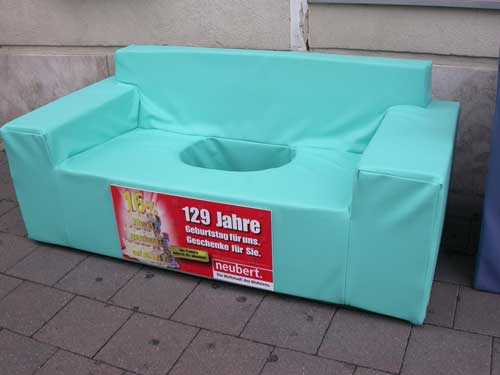
mn_050820w.jpg

I know there’s a furniture war on, but I also realise that Möbel Neubert won’t be trying to sell me a double commode (note: false friend). The penny only dropped a couple of hours later.

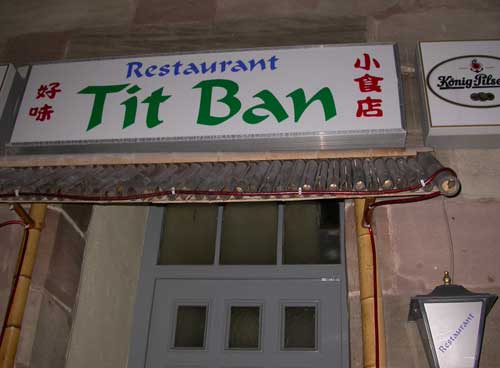
tb1_050819.jpg

This is posted for Tony of Germersheim, at his suggestion. I don’t know if he wants to lower the tone of this weblog even further or raise it. The Chinese appears to mean something like ‘Good taste little restaurant’ – possibly some would disagree.

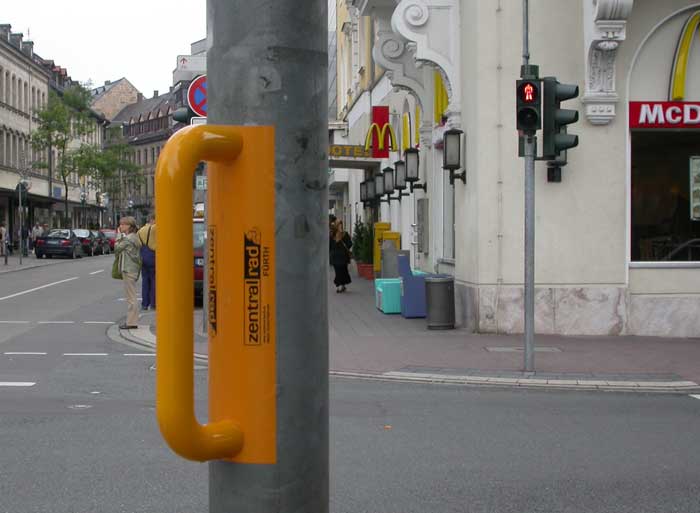
zr1_050820w.jpg

The yellow handle in the foreground probably explains itself. In the background is a further clue to the first picture above.

Visitor maps / Weltkarte für Transblawg

I am trying out Gvisit (which I read about on Sonja’s blog) and Clustrmaps (which I read about on Isabella’s blog). See bottom right column.

Unten in der rechten Spalte: Links zu zwei Sites, die Aufrufe dieser Site graphisch auf einer Weltkarte darstellen.

Gvisit just records recent visitors, apparently, but it gives names of towns. Clustrmaps recalls all of them, but mine hasn’t been going long. On Isabella’s site (scroll down) you can see one that’s been running for some time (I envy her the red spot in the middle of the Pacific Ocean).

Birth certificates / Geburtsurkunden

Following the last entry, I should add a footnote on birth certificates, because that term Abstammungsurkunde is one of the problems for translators who haven’t encountered it before.

There are three kinds of birth certificate in Germany:

Geburtsschein (minimum details)
Geburtsurkunde (most details)
Abstammungsurkunde (most details – including natural parents)

The Geburtsschein has minimum details, for the sake of privacy, but it will enable someone to prove their age, for instance when they receive a pension.

There’s also a multilingual birth certificate: cheaper than getting a translation. Any register office should be able to issue one.

I have no idea how the Abstammungsurkunde works with adopted children, since I thought it wasn’t that easy to see your natural parents. Anyway, you need one of these to get married, to avoid incest. As the Zeit article quotes:

Herr L., der »Verlobte«, fragt trotzdem nach dem Sinn der Abstammungsurkunde. Die Standesbeamtin, die das Leben zu kennen scheint, sagt, dass das Leben voller Überraschungen sei. Es gelte eben zu verhindern, dass zwei Geschwister, die durch Adoptionen als Babys getrennt worden seien, einander ohne Kenntnis ihrer Abstammung heiraten, was zu dem Vergehen eines Inzestes führe, das durch Vorlage einer Abstammungsurkunde leicht hätte verhindert werden können.
Herr L. erkennt den Humor der Erklärung und scherzt: »Das kommt in Altona ja sicher zweimal in der Woche vor.« Frau Z. hingegen hat es gar nicht komisch gemeint und sagt: »Nein, so oft nicht. Aber das Leben kann sehr bunt sein.«

Some Geburtsurkunden contain the line ‘Mit Abstammungsurkunde identisch’, which means they can be used instead of an Abstammungsurkunde. I would translate Abstammungsurkunde as ‘birth certificate showing natural parents’ or ‘long form birth certificate’, although the latter may not be a precise equivalent and its definition may vary from country to country. Don’t translate it as ‘certificate of descent’ – sounds a bit like a pedigree dog.

Here’s something on Britain:

There are two types of birth certificates:-
* the full certificate. This is a copy of the entry in the birth register, giving all the recorded details
* the short certificate. This only gives the child’s full name, sex, date and place of birth. It does not give the name and particulars of the mother or father. A short certificate is issued free of charge when a birth is first registered and is sufficient for most official purposes.

Marrying in Germany

A long article in Die Zeit about a German and an American who tried to get a registry office wedding in Germany and eventually decided America was easier. We know about this problem:

Frau Z. raschelt mit ihren Unterlagen und sagt: »Des Weiteren benötigen wir eine Heiratsurkunde der letzten Ehe von Frau B. sowie Scheidungsurkunden sämtlicher Vorehen mit Übersetzungen der fremdsprachlichen Urkunden durch vereidigte Dolmetscher bei der konsularischen Vertretung. Und eine eidesstattliche Erklärung über den Familienstand im Falle einer Auslandsbeteiligung.« Eine solche läge ja hier vor. Frau Z. kann offenkundig kein Englisch, denkt Herr L., sonst benötigte sie keine Übersetzung. Er ist feindselig geworden.

But it wasn’t even the worst. The couple have difficulty with the word Abstammungsurkunde (her parents were Jewish). Perhaps it should be renamed ‘Long form birth certificate’? (Via Handakte WebLAWg)