I saw this wall rather late:

For those who complain about seeing only half of my face on the blog, here is the whole thing. Unfortunately a lot of the background is missing:


I saw this wall rather late:
For those who complain about seeing only half of my face on the blog, here is the whole thing. Unfortunately a lot of the background is missing:
The George Washington University Law School has some vocabulary tests and a drilling utility online. You can have the answer shown and decide yourself if you were right or wrong. The drills work in IE for me, not in Firefox, but that may be my setup.
The material comes from Profs. Gregory E. Maggs and Robert Brauneis, and there are some Internet links there too (including one to me!).
Grace Donalds, née Smith, is a magistrate on the Cayman Islands (report). She was at Wellesley College with Hillary Clinton and studied law later at LSE in London.
bq. Another of Mrs Donalds’ qualifications is that she speaks German and reads French. In August 1975 the German Academic Exchange granted her a scholarship to pursue a course in Modern German Law. In addition, while studying at LSE she worked for two summers as a German to English translator of corporate documents at law firms in Frankfurt, West Germany.
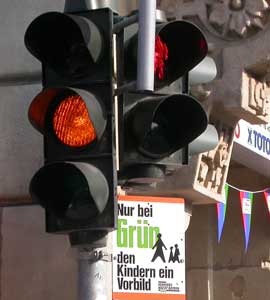
Udo reports the case of a pedestrian who crossed the road when the light was red and was given a fixed penalty notice for 5 euros. He was seen by two policemen (and finished up paying a lot more because the deadline had passed).
I’ve lived here all this time and I never knew it was punishable.
How about the UK? You see signs on the road there saying ‘Look right’, so you know where to check there is no traffic before crossing.
The Highway Code contains some provisions which are subject to a penalty. They contain the words must or must not:
bq. Many of the rules in the Code are legal requirements, and if you disobey these rules you are committing a criminal offence. You may be fined, given penalty points on your licence or be disqualified from driving. In the most serious cases you may be sent to prison. Such rules are identified by the use of the words MUST / MUST NOT. In addition the rule includes an abbreviated reference to the legislation which creates the offence.
Not so the rules for crossing against the lights as a pedestrian:
bq. 21: At traffic lights. There may be special signals for pedestrians. You should only start to cross the road when the green figure shows. If you have started to cross the road and the green figure goes out, you should still have time to reach the other side, but do not delay.
Note should, not must.
See the comments to Udo’s entry. Is it a regulatory offence in Austria too? Doesn’t sound like it.
Yes, the rumour about the elephant was true.

I think people should turn off their mobile phones on some occasions:

Mark Liberman at Language Log writes of law review and style guides. This is useful. I know that law reviews are written by law students and that it’s a big thing on your c.v. if you are good enough to be invited to assist in law review in your second year of law school. I also have a copy of the Bluebook – A Uniform System of Citation, which is produced by those who produce law review in a few U.S. universities, and which probably differs like the length of the chancellor’s foot – and therefore I also have a copy of the ALWD Citation Manual, which may be more reliable but which does not yet deal with foreign sources, which are the most important for translators, but which promises its separate guide to foreign materials before the end of the year (or so they wrote to me).
But I never put the two together – law review = inexperienced students = possible risk of them being over-prescriptive, like Lynne Truss or Bastian Sick (albeit earning less money for it in the short term).
Style guides are just systems. There often has to be some sort of system, but the more you think about it and the more consistent you make it over a range of texts, the more of a millstone it seems to become.
And style guides don’t say why. So you look for reasons why.
The best thing I read about style recently was in Judith Butcher’s Cambridge Handbook – Copy-Editing. She writes, about capitalization:
bq. Many authors have strong feelings about capitalization, so follow their system if they have a sensible one. If their usage is inconsistent or unhelpful, suggest an alternative system, giving specific examples. If you do introduce a system yourself, it is easy to be led, by the thought of ‘consistency’, into having too many capitals or too few.
Mark quotes an email from John W. Brewer (how many more interesting responses we would have if there were a comments function):
… a key part of law review culture is a hyperlegalistic concern with details of style and usage, and an almost pathological fear of exercising discretionary judgment among plausible alternatives. For any style/usage issue, the notion is that there must be a rule, and you can look the rule up in an authoritative source, and once you’ve done that you should follow the rule strictly, both in your own writing and especially in seizing opportunities to make petty corrections to the writing of others.
and this in turn quotes yet another law review style guide, from Texas.
See also the earlier Language Log entry on Ann Coulter (Google says she is an attorney and conservative author) finding a non-existent distinction between ‘that’ and ‘which’ in defining relative clauses.