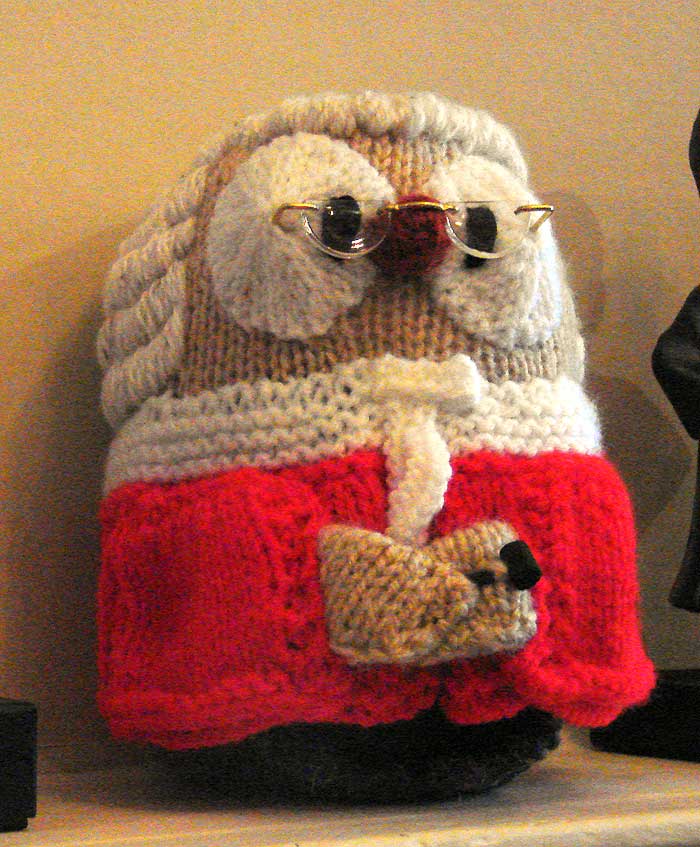
High court judge

High court judge, Wildy’s, December 2006.
200612120upm54w.jpg

More:

High Court judges’ dress depends on the division in which they sit, the type of case they are trying and the time of year. On Red Letter days – which include the Sovereign’s birthday, the State Opening of Parliament and some Saints’ days – all judges wear the scarlet robe for the appropriate season. A short wig is worn in all cases.

Queen’s Bench judges have five sets of robes. When trying civil cases in the winter, they wear a black robe faced with fur, a black scarf and girdle and a scarlet tippet. In summer, dress includes a violet robe faced with silk, a black scarf and girdle and a scarlet tippet. When dealing with criminal cases in the winter, judges wear the scarlet robe of the ceremonial dress but without the scarlet cloth and fur mantle. The costume also includes a black scarf and girdle and a scarlet casting-hood or tippet. For criminal business in the summer, a similar scarlet robe is worn but with silk rather than fur facings.

Chancery judges have one set of scarlet and ermine robes and one of black silk. Other items include a scarf, a mantle, a hood, Black Cap, a tippet, white gloves, knee breeches and steel buckled shoes – most of these only worn on ceremonial occasions. In the Chancery and Family divisions, judges wear a court coat and waistcoat with bands and a skirt or trousers beneath a black silk gown and a short wig. Court dress is not worn in chambers.

When sitting in the Criminal Division of the Court of Appeal, High Court judges wear a black silk gown and a short wig.

But what is he holding – surely not a gavel? But it doesn’t look like a black cap, either.

Although they’re often seen in cartoons and TV programmes and mentioned in almost everything else involving judges, the one place you won’t see a gavel is an English or Welsh courtroom – they are not used there.

Language of precedents/Präjudizien

I used to teach some of the vocabulary of case law in English: the hierarchy of the courts; the importance of the ratio decidendi (roughly speaking, the logic behind a decision, rather than the specific facts); the difference between Rechtskraft (res judicata: a particular decision is final and unappealable) and stare decisis (new decisions should follow older ones by certain courts if they are on similar fact situations), overruling and a decision on appeal; binding and persuasive precedents; obiter dicta; distinguishing, and the declaratory theory of the common law (the law does not change, it is merely described more precisely). If a case is not on all fours with a suggested precedent, the court will distinguish, which does not mean ‘see a difference’ but ‘find a difference’ (The court distinguished the present case from Carruthers v. Witherspoon).

While I was away, first the Volokh Conspiracy (here and here) and then Mark Liberman of Language Log wrote on the origin and meaning of the term on all fours.

I first met the term in The English Legal System by Walker & Walker (don’t be put off by the amazon.co.uk review):

Cases which are indistinguishable are described as being “on all fours” with one another.

I had never encountered the earlier version to run on all fours, but the OED and other references give it. I am most convinced by the Liberman argument that one situation is on all fours with another if the comparison does not limp (der Vergleich hinkt nicht). I did think that it meant that the various points all tallied, but that may be wrong. It probably has nothing to do with the idea of a multi-legged decision.

Good German introduction to this topic in Dieter Blumenwitz, Einführung in das anglo-amerikanische Recht.
(Link removed re malware, 2017)

I see Black’s Law Dictionary links to a ‘slang’ synonym, whitehorse case, also known as horse case, goose case, or gray mule case:

A reported case with facts virtually identical to those of the instant case, so that the disposition of the reported case should determine the outcome of the present case.

This doesn’t Google too well and may be purely Texan (Garner is from Texas, I believe).

Interpreter released/Dolmetscher aus der U-Haft zu Silvester

The Tenth Criminal Chamber of the Bochum Landgericht has released an interpreter after 19 months’ pre-trial detention. He is charged with 1392 counts of fraud, about 800 counts of falsification of documents and tax evasion in the amount of 1.2 million euros. It is not yet clear how many of these charges will stand, but he has been released over the New Year as there is thought to be no danger of his absconding.

The offences relate to altering documentation for the medical and psychological test that many people have to undergo in Germany if they have lost their driving licences and want them back (MPU: medizinisch-psychologische Untersuchung). The interpreter is alleged to have helped Turkish speakers to pass this test.

Apparently the fraud charges can’t be upheld if the customers knew of the deception in advance.

In der Anklageschrift wird dem Dolmetscher vorgeworfen, vornehmlich türkischstämmige Landsleute, die ihren Führerschein verloren hatten, durch falsche Übersetzungen und andere Manipulationen durch die medizinisch-psychologische Untersuchung (MPU) geschleust zu haben. Wenn das stimmt, waren die “Idiotentests” mit diesem Mann an der Seite also wahrhaft “idiotensichere” Aufgaben. Einer der Haupttatorte war angeblich die MPU-Stelle in Recklinghausen.

The MPU test is called the ‘idiots’ test’. Here’s an idiots’ translation about it.

(From Recklinghäuser Zeitung, via Derek on www.flefo.org – I didn’t realize the adjective from Recklinghausen had an umlaut)

Blog pause – Comments closed

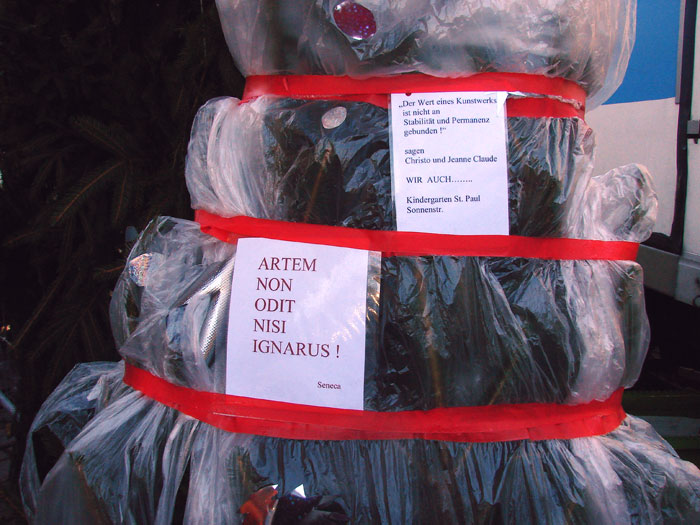
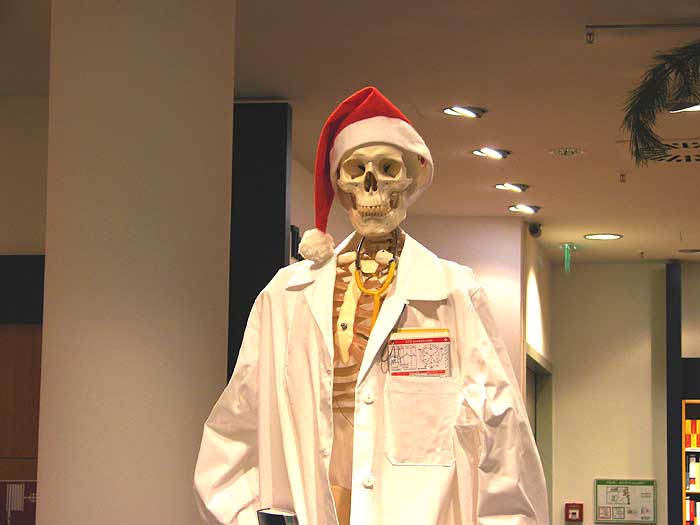
This blog is about to close down more or less till the New Year. Here are some seasonal pictures from the medical department of the Thalia bookshop in Erlangen and of the work of a Fürth kindergarten (obviously no Pisa problems here). Note the van selling Uwe’s fish from Hamburg. Bread rolls with rollmops in them are a mysterious element of many German markets.

20061128erlg04aw.jpg

DSC02471w.jpg

DSC02473w.jpg

Matrix chambers website cloned/Barristerwebsite geklont

Hier wurde eine berühmte Website geklont. Die Telefonnummern sind nicht die der Klonenden. Dahinter könnte die Absicht stecken, das Recht um Klonen zu testen (es handelt sich hier nicht um Ausgeben der Site eines anderen als die eigene, also um passing off).

Matrix Chambers website
At present still online, but how much longer:
Lando Attorneys website

Not just the layout and colour, but also the text has been largely taken over.
What possessed them to clone this of all websites?

Cherie Booth and her fellow barristers at Matrix Chambers are usually involved in fighting discrimination, protecting human rights and exposing injustice. But Britain’s best-known team of lawyers have had to resort to legal action to defend themselves against internet pirates who are using Matrix’s personnel, host of awards and high reputation in an apparent money-making scam.

The matter isn’t as simple as it looks, because it’s not clear who is behind it and how they benefit. The names of two members of Matrix are given, with the Matrix switchboard number. Attempts by Matrix to have the site removed have been going on for at least a week, apparently.

However, Dr Simon Moores, an internet security expert, said Matrix may not succeed in banishing the Lando website from cyberspace: ‘In my opinion as a non-lawyer, Lando Attorneys are exploring the gap between “passing off” [pretending that someone else’s property is your own], which is illegal, and cloning, which isn’t. This isn’t in my opinion a visible attempt at passing off, though it comes close, because Lando have not used Matrix’s name on their site. I think this is cloning. This is a grey area of the law, which is ambivalent, in regards to websites.’

Note in particular the change in the photo of Kevin, under Staff Team (Who We Are).

From The Observer