English-Chinese legal translation/Rechtsübersetzung Chinesisch-Englisch

Slaw – which describes itself as a co-operative weblog about Canadian legal research and IT, etc. – kindly gave me a mention, and in connection with that I found a reference to a book on legal translation that has not yet appeared in North America but may have just appeared in Europe: Translating Law, by Deborah Cao. The table of contents may be seen on that site as a PDF file.

The book investigates legal translation in its many facets as an intellectual pursuit and a profession. It examines legal translation from an interdisciplinary perspective, covering theoretical and practical grounds and linguistic as well as legal issues. It analyses legal translation competence and various types of legal texts including contracts, statutes and multilateral legal instruments, presents a comparative analysis of the Common Law and the Civil Law and examines the case law from Canada, Hong Kong and the European Court of Justice.

One thing that strikes me about academic books on legal translation is that there is a lot of space given to the translation of statutes, which is something I tend to think is a bit outside the usual translation scenario, because it’s got as much to do with drafting as translating. Susan Sarcevic’s book has that emphasis too. It’s probably easier to do research on bilingual legislation too. But I will have to see the book to judge that.

Meanwhile, I had just skimmed an interesting article on Chinese legal translation: Translated Chinese as a legal language in Hong Kong legislationClara Ho-yan Chan, Instituto Politécnico de Macau. It’s largely about the translation of the Sale of Goods Act into Chinese.


Conclusory

It was exciting to read that Mark Liberman of Language Log did not know the word conclusory. I have to admit that it’s used in American law more than English, but I did know the meaning when I encountered it. Entries by Mark here and here, and by Steve at languagehat here.

I did find it adequately defined in Merriam-Webster’s Dictionary of Law and in Black’s Law Dictionary, but not in Gifis.

But it’s a problem in German law that German language dictionaries omit specialized terminology, and apparently to some extent that is true of English dictionaries too. So we must be grateful to Mark for doing all the research on the term and even getting a few lawyers to come out of the woodwork and opine.

At first I thought this was one of those wonderful American terms that are thrown in so fast as objections in examination in chief (direct examination) and cross-examination of witnesses, like ‘asked and answered’ or ‘leading’ or ‘hearsay’, but it would be ‘Objection – calls for a conclusion’.

Note the comments at languagehat, especially on the dubious word ‘facially’, meaning ‘on the face of it’.

Birthday / Geburtstag

April 16th is a big day: not only the eightieth birthday of Pope Benedict XVI, but also the fourth birthday of Transblawg.

On this auspicious or inauspicious (depending on your point of view) occasion, one is bound to ask: what do Benedict XVI and Transblawg have in common, and what not?

We have to conclude that there are only a few similarities. Both were born in Bavaria, but Transblawg is not likely to reach the age of eighty. Both speak German and English. Both invite comments – up to a point.

Transblawg has referred to the Pope more than once, for instance here.

But: Transblawg has not written a life of Jesus Christ
Transblawg is never infallible
Transblawg has not been to Rome (or even Altötting, despite pleas from a sociologist friend – would like to go there with a camera)
Transblawg is not well-dressed, and has certainly not revived archaic forms of dress
Benedict XVI does not carry a camera around with him all the time
Transblawg does not stand at a window and read stuff out to an admiring crowd
Benedict XVI probably doesn’’t have a picture of Martin Luther on the wall
And Benedict XVI has a (somewhat) more spiritual style than Transblawg, which often seems drawn to the trivial

But it takes all kinds to make a world, so happy birthday to us.

LATER NOTE, in response to comments: we do, in fact, have a suitable Austritt for holding speeches from, but the audience is missing (except where captive; pictures taken today).

20070416fue013w.jpg

20070416fue015w.jpg

20070416fue002w.jpg

British PC famous in Lithuania/Britischer Polizist in Litauen berühmt

The Guardian reports that Great Yarmouth PC Gary Pettengell, who learnt rudimentary Lithuanian in order to help the local community of Lithuanians, has been voted Lithuanian personality of the year.

It’s a different question how reliable the following translation is – at all events, the English original is probably not used much nowadays:

Hello, hello, hello
Labas, labas, labas

Move along there, please
Vijeok deasi prasau

Let’s be having you
Kliosek minas

Evening all
Labanakt

Love padlocks/Lucchetti d’amore

20070320flo223w.jpg

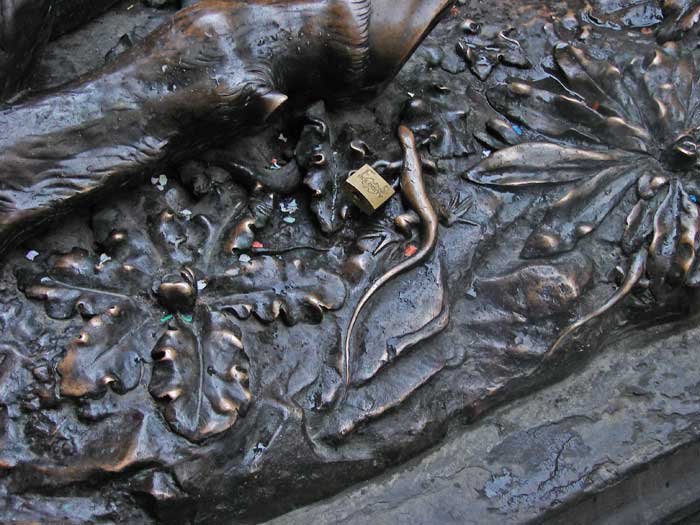
When I saw this padlock (Vorhängeschloss) on the Porcellino statue in Florence, I didn’t understand it. Now I think I have found the solution: love padlocks.

Apparently 5,500 were removed from the statue of Benvenuto Cellino on the Ponte Vecchio in the winter of 2005-6.

One is supposed to stroke the boar statue if one wants to come back to Florence. I did that. But then I have never stroked the ring on the Schöner Brunnen in Nuremberg, and I keep finding myself back there, so maybe the chances are slim.