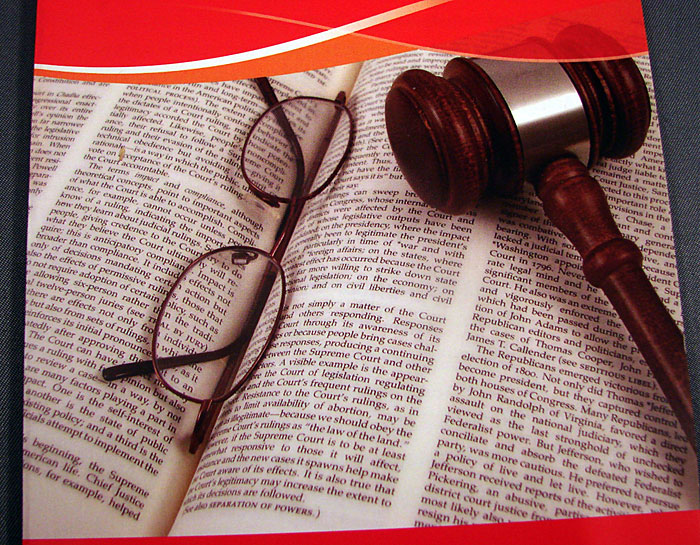
The hammer, the mallet and the gavel/Hammer und Schlegel

Further to the last entry, I wondered how an auctioneer’s hammer – the British equivalent – was taken to the USA and became a gavel, and I also wondered what the judge actually does with the gavel. Wikipedia was helpful here:

A gavel is a small ceremonial mallet commonly made of hardwood, typically fashioned with a handle and often struck against a sound block to enhance its sounding qualities. It is a symbol of the presiding officer’s authority and right to act officially in his capacity,[1] and as such, is used by presiding officers—notably chairmen and auctioneers—to call for attention or to punctuate rulings and proclamations. It is customarily struck to indicate the opening and closing of proceedings, giving rise to the phrase “gavel-to-gavel” to describe the entirety of a meeting or session.

Apparently there are rules on how to use the gavel:

Robert’s Rules of Order Newly Revised provides guidelines on the proper use of the gavel in deliberative assemblies. For instance, the chair is never to use the gavel in an attempt to drown out a disorderly member; … rather, the chair should give one vigorous tap at a time at intervals. … The chair should not lean on the gavel, juggle or toy with it, or use it to challenge or threaten or to emphasize remarks.[ …The prohibited practice of a chair cutting off members’ right to debate or introduce secondary motions by quickly putting a question to vote before any member can get the floor is referred to as “gaveling through” a measure.

Richard Nixon broke the Senate’s 1789 ivory gavel in a heated debate on nuclear energy.
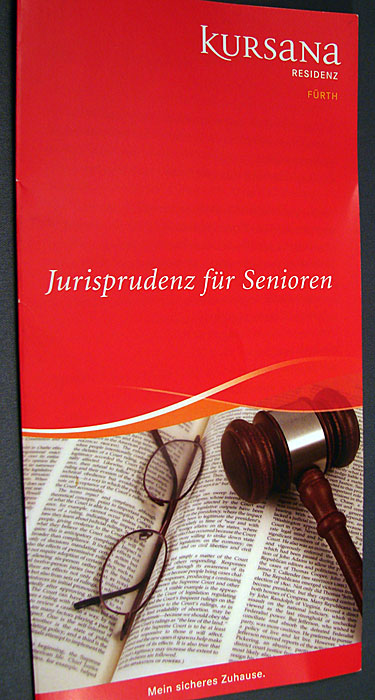
Law for senior citizens/Jurisprudenz für Senioren

Kursana run old people’s homes (‘residences’) in several parts of Germany. The series of talks for old people sounds most impressive.

But what is this? A gavel? What looks like The Oxford Companion to the Supreme Court of the USA under a pair of reading glasses? A course in American law?

No, apparently not. It looks as if the talks are practical talks on the reform of German inheritance tax, on living wills, and even on the law of old people’s homes (Neuregelung des Heimrechts), all presented by a Nuremberg lawyer. I wonder where they found the picture?

Dying in parliament/Tod im britischen Parlamentsgebäude

John Mesirow – always worth reading – reports on More Weird and Wacky British Laws.

This lot come from the Daily Mirror on March 20. But they have surely been round the Internet a few times – BBC News reported them last November. Probably they originate from some no longer acknowledged book, which in turn got them from a dubious source.

I am wondering about

IT is illegal to die in the Houses of Parliament. We’re not sure what the punishment for this particular offence would be.

Too true: of course there is no punishment. What is meant by ‘illegal’?

My understanding was that deaths in the House of Commons or House of Lords are reported as happening outside the building. Wikipedia has more on this:

No one is allowed to die within the Palace of Westminster, because, as it is a royal palace, any person who dies there would eligible for a royal funeral.[33] Most deaths on the premises are said to have taken place at St. Thomas’ Hospital, the nearest hospital to the palace.[34]

Wikipedia quotes BBC News and the Daily Telegraph as sources.

Paraguayan sausage casings save Switzerland/Cervelat gerettet

It’s been widely reported that an EU ban on Brazilian beef sausage casings has threatened the Swiss national sausage, the cervelat. Most other sausage casings fail to curl and split. truly madly deeply was concerned.

It now appears that sausage casings from Paraguay may escape the ban. Paraguayan farmers can’t afford to feed their cattle anything that would give them BSE.

Court case on poor interpreting/Klage über fehlerhaftes Dolmetschen in Ontario

A class-action lawsuit in Ontario was filed in April alleging that the government uses an inadequate test for court interpreters.

This was reported by the Globe and Mail – original article available for payment. It can also be found on Lia Barros’ Portuguese translation weblog, It’s all about translations, here.

The suit alleges that despite years of clear warnings and complaints from judges, Crown prosecutors, defence counsel and even its own staff, the government still uses an inadequate test for interpreters (for half the languages interpreted in the province’s courts, no attempt is made to even evaluate the candidate’s fluency in the second language) and still uses those who either don’t take or fail even that minimal test.

A mistrial was declared in Mr. Sidhu’s first trial because of incompetent translation; the interpreter had used the word “Henh?” to indicate a lack of comprehension, 27 times in a 36-page transcript.Mr. Sidhu was convicted in a second trial, with different interpreters, and sentenced to six months in jail.

Exciting stuff, so no excuse for not reporting it earlier.

Tilman belt cutter/Tilman Riemenschneider

A spot of machine translation at www.tourism-guide.org. Ingolstadt:

The Muenster to beautiful our love the woman or dear woman cathedral is a lategothical resounding church in Ingolstadt. Remarkably for 15. Century is the over hitting a corner position of the two towers.

Rothenburg ob der Tauber (aka Rothenburg whether that deaf ones):

It is remarkable at from the outside simply working gothical church that she possesses two differently high towers. One of the towers is 57 m and other 55 m highly. In this important church the famous holy blood altar of the Bildschnitzers Tilman belt cutter on the west loft, whom it carved around 1500 for a holy blood Reliquie, is. The Reliquie is kept thereby in a rock crystal cap of the Reliquienkreuzes. (approx. 1270)

Note also the organ with 5500 whistles. There is more.