
Miscellaneous/Vermischtes

Some miscellanea today. I did start twittering – see right-hand column – but have not really got into it. It will be useful for posting quick links, but without following and being followed by a large number of translators and/or lawyers, it will not be useful for terminology questions, for instance.

1. Weißwurst
Today (as already tweeted), IPKAT has an entry on the Weißwurst case. It has a photo of a cat – one of the old-style round-faced Siamese type – that has grabbed an uncooked British sausage. Something to shock Germans!

The writer, Marc Mimler, refers to the tradition that the Weißwurst should not hear the bells chime midday. He doesn’t mention the controversy as to whether it is OK to cut the sausage with a knife, or whether it is not better to suck out the contents. Enough said.

The case was also mentioned on the Class 46 Blog by Birgit Clark.

2. Large statue of Christ
As reported, the Fürth Stadtheimatpfleger has problems with the Neue Mitte, the huge shopping centre the town council want to splat across the town. Meanwhile, the Bezirksheimatpflegerin Andrea Kluxen has problems with a planned 55-metre statue of Christ to be erected near Wassertrüdingen near Ansbach. This is the same one that was planned for Bad Reichenhall last year. This recalls Franz Josef Strauss’s daughter Monika Hohlmeier, who is being exported to Franconia as a potential MEP. The Augsburger Allgemeine says:

Die angeblich weltweit größte Christus-Statue solle auf einer Ackerfläche am Ortsrand errichtet werden. Teil des Projekts sei ein «Pilgerhotel» mit 185 Zimmern, Wellness-Bereich und einem Restaurant. Die Baukosten von 20 Millionen Euro wolle eine Stiftung des Hamburger Unternehmers Harry Vossberg übernehmen, erläuterte Babel.

The artist is Angerer der Ältere, who seems to do Tolkieny stuff. Pictures here.

3. Court interpreters in Los Angeles
The Los Angeles Times on American Justice in a Foreign Language an article about interpreters and how the courts found a telephone interpreter for a variety of Mixe spoken by only about 7,000 people in Mexico.
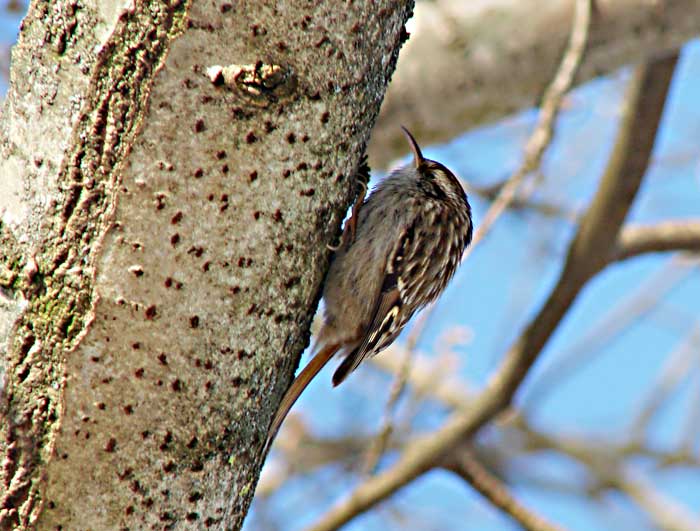
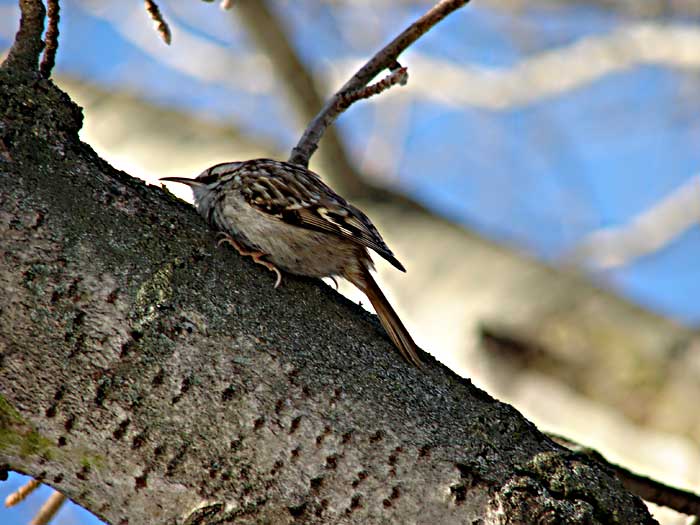
Short-toed tree creeper/Gartenbaumläufer

These tree creepers seem much less frightened than the nuthatches, which I have only got blurred pictures of.

It would be easier to tell which one it is from its voice, apparently (Gartenbaumläufer: short-toed tree creeper, Waldbaumläufer: tree creeper – and both have equally long toes, of course).

LATER NOTE: I am told it is a short-toed tree-creeper, in view of the colouring on the sides.

Prawo Jazdy caught at last/Endlich gefasst

The Irish Times reports that Prawo Jazdy is the Polish term for driving licence – it is not the name of the driver.

HE WAS one of Ireland’s most reckless drivers, a serial offender who crossed the country wantonly piling up dozens of speeding fines and parking tickets while somehow managing to elude the law.

So effective was his modus operandi of giving a different address each time he was caught that by June 2007 there were more than 50 separate entries under his name, Prawo Jazdy, in the Garda Pulse system. And still not a single conviction.

It sounds as if the Irish don’t have EU-style driving licences yet, but it isn’t absolutely clear:

In Poland, a booklet-type licence such as the one used in the Republic was phased out in 2004 and replaced with a pink, credit card-sized licence with an EU flag, the words Prawo Jazdy in the top right corner with (in admittedly smaller type) the holder’s name and personal details.

(Thanks to Susanne on the pt yahoo group)

Bad translations in Vienna/Wiener Museen mit schlechtem Englisch

Riccardo Schiaffino, who doesn’t speak German, comments on a visit to Vienna in Saving a few dimes while spending a ton.

At the Leopold Museum’s show on the Vienna art scene up to 1918 the English translation of a note on the origins of WW I said the Sarajevo assassination was due to the ultimatum issued from Austria to Serbia.

Since the ultimatum of course followed the assassination, either the German original was strangely wrong or the translator had a shaky knowledge of modern history.

At the Belvedere, in the show celebrating Gustav Klimt and the Kunstschau 1908, the English legend under a costume design by Emil Orlik said it was “a design for Shakespeare’s ‘Das Wintermärchen'”. That is, the English label gave Shakespeare’s title in German. The correct translation should have been “a costume design for Shakespeare’s The Winter Tale”, or perhaps “… for a German staging of the Winter Tale”.

This isn’t purely a Viennese problem. I recall the Germanisches Nationalmuseum in Nuremberg always had the most dreadful English in their exhibitions, on the level of ‘why bother with a translation at all?’ I haven’t been to an exhibition recently, though.

Franconian and Bavarian logos/Landessymbole

Some translators would like to have their Land logo on their business cards, but apparently that isn’t permitted. For this purpose, a Land symbol is created for anyone to use: Das Landessymbol Freistaat Bayern:

Um den Wünschen der Bürger nach einem genehmigungsfreien Zeichen dennoch entsprechen zu können, hat das Bayerische Staatsministerium des Innern 1987 folgende allgemeine Genehmigung erteilt:

The site shows six symbols, including three for Franconia.

The Franconian one is quite nice. I suppose I could even merge it with two Ms – if I wanted to use it. I’m sure one could do something exciting with the Bavarian one, too. One could change the colours, for a start! Or is there a sanction against that?

In other Bavarian news, the Bavarian Federal Patents Court has held that the Weißwurst does not have to be made in Munich – see MarkenBlog.

But may one cut it with a knife, or must the contents be sucked out?

Fake non-Franconian Viking swords?/Markenpiraterie vor 1000 Jahren

Tests at the Wallace Collection reveal that the best Viking swords bore the name Ulfberht, apparently a Franconian name. Franconia has moved in the past 1000 years, though, so this may even have been in Solingen. Many museums have fake Viking swords of about the same age as the good ones, but made of inferior steel because the Russians were blocking the trade route (a familiar story). The Viking Rune writes:

The tests show that high quality steel of the Ulfberht swords is from the mines on the territory of modern Afghanistan and Iran. However, in the 11th century the trade route was blocked by Russians and the supply of steel with high carbon content ended. The demand was huge and soon low quality fakes flooded the Scandinavian market. In outward appearance they were identical to genuine Ulfberhts and their blades were very sharp. Nevertheless, due to the fact that the carbon content of the steel from which they were forged had only a third of the same in genuine high quality swords, they could fatally disserve Vikings who bought them.

The main area where the swords were found was further north, along the Baltic coast and in Scandinavia, so it is suggested that the name Ulfberht may simply have been an invented brand name rather than the name of the maker, and the fake swords an early form of brand piracy.

Markenfälschung schon im Mittelalter.

Ulfberht makes me think of Dilbert, Dogbert and Catbert.

This was reported by the Guardian in December 2008, but has now filtered through to Spiegel Online.

(Via IPKat).