
Blaise/Blasius

Blessing of the throats on St. Blaise’s day, February 3, at St. Etheldreda’s in London (probably the only pre-Reformation church in England restored to Catholicism). St. Etheldreda is the patron saint of throat complaints. I haven’t actually got a sore throat, but perhaps this is why:

Blessing of the Throats, London
Though not strictly a folk custom, the annual Blessing of the Throats service at London’s St Etheldreda’s church in Ely Place is quirky enough to figure in any list of strange British customs.
St Etheldreda’s is the second oldest Catholic church in England, returned to Catholic use in the 19th century. It is here that on February 3, St Blaise’s day, a ceremony is held to ask for that saint’s help in treating those with throat problems. Blaise, a 4th century doctor in Armenia who became bishop of his home city Sebaste, saved the life of a small child with a fish bone stuck in his throat as the saint was being led off to be tortured for his faith.

Meanwhile, in Wolfsburg:

Blasius-Segen gegen Halserkrankung, wird erteilt am Dienstag, 3. Februar, um 18 Uhr. (St. Christophorus)

Wikipedia says Etheldreda’s real name was Æthelthryth.

(Via Baroque in Hackney)
Blackstone

Blackstone’s commentaries online (he doesn’t start English law in 1066).

BOTH thefe undertakings, of king Edgar and Edward the confeffor, feem to have been no more than a new edition, or frefh promulgation, of Alfreds’s code or dome-book, with fuch additions and improvements as the experience of a century and an half had fuggefted. For Alfred is generally ftiled by the fame hiftorians the legum Anglicanarum conditor, as Edward the confeffor is the reftitutor. Thefe however are the laws which our hiftories fo often mention under the name of the laws of Edward the confeffor; which our anceftors ftruggled fo hardly to maintain, under the firft princes of the Norman line; and which fubfequent princes fo frequently promifed to keep and to reftore, as the moft popular act they could do, when preffed by foreign emergencies or domeftic difcontents. Thefe are the laws, that fo vigoroufly withftood the repeated attacks of the civil law; which eftablifhed in the twelfth century a new Roman empire over moft of the ftates on the continent: ftates that have loft, and perhaps upon that account, their political liberties; which the free conftitution of England, perhaps upon the fame account has been rather improved than debafed. Thefe, in fhort, are the laws which gave rife and original to that collection of maxims and cuftoms, which is now known by the name of the common law. A name either given to it, in contradiftinction to other laws, as the ftatute law, the civil law, the law merchant, and the like; or, more probably, as a law common to all the realm, the jus commune or folcright mentioned by king Edward the elder, after the abolition of the feveral provincial cuftoms and particular laws beforementioned.

BUT though this is the moft likely foundation of this collection of maxims and cuftoms, yet the maxims and cuftoms, fo collected, are of higher antiquity than memory or hiftory can reach: nothing being more difficult than to afcertain the precife beginning and firft fpring of an antient and long eftablifhed cuftom. Whence it is that in our law the goodnefs of a cuftom depends upon it’s having been ufed time out of mind; or, in the folemnity of our legal phrafe, time whereof the memory of man runneth not to the contrary. This it is that gives it it’s weight and authority; and of this nature are the maxims and cuftom which compofe the common law, or lex non fcripta, of the kingdom.

Not me/Anti-reziprok

A mysterious email:

Sehr geehrter Webmaster von https://transblawg.co.uk,

für unseren Kunde optimieren wir derzeit den Webauftritt http://www.babywagen.info und erhöhen die Domainpop.

Da Ihre Seite http://www.babywagen.info themenverwandt ist, würden wir uns sehr über eine Kooperation freuen.
Selbstverständlich wird im Gegenzug ebenso ein Backlink mit einem Wunschtext Ihrer Wahl und gerne auch inkl. Beschreibungstext veröffentlicht.
Auch anti-reziproke Linkvereinbarungen sind jederzeit möglich.

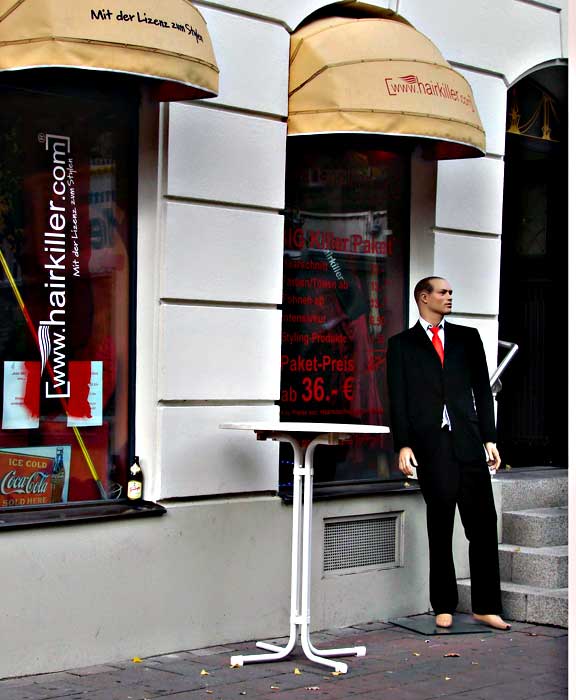
Hairdressers’ names in Germany/Friseurnamen

Under Huns, Hair Salons and Puns, Strange Maps reprints a map from Die Zeit, showing the incidence in Germany of salons named Haareszeiten, Haarmonie and Haargenau. Plus link to a flickr pool on hairdressers with funny names.

The map shows little except that the names are widespread. According to the article in Die Zeit, there are fewer such ridiculous names in Berlin and Munich, where they have had their day, than in Stuttgart or North-Rhine-Westphalia.

Was in Stuttgart noch als originell gilt, ist in Berlin längst verpönt. Dort nämlich ist der Originalitätsdruck so groß, dass die Friseure sich kaum noch trauen, sich wie alle zu nennen. Friseure heißen in den Berliner Bezirken, in denen die jungen, ironischen Menschen wohnen, schon wieder “Friseursalon”.

It looks as if this topic has been covered in more depth elsewhere. Even Bastian Sick has done it. Maybe Die Zeit just took the first three names mentioned in this thread at www.haarforum.de and pinned them down in the Yellow Pages. www.wissen-friseur.de has many more listed. So does ronsens. All have more links, and Google is full of them. In fact, little else is written about on the Internet than hairdressers’ names.

I’ve already shown a photo of the local Happy Hairy People.

This reminds me of opticians’ window displays.

ADDED LATER: