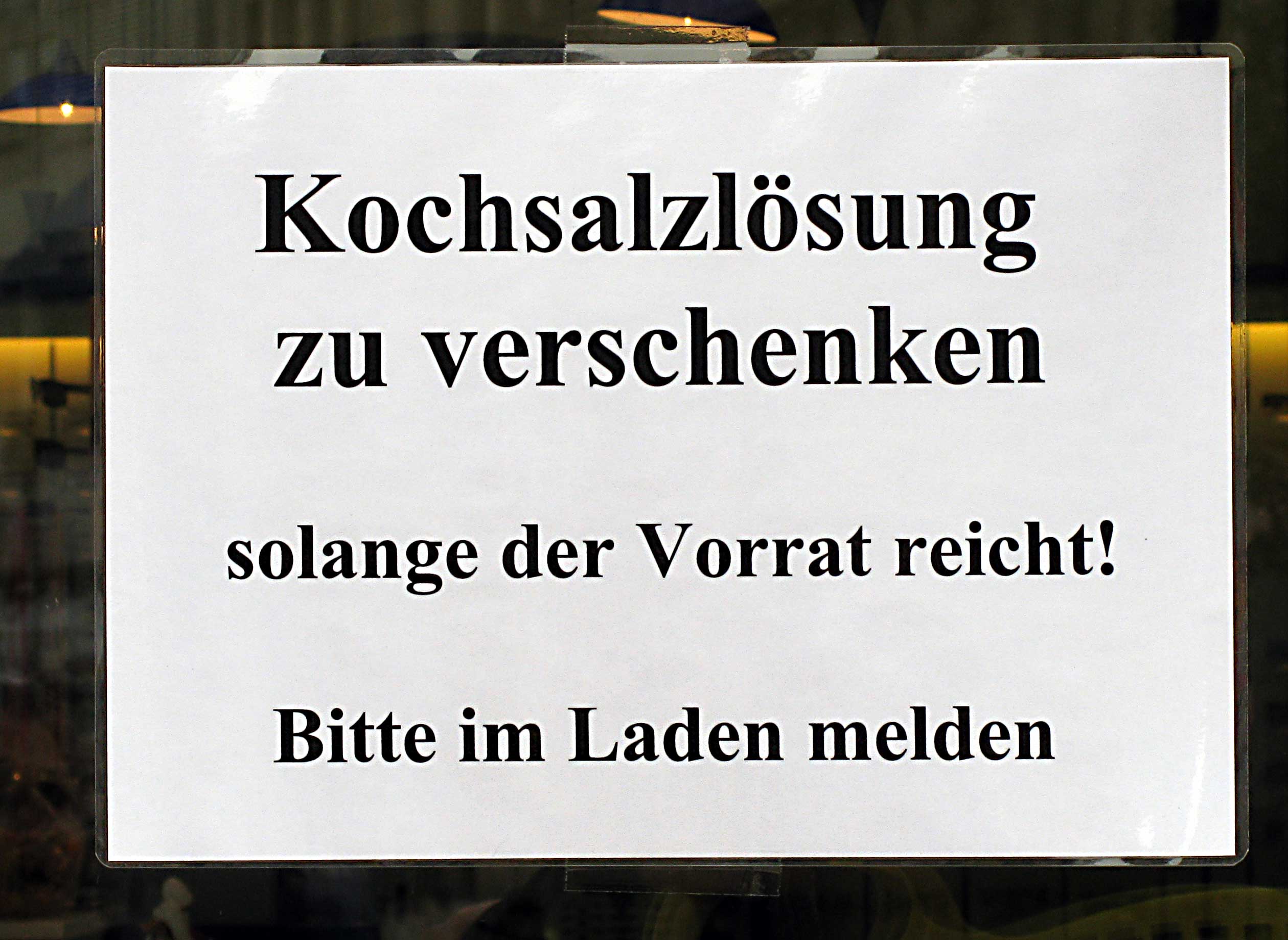
This is at the optician’s next to the Deutsche Bank. Probably all snapped up now. To think I made up some salt water yesterday because I had something in my eye.
Gearing up for the EU election:

Bretzeln:


This is at the optician’s next to the Deutsche Bank. Probably all snapped up now. To think I made up some salt water yesterday because I had something in my eye.
Gearing up for the EU election:
Bretzeln:
I haven’t got far with my introduction to English law, but looking ahead, when (if) I get round to the courts, one court of interest is the Judicial Committee of the Privy Council. It’s easy to start looking at this one in isolation. Frances Gibb has an article in the Times headed Does anyone understand what the Privy Council does? which is a good starting point.
Of course, I don’t understand what the Privy Council does, and never have done. What I know a bit about is the Judicial Committee of the Privy Council. The Privy Council is one thing, its court another. The same goes for the House of Lords – a chamber of parliament, but containing within it a court, the Judicial Committee of the House of Lords. It gets confusing when the long name of the court is abbreviated.
So, the Privy Council is a bunch of people whose predecessors once advised the monarch in what I tend to call the Middle Ages. In German it could be called Kronrat. I should think in those days it was clearer who was a member, but nowadays it’s a mystery not just to me. It isn’t a full-time occupation in itself. I liked the quote referring to it only occasionally emerging from the ‘constitutional fog’.
Before I get down to the Judicial Committee, I recommend further reading on what the Privy Council is for those who like obscure knowledge.
Who are Privy Counsellors? Currently there are more than 540, mostly senior politicians who were once MPs. As with a gentlemen’s club or secret society, members swear allegiance to the Queen and to “assist and defend…against all Foreign Princes”.
One thing I don’t think the article mentions is that members of the Privy Council can be recognised by their title – some of them call themselves ‘Right Honorable’, unless they have a superior title. (Note the spelling of Privy Counsellor – I admit that was new to me).
Turning to the court, the Judicial Committee of the Privy Council is a relic of the British Empire. It used to be the highest court of appeal for all colonies. It still acts as a court of appeal for the (few) remaining colonies), and some Commonwealth countries have chosen to retain it as their final court of appeal.
(T’he Commonwealth is a voluntary association of independent states that used to be colonies).
Its members are the same judges, appointed lords, who constitute the Judicial Committee of the House of Lords, plus occasionally one or two judges from whatever jurisdiction the case is about.
It acts as the final court of appeal for many former colonies and UK overseas territories, mainly in the Caribbean but also including appeals from the Channel Islands and Isle of Man, Admiralty appeals from the Cinque Ports, and disciplinary appeals involving doctors and dentists as well as some appeals from ecclesiastical courts.
Since 1998 it has also had power to rule on constitutional appeals arising over devolved powers to Scotland and Wales.
In recent years its overseas jurisdiction has reduced as successive countries have cut off the Privy Council as a court of final appeal: Canada, India, Sri Lanka, African nations, Singapore and, most recently, Hong Kong and New Zealand have all withdrawn.
In all it handles about 55 to 65 Commonwealth and devolution appeals a year, appeals nominally to the Queen as head of state. The judges, notes Mr O’Connor, do not make decisions like other courts; they “humbly advise Her Majesty” whether to grant a petition to the appellant. But the Queen can also refer to it any matter that she wants to. In effect, he says, it is “an embryonic, but unused, constitutional court”.
It’s curious that the court can find itself making decisions on the death penalty, which is not part of English law, or on written constitutions, which the UK does not have.
I have mentioned Linguee and LinearB – see comments under the latter.
At first I disliked Linguee because I could not see where the texts came from without clicking through, and most of the English equivalents were bad. Admittedly this is not a full investigation, and readers are invited to do their own searches. My first impression of LinearB was good, because the sentences were good English, although they didn’t reveal the source at all.
I now realize that LinearB is full of Europarl, a database of bilingual documents from the proceedings of the European Parliament. Meanwhile it transpires that Linguee incorporates the acquis communautaire TM (I assume), and Europarl too. If I therefore look up the word Rechtsbehelf on both sites, I get masses of quite good EU equivalents, equivalents I could find myself on the Web anyway. Actually, it’s surprising that LinearB doesn’t use that material too.
I just looked at the example in the comments, Bestand as a noun, in Linguee and the results are not bad at all. I also think it is likely that Linguee is expanding and will expand fast. However, I suspect that when I have a genuine question to ask it, it will give me some more Gerglish and not much help.
Pilgrimages aren’t what they were, apparently.
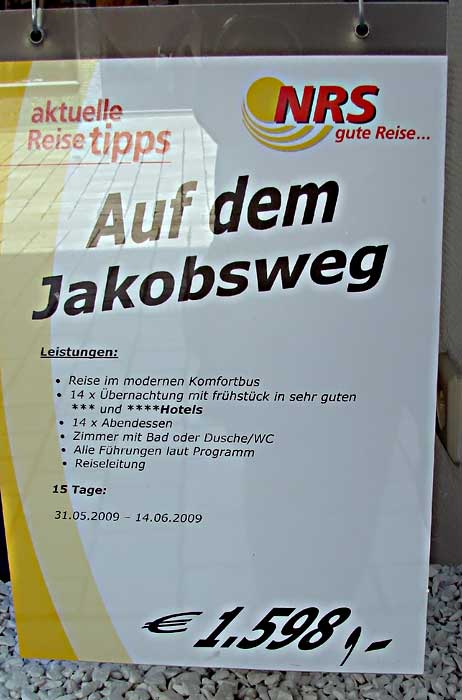
Reise im modernen Komfortbus
14 x Übernachtung mit frühstück in sehr guten *** und **** Hotels
14 x ‘Abendessen
Zimmer mit Bad oder Dusche/WC
Alle Führungen laut Programm
Reiseleitung
None of this ‘give me my scallop shell of quiet‘ here.
Mago at Life in Translation links to another multilingual website, Linear B.
The original idea came via James D. Reed of SpanishLegalTranslation.
Here you can choose your language pair and search translation memories (aligned texts).
The results are much better than those of the two multilingual sites recently mentioned here, for instance Linguee.
Here are my results for Rechtsbehelf:
appeal – [ 6 sentences matched , 3 shown ]
… lesung vorrangig drehten , im kompromisspaket niederschlag gefunden haben . es geht um den rechtsbehelf -lrb- artikel 4 -rrb- , den transparenzmechanismus -lrb- artikel 6 der rahmenrichtlinie -rrb- , …
… that dominated discussion between the council and parliament during second reading : right of appeal -lrb- article 4 -rrb- , the transparency mechanism -lrb- article 6 of the framework …unser ziel ist es zudem , den asylbewerbern das recht zu sichern , auf dem gebiet des mitgliedstaats zu verbleiben , bis über ihren rechtsbehelf entschieden worden ist .
we aim to secure for asylum seekers the right to remain on the territory of a member state until their appeal has been decided .… antrags nun auf unserem hoheitsgebiet verbleiben kann , bis die endgültige entscheidung über seinen rechtsbehelf gefallen ist .
… applicant could then remain on our territory while awaiting a final ruling on his appeal .
[ View more matching sentences ]legal remedy – [ 2 sentences matched ]
zweitens wollen wir das recht des asyl suchenden auf einen wirksamen rechtsbehelf nach artikel 38 stärken .
secondly , we want to reinforce the asylum seeker ’ s right to an effective legal remedy in accordance with article 38 .… bestrafung ohne ein ordnungsgemäßes gerichtsverfahren , die meinungsfreiheit , das recht auf einen wirksamen rechtsbehelf und das recht auf freiheit , sicherheit und ein faires verfahren verankert .
… no punishment without law , freedom of expression , the right to an effective legal remedy and the right to liberty , security and a fair trial .question – [ 1 sentence matched ]
für den fall , dass der rechtsbehelf keine grundsätzlich aufschiebende wirkung hat , müssen die mitgliedstaaten überdies laut richtlinie festlegen , wann ein asylbewerber eine aufschiebende wirkung beantragen kann .
if , moreover , there is no question of a standard suspensive effect of an appeal , then the directive requires that …recourse – [ 1 sentence matched ]
weitere mit china behandelte fragen sind die unterdrückung der politisch andersdenkenden , die willkürlichen inhaftierungen , der rechtsbehelf gegen die todesstrafe und die unterdrückung der ethnischen minderheiten .
… the repression of political dissent , the arbitrary conditions of detention , the frequent recourse to the death penalty and the repression of ethnic minorities .right – [ 1 sentence matched ]
zum rechtsbehelf wird im kompromisspaket den ansichten des parlaments gefolgt , wonach die mitgliedstaaten aufgefordert werden sicherzustellen , dass jeder fall aufgrund des vorliegenden tatbestands beurteilt wird .
on right of appeal , the compromise package takes parliament ‘s line by requiring member states to ensure that the merits of the case are duly taken into account .
The ‘Rechtsbehelf gegen die Todesstrafe’ seems to have gone a bit off course, and the ‘conditions of detention’ in the same example, but I think it was a native speaker of English messing that one up.
The site is mysterious but I found a PDF file with more details, including an address and inter alia a table showing a number of German words and phrases and the automatically extracted translations, followed by the ideal translation. Details: Searchable Translation Memories
Chris Callison-Burch, Colin Bannard & Josh Schroeder
Linear B Ltd.
39 B Cumberland Street
Edinburgh EH3 6RA
{chris,colin,josh}@linearb.co.uk
Deutscher AnwaltSpiegel (PDF)
(via GALJ)