
In witness whereof/Zu Urkund dessen

There are conventional German equivalents of numerous fixed expressions in English legalese. Dietl-Lorenz, for example, has:

in witness whereof I have hereunto set my hand: zum Zeugnis dessen habe ich diese Urkunde eigenhändig unterschrieben

and Romain:

in witness whereof: zu Urkund dessen

I prefer ‘zu Urkund dessen’ – I think it’s closer to the meaning.

Does anyone use a simpler translation?

The question of plain English is indirectly raised by the TransLegal Legal English blog, which suggests an improvement:

Try a straightforward closing like this:

THE PARTIES, INTENDING TO BE LEGALLY BOUND, have executed this agreement on the date first set forth above.”

This still looks pretty unstraightforward to me (set forth is a normal American expression, British set out, but it still sounds rather lawyerly to me). But yes, being legally bound is the main point. There is also a criticism that ‘the year of our Lord’ is objectionable for religious reasons, and that ‘witness’ implies that there were witnesses (this is a misunderstanding of ‘in witness whereof’)

Doonan and Foster, in Drafting, 2001, (an impression of an earlier version is given in Google Books) recommend:

These incantations may be revised to:
Executed as a deed on …
Or:
Signed and delivered as a deed on…
Or:
The parties have signed this document as a deed on …

(This assumes English law, where a deed has a special meaning)

Plain English books can be useful where they make it clear whether the two words in a doublet are synonyms or not, or what the meaning of fixed expressions is. (I’m not so sure that law can be written completely in plain English).
Austrian bean counters eye Heinz/Gebackene Bohnen

Heinz face anger over 58th variety, writes William Green in the Austrian Times.

Surely this is naive? I remember over twenty years ago being annoyed when I discovered that Cadbury’s chocolate sold in Germany had more sugar than the British kind.

Another taster Kathryn Quinn, 25, from Cumbria that now lives in Vienna said: “I lived off beans at University in Birmingham but the beans here taste horrible. It’s a shame as they were cheap and good for you. It’s just as well I can afford something better from the local cooking here.”

According to the Heinz labels the British tin is more than half full with beans – while the Austrian version contains less than half.

And the British beans have five per cent more tomato in their sauce than the Austrians who have more water, sugar and salt instead.

(Tweeted by Bob Kerns)

DE>EN problems/DE>EN-Probleme

1. Abigail on The Greener Word links to a Daily Telegraph article about some confusion as to whether a camel’s Schwanz is a tail or a penis.

The respected international news agency Reuters published a story on Tuesday reporting that the penis of a large giraffe model at Berlin’s Legoland Discovery Center had been stolen four times.

The 12in appendage, which is made out of around 15,000 bricks, had been repeatedly targeted by souvenir hunters since the statue was installed in 2007, it said.

2. Anatol at the Bremer Sprachblog looks at the English part of Angela Merkel’s Facebook entry and finds that her favourite quotation could have done with a more practised translator into English.

Zum Sprachlichen: Merkels Facebook-Profil ist konsequent zweisprachig Englisch-Deutsch. Eigentlich ist das ja eine gute Sache, nur leider hat sie es nicht für nötig gehalten, für die englischen Übersetzungen jemanden zu bezahlen, der sich mit sowas auskennt.

Vor allem ihr „Lieblingszitat“ hat es mir angetan:

Favorite Quotations: In der Politik geht es nicht darum, Recht zu haben, sondern Recht zu behalten // The point of policy is not to be right but to be right after all (Konrad Adenauer)

Gut, das Zitat ist nicht gerade einfach zu übersetzen, aber viel schlechter als auf der Facebook-Seite könnte es nur Google Translate („In politics it is not a matter of law to have, but to be right“).

3. A commenter on the Bremer Sprachblog entry refers to a translation problem relating to President Obama. Accounts of fisticuffs when Obama made a speech had misunderstood the metaphorical meaning of ‘seeking to grab the megaphone from his opponents’. BILDblog:

President Barack Obama assailed critics of his health care initiative Saturday, seeking to grab the megaphone from his opponents and boost momentum in his drive for congressional passage of his chief domestic priority.

(Deutsch etwa: Präsident Obama griff am Sonntag Samstag Kritiker seiner Gesundheitsreform-Initiative an und versuchte, seinen Gegnern das Megaphon zu entwinden und seinem wichtigsten innenpolitischen Projekt für die Abstimmung im US-Kongress neuen Schub zu verleihen.)

Yes, we gähn

(Headline of Bild Zeitung on the Merkel/Steinmeier ‘duel’ – one of the most ridiculous programmes I’ve seen).

Obama’s ‘Yes, we can’ made a huge impression in Germany, and since then is quoted everywhere daily.

Indeed, a weekly TV programme is about to start called ‘Yes, we can dance’.

“Yes we can” site:de – 174,000 ghits
“Yes we can” site:uk – 65,200 ghits

Taz:

Steinmerkel gegen Merkelmeier

New court-martial building in Sennelager/Neues britisches Militärgerichtsgebäude

The US military courthouse in Fürth has long gone. It was the biggest outside the USA. Happy times of watching trials on the murder of taxi drivers etc. (They had a great basement theatre too, in which they used to put on musicals and plays).

British military court buildings in Germany are on the rise, however. Here’s a video of Baroness Scotland opening a new court building in Sennelager. You can also see a couple of judges in ill-fitting, perhaps borrowed, ceremonial wigs.

Attorney General Opens New Military Court Centre At Sennelager In Glittering Ceremony

Militärgerichtshof für britische Soldaten in Deutschland eingerichtet, beck-blog.

Fürth and Unesco/Weltkulturerbe?

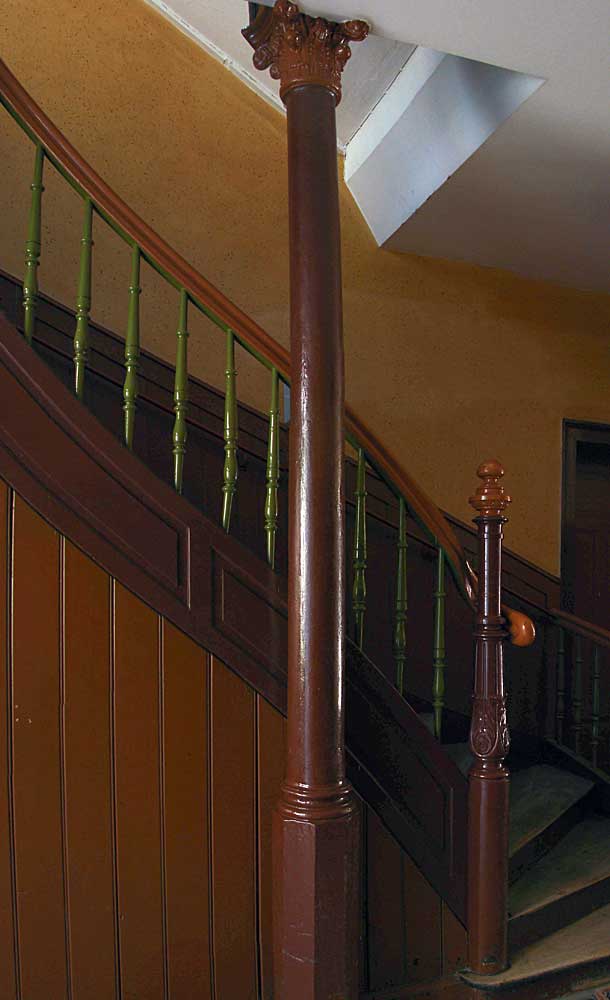
Here’s a staircase in a building in Mathildenstraße – when I pass an open door, I like to look into the staircase and back yard:

They’re not all very pretentious buildings, but there is a huge unbombed city centre with a huge number of listed buildings. Now there is an initiative to get Fürth recognized by Unesco as a world heritage site. Here’s a list of those in Germany – and everywhere else.

The Fürther Nachrichten report – in German but with pictures. The initiative is headed by Lothar Berthold, who publishes books on Fürth history, and there is a book on this subject too – in colour only direct from the publisher, in black and white also in bookshops.

Einzigartiges Fürth, Bildband der Initiative Weltkulturbewerber Fürth, 126 Seiten. In Farbe erhältlich nur beim Städtebilder-Verlag von Lothar Berthold, Schwabacher Straße 17, 90762 Fürth, Telefon (0911) 77 31 92, 28 Euro, in Schwarzweiß-Ausführung auch im Buchhandel, 18 Euro.