The fourth book from the left on your bookshelf/Das 4. Buch in deinem Regal v.l.

Which bookshelf? I have sixteen bookcases. So I chose the fourth from the left on one shelf. It is by Rob Eastaway, What is a googly? The Mysteries of Cricket Explained.

I haven’t read this book yet, just skimmed it, but even then it gave me some useful information. It does start off by comparing cricket to rounders, which we used to play at school.

Well, the good news is that if you understand rounders then you understand the basics of cricket. … (details)… However, comparing cricket with rounders is like comparing chess with draughts. Yes, chess and draughts are both played on a chequered board, and cricket and rounders are both played on a field …

Draughts is BrE for checkers. I notice the book is careful to compare cricket with rounders, not baseball.

Chris Durban and Eugene Seidel: The Prosperous Translator

I am going to introduce two books by colleagues that have fallen into my hands in recent years. This is not a review, as I haven’t read them all.

The Prosperous Translator – Advice from Fire Ant & Worker Bee is a compilation of the agony aunt and uncle column in Gabe Bokor’s Translation Journal. The authors answer questions from translators and would-be translators. They have been doing this for many years now.

I always thought that the questions were invented by the authors, but I have been firmly told this is not so. I have also been tempted to create a spoof column in this style: I think the format has a lot of potential.

The book has a website. You can buy it from lulu.com or from amazon (the latter probably gives the authors less royalties).

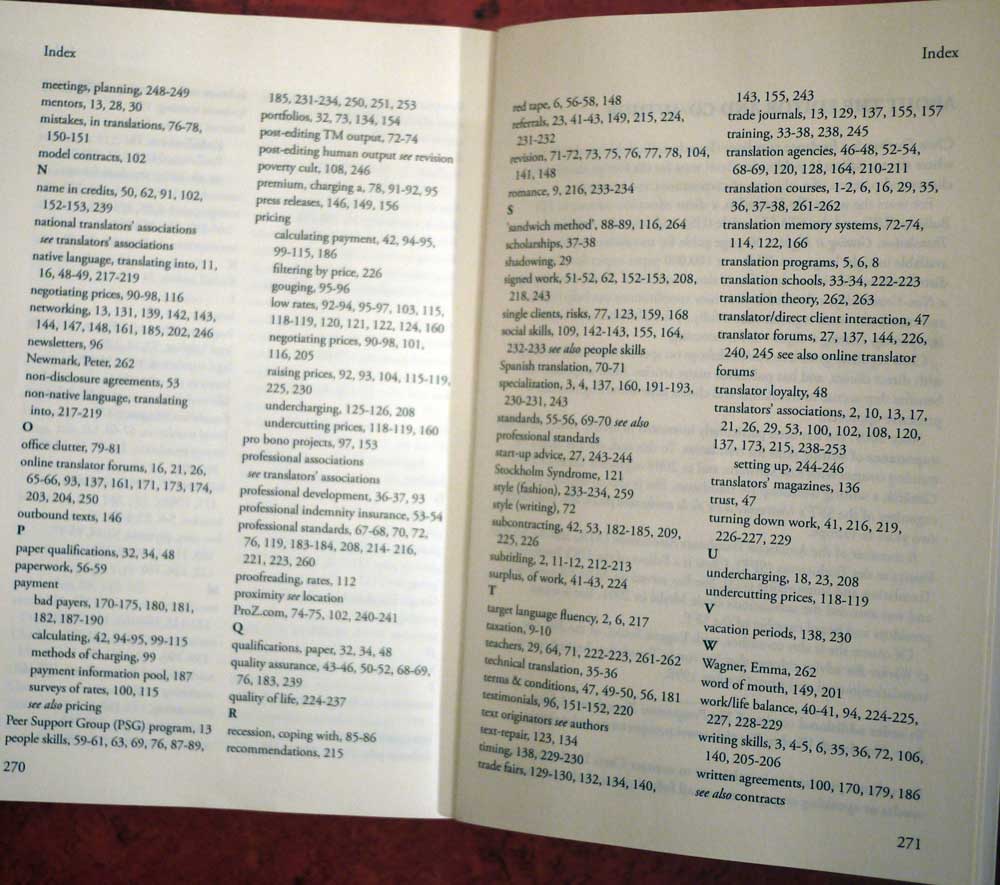
What I find very interesting is the classification into topics and the index (Chris told me the index was done by a professional indexer). This makes the information more accessible.

It wasn’t very easy to photograph that. I toyed with tearing a page out and scanning it (can’t be bothered to reinstall my flatbed scanner), but the pages seem very hard to tear out – a mark of quality – so I left it in.

Thus there are a number of queries on legal translation now collected together, as one sub-chapter of ‘8: Specializing’ (by the way, I find the spelling of -ise/-ize words inconsistent). Other main chapters: Is this a real option for me? – Getting started – Doing the job – Client/cupplier relations – Pricing and value – Marketing and finding clients – Pamynet issues – Ethics – Quality of life – Professional associations – Kitchen sink.

I lingered just now on an entry where the asker is caught off guard by a client dropping in and wonders what to do about the clutter. You can read this – any many more – at the Translation Journal site.

Dear Fire Ant & Worker Bee,

I am a freelance translator with an office in my home and a reasonably successful business serving clients in the UK and the Netherlands. The other day I was caught off guard when a client phoned me out of the blue and insisted on dropping in to review a text in person (he happened to be in the neighbourhood, and the text was urgent).

It was a chastening experience—not for the text itself and our discussion, which went very well, but because my office is a shambles, with papers papers papers and files files files as far as the eye can see. I will spare you the details, but from the look on this man’s face as he crossed the threshold, I don’t think my frantic hoovering accomplished much. …

Litter Bug

A:

Dear Bug,


Successful techniques we have observed firsthand depend on the size of your office, the size of the cluttered patch, and advance notice.

we have five suggestions (note that for options 3 to 5, you will have to buy in supplies in advance):

1. Square Up the Corners: somehow piles of papers that are carefully stacked look infinitely neater than those in haystack format.
2. Strategic Lighting: carefully targeted, this can be a big help, depending on the time of day.
3. The Green Plant/Colorful Bouquet: a strategically placed giant green plant or bouquet may divert the visitor’s eye temporarily.
4. Archives In Transit: a store of packing cases folded behind a bookcase will serve you in good stead. Should a client-intruder’s call alert you to an impending visit, whip these out and place all extraneous documents/papers inside. Tape shut and stack neatly as per Square Up the Corners (above). Explain briefly to your visitor that your archives have just been transferred in from storage or are on their way out.
5. Emergency Tape: in extreme cases—and depending on the layout of your office—you might consider taping off the cluttered area with that striped fluorescent tape they use to mark out danger areas on construction sites. Explain briefly to your visitor that there was a burglary the previous night and the police have instructed you to leave everything as is until they can get over for fingerprinting. (Let us know how this one works, OK ?). The tape can be found in most hardware stores.

FA & WB

Comments have been closed on this post.

IEL 7: Equity/Billigkeitsrecht

Developments in civil law

From 1066 on, the central system of law was the common law, so called because it was common to the whole country, not local. The term later took on other meanings too.

When we talk about the history of the common law, we are usually thinking about civil law, which individuals are interested in developing, not criminal law, which is the prerogative of the state.

The common law courts were centred in London and decided what was law. This common law became increasingly rigid. There were a restricted number of actions that individuals could take. If a person had a problem for which no action existed, then however unjust it seemed, there was no remedy. And if there was a remedy, it was only damages.

The way in which this rigid system was alleviated was by people petitioning the Chancellor, the king’s right-hand man, for help. The Chancellor’s decisions gradually developed into a second, supplementary system of law known as equity. It was administered by the Court of Chancery.

Until 1875, there were now two systems of law: the common law and equity. They had separate court systems, and it was eventually decided that where there was a conflict between the two, equity should prevail. For example, equity created the trust, and trusts remained in effect in English law.

Equity originally means fairness, and it was so named because it was created to give a fairer treatment to those who suffered under the common law system. However, it was not always fairer than the common law.

Equity was never a complete system, because it was developed to fill in gaps in the common law. It created:

new rights, for example the rights of a beneficiary under a trust

new remedies, for example the injunction (an order of the court compelling a person to do something or restraining a person from doing something) and specific performance (an order of the court compelling a person to perform an obligation existing under a contract, rather than just to pay damages for non-performance.)

Equity eventually became just as rigid as the common law had been.

It is not difficult to understand how this situation arose, and how equity came into existence. What is more difficult is the role of equity today, after the two systems were merged in 1875. Both systems are now applied in all courts, but the distinction between them is still recognized today.

Equity today

Equitable remedies are discretionary: the court can decide whether or not to award them to the person who wins a case. If that person has behaved in a way the court does not approve, it may decide to award only damages, the common-law remedy (if appropriate). There is a maxim He who comes to equity must come with clean hands which applies here. There are a number of these maxims of equity, which are always amusing.

Equity plays a large role in the law of property and trusts. In land law, there are legal (common-law) rights, and equitable rights.

Some language notes:
The word law is sometimes used to mean common law as opposed to equity. When there were separate courts, an action was said to be at law or in equity. At law is short for at common law. Similarly, an action could be described as legal or equitable. Legal here means nach dem Common Law /gemeinem Recht, not rechtlich or gesetzlich.

An injunction is a court order to do or stop doing something, among other things. It can be interim or permanent. There is no single German equivalent, therefore. It might be an einstweilige Verfügung, for example. It might be Verfügung, Anordnung, Unterlassungsverfügung, depending on the situation.

Equity has other meanings. For example, a person may own a house with a mortgage on it. If the house is worth £200,000 and the mortgage is for £50,000, the equity in the house is £150,000. This is sometimes called the equity of redemption. If a house has lost value and is worth less than the mortgage, the term negative equity is used. This is a term frequently encountered in the press.

One might encounter the expression legal or equitable remedies in an otherwise harmless-looking contract. Here is a sentence someone on proz.com wanted to translate into German:

This paragraph does not limit any other remedies that X may have against Y as contained in this Agreement or in law or equity.

To translate this, you need to know whether the contract is now to apply in Germany. (Some translators ‘localize’ the legal small-print on software licences – really, this work should be done by a lawyer, who at least has professional insurance to cover legal work). If so, common law and equity are no longer relevant and it just means ‘any remedies whatsoever’. If the text refers to England and Wales, for instance, the better translation would be nach Common Law oder nach Billigkeitsrecht. Suggestions on ProZ included auf vertraglicher oder gesetzlicher Grundlage and aufgrund Gesetzes oder aus Billigkeitserwägungen. One could argue about that.

You might meet the term equity partner in a law firm, meaning a solicitor who owns a share of the firm, in contrast to salaried partner, who is more important than an associate solicitor but only receives a salary, not a share of profits.

This is probably enough to think about for today. Here is a nice simple explanation of equity (in the USA) on the Cornell University website, which I recommend for legal information.

A book you can do nothing but laugh at/Ein Buch, bei dem du nur lachen kannst

This is a bit ambiguous, but assuming it’s meant seriously, one book translation I have mentioned before that I still find funny is Der tiefere Sinn des Labenz, a translation by Sven Böttcher of The Deeper Meaning of Liff by Douglas Adams and John Lloyd. It takes obscure place names and uses them to denote things for which no one word exists. The German is a recreation, rather than a translation, and it contains the whole English original.

Liff (n.) A common object or experience for which no word yet exists.

Limassol (n.) The correct name for one of those little paper umbrellas which come in cocktails with too much pineapple juice in them.

Lindisfarne (adj.) Descriptive of the pleasant smell of an empty biscuit tin.

Labenz, das Ein allgemein bekannter Gegenstand oder eine vertraute Erfahrung, für den oder die bisher noch keine Bezeichnung existiert.

Lamboing, das Geräusch, mit dem eine Glühbirne den Geist aufgibt.

Here’s a related website.