
Photos from the second Grafflmarkt in 2012, on 14 and 15 September



Photos from the second Grafflmarkt in 2012, on 14 and 15 September
‘Official’ English translations of Spanish statutes: Rob Lunn, whose blog I’ve only been following recently, has a guest post on Juliette Scott’s From Words to Deeds – a rewrite of an earlier post of his (see interesting comment there). He has written about his experience of the MA in legal translation course at City University in London, for example here, and this links to one of his concerns with the online translations: what approach were the translators told to take, how much information did they have, for whom were they required to be translating? This leads to a succinct account of the problems faced by legal translators:
So, this dilemma of having to choose what legal language to use does come up, and it is something that needs to be taken into account by both the outsourcer and the translator. Where this decision is left to you as the translator, this would probably mean translating into the legal language of the jurisdiction that you normally do, being careful to not unnecessarily use terms from other systems. And while you’d probably turn down jobs that are specifically for other legal systems, it would be an interesting challenge to try to translate into a “neutral”, international or European legal English. Although a true neutral legal translation would probably be impossible to achieve as you’d always have to base it on one particular native English system, be that common or civil, or UK or US based, which is what seems to end up happening in most cases. If not, where would you get the terminology from? Bar inventing it.
Rob has also blogged about his legal dictionaries.
Among these, he mentions a dictionary I have myself as an ebook: Louisiana Civil Law Dictionary, (2011), Gregory W. Rome and Stephan Kinsella. It’s interesting to see the language used in Louisiana to describe civil law. You can look inside the book at amazon, and the Kindle edition is only EUR 7.21 in Germany.
Incidentally, I do not keep a full blogroll here. I follow more blogs on Google Reader than I list in my blogroll. And sometimes I forget to add the ones I like, or alternatively the blog I was following seems to have died before I got round to linking it here. But many other translators’ blogs have good up-to-date blogrolls if you need more to follow.
LATER NOTE: Only just added Elisabeth John’s Ü wie Übersetzen, one of my favourites, and sadly read that Miguel Llorens of the Financial Translation Blog died recently.
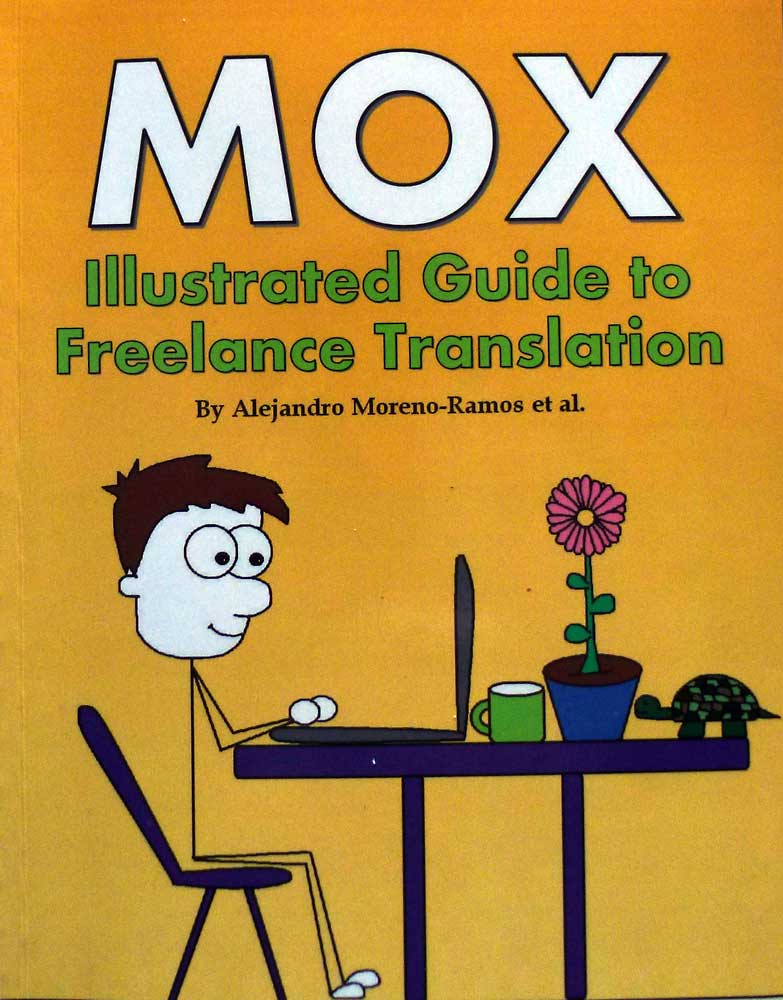
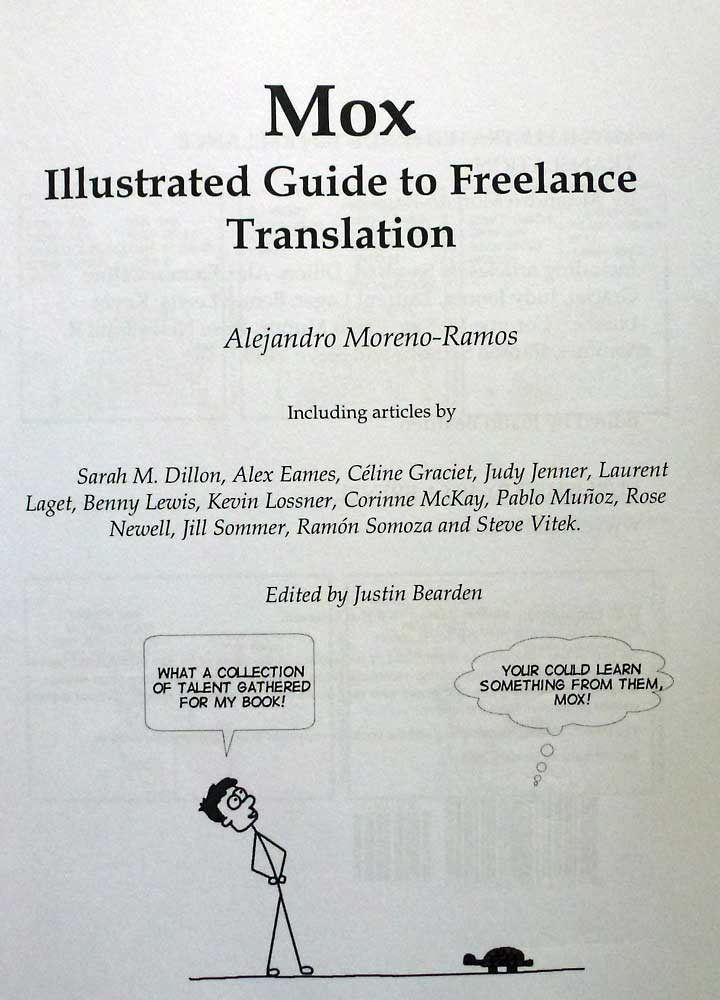
I finally got around to buying Mox – Illustrated Guide to Freelance Translation. I always like seeing the cartoons on the blog, but I seem to have missed the book actually being published.
Alejandro Moreno-Ramos is a translator from English and French to European Spanish, trained in electromechanical engineering, who has been publishing cartoons on the web for some time about Mox, his alter ego:
Mox is a young but well educated translator. Two PhDs, six languages… and he hardly earns the minimum wage
Other characters include Mox’s girlfirend, Lena, his pet tortoise, the senior translator Calvo, the evil project manager Pam and Crados, the evil CAT software.
Some of the cartoons are based on ideas sent in by other translators, and the book contains a number of articles by some of the most famous translators on the interwebs.
My favourite cartoons were those where St. Jerome shows Mox the various circles of translators’ hell (only six here) and the local translators’ association (‘We meet once a week over some beers. Our main real activity is to complain among ourselves about low rates’).
In the Guardian. Germany’s ambassador to the UK, Georg Boomgaarden – your questions answered.
Question by jfriedrich, 21 September 2012 3:28PM
Good day to you sir. I’m German and my question deals with a very much neglected issue, regarding the culinary well-being of British expats in Germany. Why is it next to virtually impossible to get British sausages even over delicatessen counters in Germany? Would Germany not gain tremendously in the eyes of our British friends if we could become a bit more accomodating? Also, haven’t you developed a craving for these tubes yourself and can you imagine what it’s like being hooked on them and finding the only substitute in (admittedly exellent) Nürnberger Rossbratwürste? The British banger is the quintessential ingredient for a proper fry-up and even if this helps the British tourism board, I cannot possible pop over everytime I develop a craving. Regards
Response of Georg Boomgaarden:
Sausages are not in Federal, but in Laender competence (states).
Just like translators and interpreters
Mind you, can a German not spell Rostbratwürste, or was it a joke?
From Laudator Temporis Acti, quoting Gerald Moore’s autobiography, The Unashamed Accompanist.
A young friend of mine was playing the accompaniment to me one day of Wolf’s song “Bitt’ ihn, O Mutter” (Beg Him, O Mother). This accompaniment is written with Wolf’s usual eloquence and urgency, but it was played by this young lady with such viciousness that I ventured to ask her if she knew what “Bitt’ ihn, O Mutter” meant. “Of course,” she replied. “It means ‘O Mother, bite him.'”
Thanks to Trevor.
Meanwhile, the Guardian has a series called Germany – The accidental empire, and today there has been an odd article and some discussion of the length of German words and people’s favourite ones (not necessarily long). I remember Jonathan Franzen saying he liked obwohl. I am not sure what one commenter‘s Dampfesse means. Of course, with all the Latin and Greek in English, we are protected from ghe directness of Durchfall.
I am fond of Prekariat.
There’s an article on the German Federal Constitutional Court on the Matrix Chambers eutopialaw blog, by a German law professor called Daniel Thym, which is really heavy going and I wonder if it was written in English or translated in the writer’s head from German.
Since first posting this, I have discovered that there is an original German text online (see notes at end). So I include it:
Nun lassen sich die Kritiker das Argument der Verfassungswidrigkeit nicht so schnell aus der Hand nehmen.
Critics won’t renounce at the argument that bailouts violate the German constitution single-handedly.
Der mediale Hype um die Bundestags-Abstimmungen zur Euro-Rettung sowie die BVerfG-Urteile zeigt, wie die verfassungsjuristische Stärkung des Nationalstaats in eine politische Alltagspraxis umschlägt, die ihrerseits eine diskursive und identifikatorische Stärkung der nationalstaatlichen Identität mit sich bringt.
Extensive media coverage, both domestic and international, of the German Constitutional Court judgments and parliamentary votes show that the fortification of domestic institutions by means of constitutional interpretation has an impact upon everyday political practices which bring about the discursive strengthening of national identity.
I’m afraid my constitutional-law translations might sound like this.
I’ve bought a book on copyright law, I think it was, before now where I only realized after I had got it that it was by a non-native speaker and too hard to read. I admire translators who understand how to mould German sentences into natural English ones, but I’m not sure I know enough about the art.
But there’s a following post by Peter Lindseth, who has written on the blog before, and that is fine as usual.
LATER NOTE: Ah, I see from Lindseth’s post that the Daniel Thym post was translated into English. That’s a relief, but it shouldn’t be! Here’s the original German.