Human rights and the EU/Britische Zeitungen verwechselt EU (wieder)

On the UK Human Rights Blog, Adam Wagner explains to The Sun (as if it was interested) that the European Court of Human Rights has nothing to do with the European Union:

No, The Sun, the Human Rights Act is not the EU

I was watching the England football team beat Ireland in the World Cup earlier when I was tweeted a cracking bit of legal gobbledegook from The Sun: Youngsters at risk after EU ruling. According to The Sun, Now the “EU could let fiends like him prey on your children“.

and at the end

And did you notice my error at the beginning of the post? England beat Ireland in the Rugby Six Nations, not the football World Cup. Did it jar? Don’t be so pedantic. EU, European Convention, football, rugby – what really is the difference?

There’s a wonderful book by Tom Kennedy, Learning European Law – A Primer and Vade-mecum – unfortunately dated 1998 and I presume not likely to be updated. One of the topics he deals with in the introduction is the prevalence of newspaper howlers, and he has a whole page of them, including some from The Times and The Financial Times.

The European Commission lists Euromyths.

Using CAT tools for legal translations/CAT-Programme auch für juristische Übersetzungen

There’s a useful post on Percy Balemans’ blog, Translation is an Art, about using CAT tools for non-repetitive texts: The Usefulness of CAT Tools.

She gives seven reasons why CAT tools can be useful even if your text is not repetitive.

Consistency
Even if texts are not repetitive, consistency is still important. The concordance feature in your CAT tool allows you to search for words or phrases so you can check how they were translated before. This is also very useful in case you haven’t got a terminology list (yet).
Quality control
These days, CAT tools offer more and more quality control options. You can have your translation checked for, among other things, correct punctuation, conversion of numbers, tags and consistent terminology. If, like me, you tend to mix up numbers (typing 1956 instead of 1965 for example), it’s good to know you no longer have to worry about this, because your CAT tool will warn you when you’ve made a mistake.

I’m really pleased to read this summary because when I started using a translation memory program – STAR Transit – in 1998, and much later, I would hear colleagues saying ‘You can’t use it for legal translation’. It really annoyed me when people who knew nothing about what the programs can do simply said to younger colleagues: Forget about CAT in your field.

Sure, the original idea of such software was that if you were translating a computer manual, for instance, and the same sentence came up frequently, you could automatically ensure that your approach remained the same. Your speed of translating would increase by many times (and you would fall into the grasp of those translation agencies who pay less if their source text is repetitive).

But those programs did more than just show you repetitions. My program links up to one or more terminology databases I’ve created over the years containing solutions to problems I’ve handled. It highlights in the German text the words I have recorded in my dictionaries. Nowadays, it even links to past translations and suggests phrases (I find this less useful for contract translations than I thought I would). It would allow me to check a translation against a glossary to see if I’ve been consistent. It will check all the numbers in a document to see if I’ve made a typo. It will also check a number of other routine things (see the quote above).

This quality control does not usually save me time. There are some cases where it speeds up working on a repetitive text – for instance, a client sends two almost-identical contracts, or an update of an earlier one. There I could use the function in Word to compare documents, but the CAT tool makes it much easier.

LATER NOTE: See also Jayne Fox on the same topic.

What’s going on in Fürth?/Was passiert in Fürth?

Regular readers will be wondering what’s happening in Fürth? I’ve been doing a lot of work, but so has the beaver. Situation on January 5:

February 6:

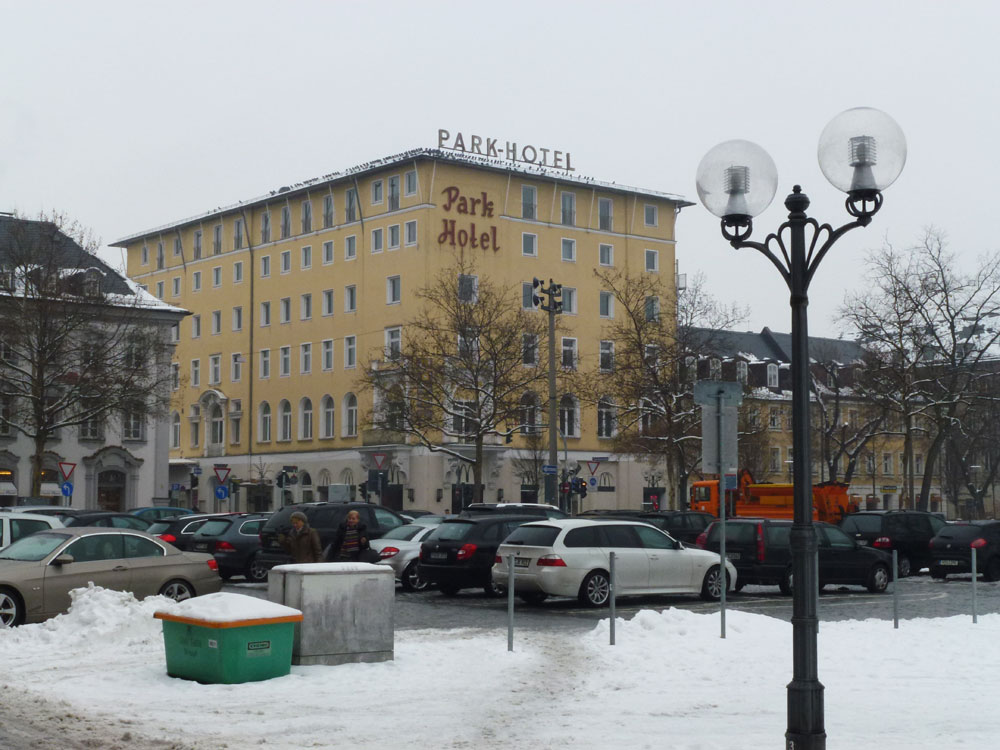
Meanwhile, there is a fight going on about the demolition of the Park Hotel. The City Council appear to believe that allowing a rather small shopping centre to be built while removing the famous banqueting hall (a place a bit like the Tower Ballroom in Blackpool but which no one has shown any interest in since the 1950s) and replacing the historic front with boring modern architecture would save the town centre from decline, whereas others wish to preserve the historic front (which again, no one has seen since the 1950s) and the banqueting hall (we were allowed in there recently) at the expense of the potential small shopping centre.

This is the 1950s yellow exterior of the Park Hotel, which is quite nice really but none of the plans intend to keep it:

There is or was already a shopping centre in Fürth, known as the City Center. It was never terribly wonderful and has the distinction of having 351 owners, which makes it hard to sell. I was surprised yesterday when coming back from Nuremberg on the underground to hear the announcement ‘Exit here for Line 1 train to City Center and Fürth’ (the City Center is in a kind of limbo but in decline after a failed sale).

City Center in the Fürth Wiki (in German)

Here you can find a picture of the Park Hotel as it might be with its historic façade hidden behind the yellow). It looks very nice but it’s not going to happen, folks! If you scroll down, you can also see the ceiling construction of the banqueting hall (Festsaal). This would be very easy to restore, but when it was opened to the public for a couple of hours the ceiling could not be seen.

Misdirected emails/Email-Adressen, die einander ähnlich sind

I know I’m not the only Margaret Marks out there, but I do keep getting emails sent to one in Washington State, I believe.
Margaret

You may find this helpful for you and your husband to use when planning meals on Sundays. And that frozen meal was called Organic Bistro.

Have a great week!

Erika Brown, RD, CD
20/20 Lifestyles Dietitian

A meal planner was attached.

Judges and dictionaries in the USA/Richter und Wörterbücher in den USA

The topic of judges and dictionaries was the subject of an earlier post.

Now a new paper has appeared on the subject: Oasis or Mirage: The Supreme Court’s Thirst for Dictionaries in the Rehnquist and Roberts Eras, by James J. Brudney and Lawrence Baum. From the beginning of the abstract:

The Supreme Court’s use of dictionaries, virtually non-existent before 1987, has dramatically increased during the Rehnquist and Roberts Court eras to the point where as many as one-third of statutory decisions invoke dictionary definitions. The increase is linked to the rise of textualism and its intense focus on ordinary meaning. This Article explores the Court’s new dictionary culture in depth from empirical and doctrinal perspectives. Among our findings are (a) while textualist justices are the highest dictionary users, purposivist justices invoke dictionary definitions with comparable frequency; (b) dictionary use is especially heavy in the criminal law area, serving what we describe as a Notice function; (c) dictionary use overall is strikingly ad hoc and subjective. We demonstrate how the Court’s patterns of dictionary usage reflect a casual form of opportunistic conduct: the justices almost always invoke one or at most two dictionaries, they have varied individual brand preferences from which they often depart, they seem to use general and legal dictionaries interchangeably, and they lack a coherent position on citing to editions from the time of statutory enactment versus the time the instant case was filed.

Via the UKSC Blog, Dictionary: A way to define an argument – actually an article by Robert Barnes in the Washington Post, reprinted. It discusses the 94-page paper and the problems of the way most judges use dictionaries – simply ransacking them to find a definition that confims what they already believe. I liked this:

Judge Richard Posner of the U.S. Court of Appeals for the 7th Circuit wrote last year that “dictionary definitions are acontextual whereas the meaning of sentences depends critically on context, including all sorts of background understandings.”

(a link is given but it doesn’t work).

MA dissertation on legal translation (Louisiana law)/Louisianas Zivilgesetzbuch als Quelle für Terminologie

Rob Lunn is a legal translator in Spain who has been doing an MA in legal translation at City University in London. On his blog Legally Yours, he offers Abstract and download of my dissertation on legal translation.

While it specifically looks at using the Louisiana Civil Code as a source of ‘third-system’ translations for Spanish legal terms, it also explores some of the general issues involved in bridging the gap between legal systems in translation, including non-equivalence and the idea that different audiences might require different kinds of legal English.

When I was first teaching legal translation in the 1980s, before the days of much legal translation theory, I was happy to use Martin Weston’s An English Reader’s Guide to the French Legal System, above all because of its chapter on translation methodology, which listed ways to deal with a foreign term. I didn’t always agree with Weston’s conclusions, but he offered a good framework to think about the problem. Weston is also in Rob’s excellent bibliography.

There are two useful tables on terms in the appendix. It’s a good place to get an orientation on the problems discussed. Civil-law terms needing translation into English are obviously found in German too. For instance, there’s the consideration of whether one translates Dienstbarkeit (Spanish servidumbre) as servitude or easement.

The dissertation invites further research into the search for terminological equivalents – he concentrates on property law.

Elsewhere in the blog, Rob explains why the Louisiana Civil Code might be very interesting for its Spanish connections.

So, as the civil codes of both Spain and Louisiana were originally based on the same sources (i.e., Spanish law and the French Civil Code), there is bound to be an amount of shared or similar content in them, even in today’s revisions.

More surprisingly, though, is that the Louisiana Civil Code of 1825 was influential in Spain’s draft civil code of 1851, a predecessor to Spain’s first civil code, the Civil Code of 1889. According to Parise (2008), reference was made to 1,103 articles of Louisiana’s 1825 code in the comments to 1,992 articles of the Spanish draft in Concordancias, motivos y comentarios del Código civil español, the rationale for the draft written by its principal author, García Goyena.

He also recommends Rome and Kinsella’s Louisiana Civil Law Dictionary. You can get this as an ebook, incidentally.