
Aldi’s ‘London’ cheese cake

Aldi really has a lot of very British things in its selection, but I had not seen this cheesecake. This is the ultimate British product!

I remember this cheese cake as a regular item at the bakery in the 50s and 60s. It is sometimes called ‘London cheese cake’ to distinguish it from cheesecake that contains cheese. This one, as I remember it, was round and consisted of layers of flaky pastry topped with (usually dry) icing and coconut ‘shreds’. In between pastry and icing there was a blob of sponge cake. The strings of coconut must have been from a paste that was extruded in some way.

The Aldi version is rectangular and has luscious fondant icing and jam under it.
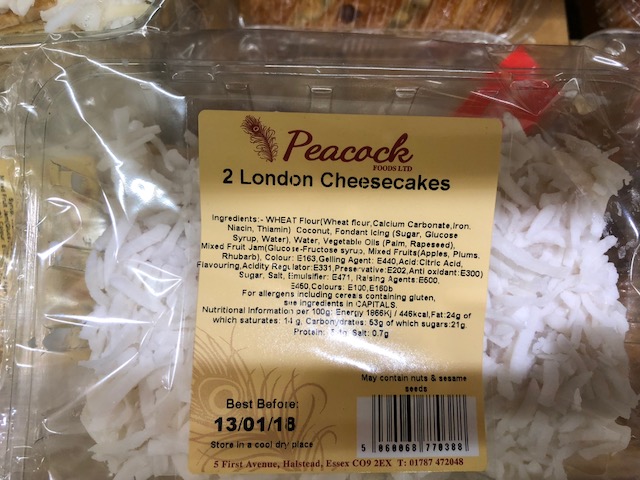
Following this, I decided to try the Greggs’ one, and on the way to Greggs I passed Kingcotts bakery, where they had their own.

The Kingcotts one was as I remember them, round, dryish but relieved by a plug of sponge cake i the middle.
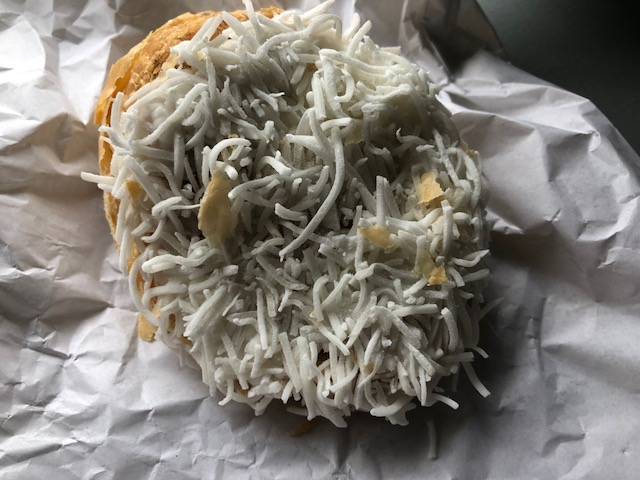
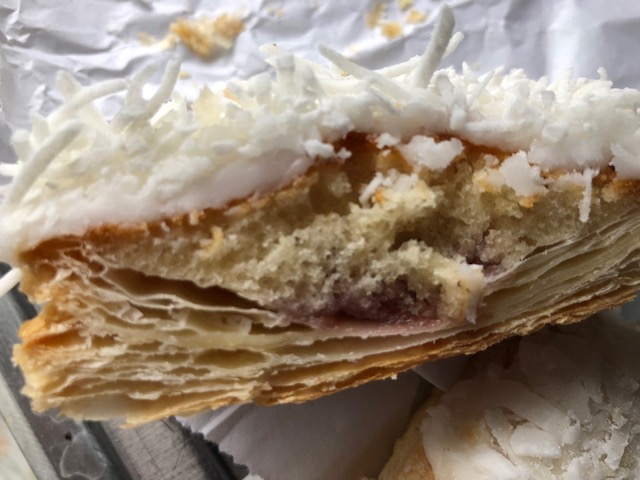
The Greggs one was squarish and had jam but no cake. It was rather thin and meagre.
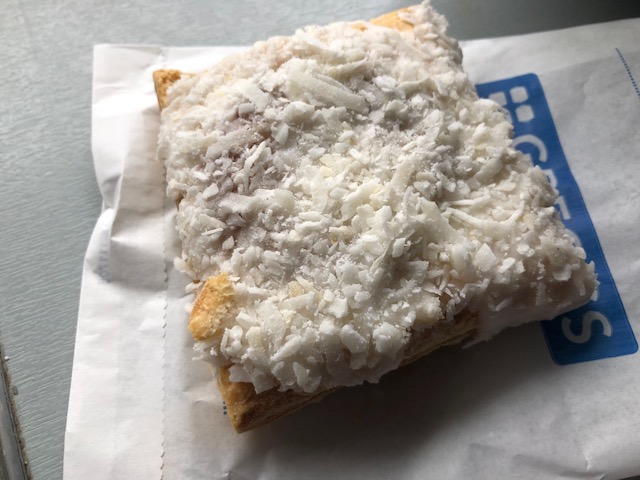
T

The coconut shred/strips on top vary. The Greggs ones do look like desiccated coconut, very dry.

Kingcotts are the makers of the famous ‘real’ bread:
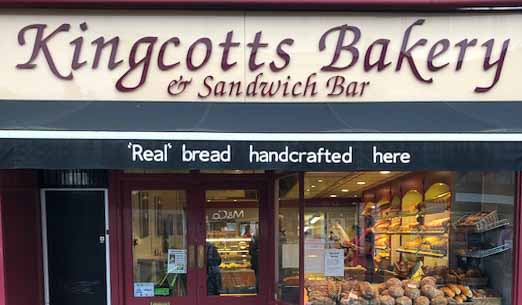
It is actually real bread. I recommend the cloudy white sandwich tin (sourdough).

Recommendations: the Kingcotts is the genuine cheesecake (£1), but only if you are in Upminster. You may have to try a local baker. The Aldi is delicious (I have forgotten the price) but not authentic: the puff pastry is slightly moist (in the direction of baklava) and the fondant icing with coconut dominates. I am sorry the Greggs is not quite right (80p). I must next find out why Godfreys in Hornchurch say theiir Tottenham cake is not the real thing, and whether Greggs is: I believe the pink colour has to come from a particular mulberry tree in Tottenham.

Legal Integration and Language Diversity: book on translation in EU lawmaking

Legal Integration and Language Diversity: Rethinking Translation in EU Lawmaking, by C.J.W. Baaij – Oxford University Press, coming out in February

This book should be interesting. It comes to the conclusion that particularly after Brexit, it would be a good idea for English to be the original language of all legislation.

  • Introduces the first comprehensive quantitative analysis of the case law of the Court of Justice of the European Union, spanning 50 years, focusing on interpreting and solving discrepancies between language versions of EU legislation

  • Integrates a variety of analytic methods and gathers data from both policy document analyses, interviews, and quantitative and qualitative examination of the EU’s Institutional Multilingualism

  • Builds a normative theoretical framework from legal translation studies and comparative law, general translation theory and language philosophy, and European studies

  • Proposes three EU policy changes that question mainstream thinking, from both political and theoretical vantage points

  • Argues that Brexit provides an additional reason in favor of rather than against recognizing English as the primary official language of the EU

(Via Wildy & Sons newsletter)

Simplifying contract language

The Case for Plain-Language Contracts, by Shawn Burton, Harvard Business Review Jan/Feb 2018

I’ve read a lot of arguments about the use of plain English, and I haven’t often been convinced by them. Now this article by Shawn Burton is at first glance an interesting one (thanks to Inge for recommending it on Twitter), but contains some problems.

Are pages of definitions; words like “heretofore,” “indemnification,” “warrant,” and “force majeure”; and phrases like “notwithstanding anything to the contrary herein,” “subject to the foregoing,” and “including but in no way limited to” necessary for an agreement to be enforceable? Is there some counterintuitive value in useless boilerplate language? Does a contract really need 15-word strings of synonyms; all-cap, italicized, bolded sentences that span multiple pages; awkward sentences containing numerous semicolons; and outdated grammar to be worthy of signature? In my opinion, the answer is a resounding no.

Of course, it would be a good idea to remove archaic words like ‘heretofore’, but what about words with a legal meaning like ‘force majeure’. (The ’15-word strings of synonyms’ are one of the reasons some legal translators prefer to translate from German to English even if German is their native language, because German contracts are simpler, partly because terms are backed up by the Civil Code and other legislation.)

Burton writes: ‘Business leaders should not have to call an attorney to interpret an agreement that they are expected to administer.’ I have my doubts about that. And the ‘litmus test’ was whether a ‘high-schooler’ could understand the contract. Maybe this worked with simplified contracts for customers, but surely not for every type of contract.

Here’s an example from the end of the article:

That article contains other useful links.

Merry Christmas

Here’s wishing a partially completed Merry Christmas to all readers.  (Ebor Street)

Here is some information on VAT on Christmas trees in Germany:

Plastic tree: 19%

Real tree sold on the market 7%

Real tree not deliberately grown, sold by farmer 5.5%

Real tree deliberately grown, sold by farmer 10.7%

Private sale or sale by small non-VAT-registered business: 0%

(Corrections to this translation may be added in the comments)

Die Höhe der Umsatzsteuer, die Sie für Ihren Tannenbaum bezahlt haben, hängt ab von der Herkunft und dem Verkäufer des Baums:

  • Der ganz normale Umsatzsteuersatz in Höhe von 19% wird fällig bei künstlichen Bäumen, das dürften meist Weihnachtsbäume aus Plastik sein.

  • Der ermäßigte Umsatzsteuersatz von 7% wird angewendet, wenn es sich um einen echten Baum handelt, der zwar artgerecht aufgewachsen ist, aber durch einen Gewerbetreibenden (zum Beispiel einen Baumarkt) oder einen nicht-pauschalierenden Landwirt verkauft wird.

  • 5,5% Umsatzsteuer will der Fiskus sehen, wenn der Baum zufällig irgendwo im Wald aufgewachsen ist und von einem Landwirt verkauft wird, der sich für die Pauschalierung der Vorsteuer entschieden hat.

  • Kaufen Sie bei einem pauschalierenden Landwirt, der den Weihnachtsbaum in einer Sonderkultur großgezogen hat, fallen 10,7% Umsatzsteuer an.

  • Falls der Weihnachtsbaum-Verkäufer Ihres Vertrauens Privatverkäufer oder Kleinunternehmer ist, zahlen Sie gar keine Umsatzsteuer.

Amerikaner/black and white cookies

I always thought Amerikaner were a German thing and wondered where they got their name from, but it turns out they are a New York cookie (via smitten kitchen).


(Image by Ben Orwoll, public domain)

Amerikaner certainly used to be made with a form of ammonium carbonate called Hirschhornsalz (Salt of Hartshorn/baker’s ammonia) in German. This is widely sold in Germany, especially at this time of year. I saw it being used by London Eats, who posts Christmas cookies from abroad at this time of year:  Fedtebrød.

If you don’t want to make do with baking powder or bicarbonate of soda, the German Deli sells Hirschhornsalz, and also potash and Lebkuchen spice.