Nominalization/Substantivierung

Wayne Schiess at Legalwriting.net
thinks legal English should use more verbs.

This example shows one problem translators from German into English have:

Now spot the two nominalizations in this sentence:

The defendant made a referral to Emily Graves, a financial planner, so Ms. Graves could provide the plaintiff with advice.

The two nominalizations, along with their helpers, are made a referral and provide . . . advice. By using verbs, we lose the helpers, enliven the text, and focus on actions:

The defendant referred the plaintiff to Emily Graves, a financial planner, so Ms. Graves could advise the plaintiff.

So when you write, spot the nouns that could be verbs and, when you can, return them to their livelier form.

Referral becomes referred the plaintiff. English needs the direct object, plaintiff.
But sometimes it isn’t clear to the translator from the German text what the direct object should be. And even if it is clear, it may take a while for the translator to work it out.

In fact, we sometimes have to replace refer X by make a referral just in order to avoid interpreting.

So the list of similar phrases given by Schiess to avoid might be useful to a translator not to avoid.

Does legal German use even more nouns than legal English? I sometimes think so. At all events, I usually vary some o the nouns with verbs. But sometimes I use the noun because it just sounds so – lawyerlike, to quote the New Yorker cartoon.
Britain not in the EU/Frankfurter Flughafen schließt Großbritannien aus der EU

Christiane Link is a German wheelchair user who lives in the UK and reports on life for the disabled in Behindertenparkplatz.

This week, personnel at Frankfurt Airport tried to stop her returning to the UK because she had no visa and ‘the UK is not part of the EU’.

Ich habe mehr und mehr den Eindruck, dass die eigentliche Gefahr für den Flugverkehr nicht von den Passagieren, sondern vom Sicherheitspersonal an den Flughäfen ausgeht. Gestern hätte man mir am Flughafen Frankfurt fast den Heimflug verweigert. Begründung: Großbritannien sei nicht in der EU und ich bräuchte ein Visum zur Einreise. PISA lässt grüßen!

Goethe on fleas/Goethe’s juristische Abhandlung über die Flöhe

The Legal Antiquarian is a promising new blog from Mike Hoeflich of the University of Kansas School of Law.

In a recent entry, it mentions Goethe’s juristische Abhandlung über die Flöhe.

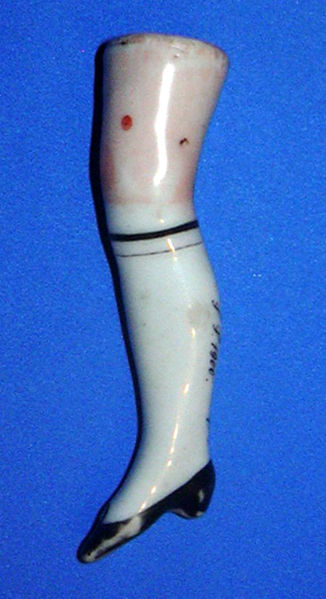
It looks as if the original was by Otto Philipp Zaunschliffer, whether in Latin or German. In the Rococo period, there was a plague of fleas, and Zaunschliffer wrote this spoof treatise on fleas in that time. It became very popular with law students. Later it was wrongly attributed to Goethe. the Wikipedia entry on Flohbein mentions this – a Flohbein (flea leg) being a ceramic woman’s leg with fleas or fleabites on the upper thigh, used to fill a pipe with tobacco. Here’s a picture from Gleiberg, via Wikipedia:

The hammer, the mallet and the gavel/Hammer und Schlegel

Further to the last entry, I wondered how an auctioneer’s hammer – the British equivalent – was taken to the USA and became a gavel, and I also wondered what the judge actually does with the gavel. Wikipedia was helpful here:

A gavel is a small ceremonial mallet commonly made of hardwood, typically fashioned with a handle and often struck against a sound block to enhance its sounding qualities. It is a symbol of the presiding officer’s authority and right to act officially in his capacity,[1] and as such, is used by presiding officers—notably chairmen and auctioneers—to call for attention or to punctuate rulings and proclamations. It is customarily struck to indicate the opening and closing of proceedings, giving rise to the phrase “gavel-to-gavel” to describe the entirety of a meeting or session.

Apparently there are rules on how to use the gavel:

Robert’s Rules of Order Newly Revised provides guidelines on the proper use of the gavel in deliberative assemblies. For instance, the chair is never to use the gavel in an attempt to drown out a disorderly member; … rather, the chair should give one vigorous tap at a time at intervals. … The chair should not lean on the gavel, juggle or toy with it, or use it to challenge or threaten or to emphasize remarks.[ …The prohibited practice of a chair cutting off members’ right to debate or introduce secondary motions by quickly putting a question to vote before any member can get the floor is referred to as “gaveling through” a measure.

Richard Nixon broke the Senate’s 1789 ivory gavel in a heated debate on nuclear energy.

Law for senior citizens/Jurisprudenz für Senioren

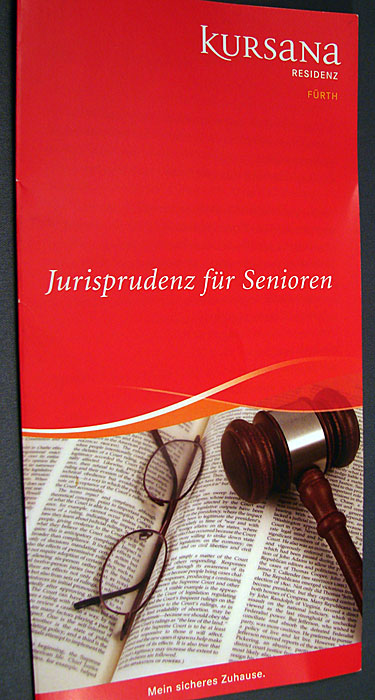
Kursana run old people’s homes (‘residences’) in several parts of Germany. The series of talks for old people sounds most impressive.

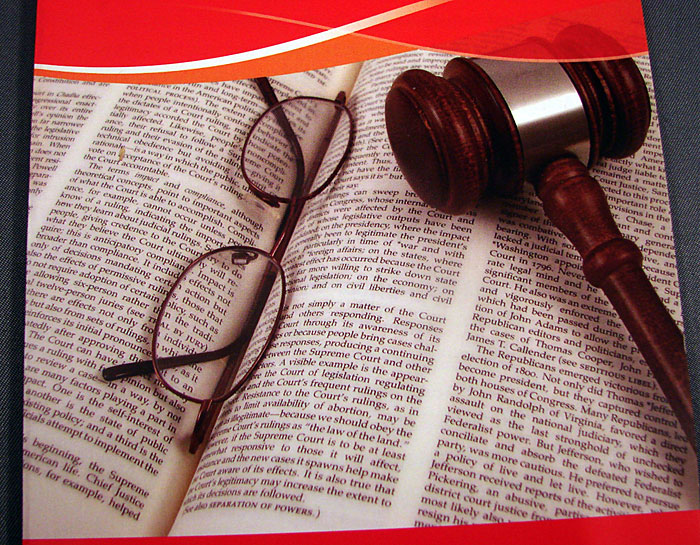
But what is this? A gavel? What looks like The Oxford Companion to the Supreme Court of the USA under a pair of reading glasses? A course in American law?

No, apparently not. It looks as if the talks are practical talks on the reform of German inheritance tax, on living wills, and even on the law of old people’s homes (Neuregelung des Heimrechts), all presented by a Nuremberg lawyer. I wonder where they found the picture?

Dying in parliament/Tod im britischen Parlamentsgebäude

John Mesirow – always worth reading – reports on More Weird and Wacky British Laws.

This lot come from the Daily Mirror on March 20. But they have surely been round the Internet a few times – BBC News reported them last November. Probably they originate from some no longer acknowledged book, which in turn got them from a dubious source.

I am wondering about

IT is illegal to die in the Houses of Parliament. We’re not sure what the punishment for this particular offence would be.

Too true: of course there is no punishment. What is meant by ‘illegal’?

My understanding was that deaths in the House of Commons or House of Lords are reported as happening outside the building. Wikipedia has more on this:

No one is allowed to die within the Palace of Westminster, because, as it is a royal palace, any person who dies there would eligible for a royal funeral.[33] Most deaths on the premises are said to have taken place at St. Thomas’ Hospital, the nearest hospital to the palace.[34]

Wikipedia quotes BBC News and the Daily Telegraph as sources.