Legal entity / Terminologie

Legal entity has two possible meanings for me, summed up by Wikipedia:

The term legal entity is sometimes used:
* to refer to a juristic person, an artificial entity that the law treats for some purposes as if it were a person, such as an incorporated organization.
* as a general term to describe all entities recognized by the law, including both juristic and natural persons.

What is called a juristic person is also called a legal person, an artificial person or a corporation (I use British English unless otherwise indicated). Company law books often write of corporate personality (this may be corporate personhood in the USA, since Wikipedia also tells me that corporate personality is another term for multiple personality disorder, which sounds more like a partnership than a company).

The first meaning would include a private or public limited company, a GmbH, an AG.
The second meaning would include all those, but also natural persons, and even groups of persons such as partnerships.

The context should make the meaning clear, however.

This old ProZ question on translating legal entity into German illustrates the pitfalls of legal translation:

Ein schöner Ausdruck! Reicht aus, hier von einer “Unternehmung” zu sprechen?
Company code (Buchungskreis): this is a legal entity to which accounting data refers. There are three company codes:
A010 Aniello Entsorgungswerke
A020 Aniello Klärwerke
A610 Aniello Dienstleistungen

The name ‘Aniello’ was just a pseudonym for these entities. I suspect myself the term was used in the second sense. But no-one even asked whether these were companies or partnerships – they may have been municipal corporations – and yet juristische Personen was the answer selected (still, it only got 3 points out of the possible 4!).

However, I can’t help thinking Volkmar Hirantner’s suggestion of Mandanten was spot-on. Mandant is a term used in accounting – for instance, if your accounting software is mandantenfähig (multi-client-capable? multi-user-enabled?), you can use it for more than one of your clients.

This sort of thing is one of the reasons why we don’t rely on dictionaries.

Gefahr im Verzug / Verfall im Verzug

Under the heading Oh Gott in Frankreich, Ullrich Fichtner writes in Der Spiegel (my emphasis):

Ach, Frankreich! Im Land der kulinarischen Weltmeister ist Verfall im Verzug: Käsemacher geben auf, Bauernhöfe werden still gelegt, in den Supermärkten herrscht der Fertigfraß. Und wer hat Schuld an der Misere? Wir selbst, die Amerikaner und die “Desperate Housewives”.

(found on a mailing list)

Translation conference in Lisbon / Übersetzungskonferenz in Lisbon

João Roque Dias announces a conference in Lisbon from 19 – 20 October 2007. Conference website Portuguese, English.

If you can’t get to the conference, don’t miss his website.

There are a large number of talks and workshops, including a legal translation workshop by one Mark Robertson, of whom it is said that he ‘holds a Degree In Sociology from the University of Essex (UK) and a Degree in Law from the College of Law (Chester, UK). Mark has been admitted to the Roll of Solicitors in 1981 and practiced law in England between 1980 and 1987. Founded and is the managing partner of Juízos de Valor Lda., a Lisbon-based company providing expert legal translations, language lessons, legal training and language consultancy services to some leading Portuguese and foreign law firms. Mark is currently co-authoring a Portuguese-English-Portuguese Encyclopaedic Law Dictionary.’

Incidentally, the ITI has for a long time now had on its website – open to non-members – an international calendar of translation events. Please enter your events there, then we’ll all know where to find them (the Lisbon conference is already in there). To see the calendar on the ITI site, click on the title just to the right of the brilliant ‘Welcome to our Home Page’.

Sorting rubbish / Mülltrennung

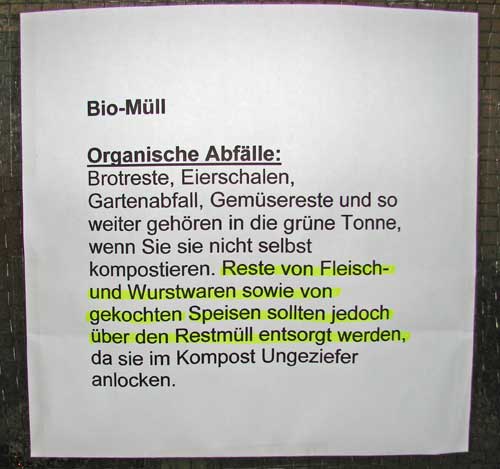
DSC09177w.jpg

This is a partial answer to a topic that has sometimes cropped up in the comments, here for instance. This was posted after I put something like boiled potatoes in the green bin. Usually, if in doubt (as in the case of meat), I look at the Fürth website, and there it says Essensreste (remains of meals) are OK. The worst (and only other) occasion was when I got a highlighted flyer pushed under my door. I don’t mind being corrected – well, I do really – but I don’t like to think that if there are brown paper bags from eight flats and a shop in the green bin, someone recognizes which is mine.

Hence the query: who else uses the rubbish bins in the street for private refuse, to avoid detection ? And what euphemistic term could one give that –
Fremdentsorgung?

Here’s the list of what goes in the green bin, from the website of the city of Fürth:

Küchenabfälle:
Obst- und Gemüseabfälle,
Kaffeefilter und Teeblätter
Essensreste
Gartenabfälle:
Grasschnitt, Laub
Schnittblumen
Heckenschnitt
Zimmerpflanzen
Sonstige kompostierbare Abfälle:
Kleintierstreu, -mist aus
Stroh, Heu, Holzspänen