Comments are open again.
I resorted the MT Blacklist entries in order of date of entry and deleted the latest ones.
Comments are open again.
I resorted the MT Blacklist entries in order of date of entry and deleted the latest ones.
This is a DE>EN
IAB-Glossar Englisch : [Begriffe und ihre Verwendung rund um den Arbeitsmarkt Englisch-Deutsch, Deutsch-Englisch]
Sonst. Personen: Heinz Werner ; Ingeborg König ; Roger Bennett *1948-*
Körperschaft: Institut für Arbeitsmarkt- und Berufsforschung, Nürnberg
Ausgabe: 6., vollst. überarb. und erw. Aufl.
Erschienen: Nürnberg : Inst. für Arbeitsmarkt- und Berufsforschung der Bundesagentur für Arbeit, 2004
Umfang: 1277 S.
Anmerkung: 5. Aufl. u. d. T.: Werner, Heinz: Glossar zur Arbeitsmarkt- und Berufsforschung : Glossar Englisch-Deutsch / Deutsch-Englisch ; Begriffe zu Arbeitsmarkt, Bildung und Sozialem
ISBN: 3-00-014822-1
Schlagwörter: Arbeitsmarkt / Berufsforschung / Wirtschaftssprachwörterbuch / Englisch / Deutsch
I used to have a paperback copy of an earlier edition, but I lent it to someone and didn’t get it back. So I decided to replace it with the latest edition, which cost 30 euros. It says to order it:
Bundesagentur für Arbeit
Service-Haus – Geschäftsstelle für Veröffentlichungen
Regensburger Straße 104
90478 Nürnberg
Fax 0911 179 11 47
e-mail: service-haus.veroeffentlichungen@arbeitsagentur.de
To be honest I have scarcely ever used it. It looks really useful. It is more than what I would call a glossary: it’s a big bilignual dictionary, with a lot of definitions and further information on the terms. However, I think it is more for translating from German to English, and it has a bias towards Germans. Or something like that.
I just looked up garden leave, which isn’t in there – just the sort of common British employment law vocabulary that I know is likely to be missing. And looking up freistellen and Freistellung, I find this particular meaning missing. It talks about releasing members of the works council from work to perform their duties, and it talks about training courses.
It’s a really useful-looking book. So why don’t I use it? Anyone else have any comments? Oh, I forgot – comments don’t work. (Jay Allen recommended me to update Movable Type from 2.64 to 3.33. But I don’t know).
Ah, now I see that it is actually available from Kater Verlag, under Arbeit, and that means you can see an excerpt if you click on Entscheidungshilfe.

Zur Zeit sind wegen technischer Probleme keine Kommentare möglich.
The reason no comments are possible here at the moment is because my comment-blocking system, MT-Blacklist (by Jay Allen of Movable Type, but no longer supported) is blocking some important combination of letters.
This in turn happened because some comedian sent me some spam comment designed to have this very effect.
I am using Movable Type 2.64, which is out of date and comes from a time before there was much comment spam. I see that languagehat uses MT 2.63, so I am not alone here. And today one of Steve’s commenters wrote:
bq. (I couldn’t post the comment with the full town name, because the system takes it, or at least the letters D—g, as “questionable content”.)
Thus are commenters censored and may not write Dryagovets. Here at Transblawg, however, Dryagovets is not the only thing you can’t write.
I will try to sort this out, but as MT Blacklist is no longer supported I may be forced to do without comments until I move the blog or start a new one. The latter is beginning to look more and more appealing.
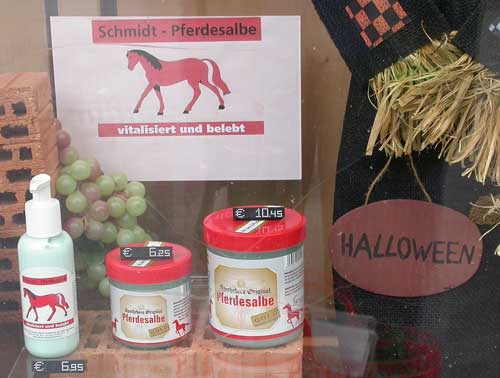
Hallowe’en has been part of German shop advertising for a few years now. Here are some examples seen yesterday. From an Apotheke (I don’t know if the green face is supposed to be before treatment or after):

Pumpkin cutting devices for masochists:
Air Berlin has been advertising Hallowe’en in Belfast, which was a new one on me. I should have thought trick-and-treating was a risky business there.
Some people have been coming to this site searching for Fürth Buddel, so it’s time I explained it. The whole pedestrian zone here is being resurfaced. At the moment, large parts have more bumps than there are speed bumps in English streets. The shops are all selling, for five euros, a soft toy called Fürth Buddel.
Now the Buddel is quite a nice toy, but it’s also a shameless clone of Mecki. What’s the legal situation there? I suppose they would say one is a hedgehog and one is a mole.


The Independent today has a map showing the most ethnically diverse areas of Britain, or perhaps England and Wales – Scotland and Northern Ireland are described in text beside the map, but not coloured in. I’ll have to go to Brighton (least religious town).
Muslims are less than 1% of Scotland’s population, but they are the second-largest religious group.
What are the chances of two people taken at random being from different ethnic groups? It various from 2% in Easington, County Durham, to 85% in Brent, London.
There’s an article too.
This is fitting, since yesterday I heard of a prediction that standard English may be replaced by a different mixture, since there are schools in London where a huge number of languages are spoken, but none of them is standard English – only a form of slang. (The reference was to Kerswill and Cheshire – as someone born in Hackney and brought up in Havering, I was particularly interested in the Hackney-Havering comparison here This seems to be the serious end of what came out in the British press as Jafaican and Tikkiny).
This was at a symposium for English teachers put on by the Institut für Fremdsprachen in Erlangen. Speaker on youth culture and social change was Tony Thorne, of King’s College, London. Further talks reminded me to get a Simpsons DVD (which is the best set to start with – is 1 too old? How about 6?), and referred to fences in the USA, using humour and comedy in ELT – how to do it without using Mr Bean – and Ireland, the Celtic Tiger?