The naming of peaches / Pfirsiche

p1_050919w.jpg

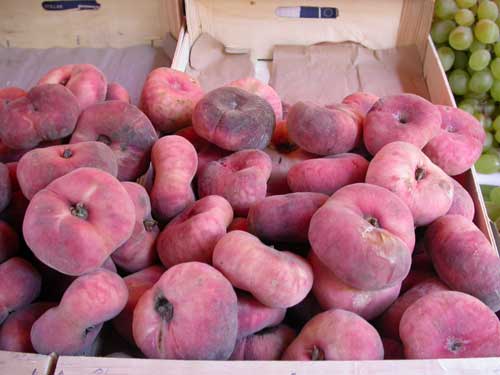
I’m very fond of these flat peaches that taste just like other white peaches.
Apparently in the USA they are called Saturn or Jupiter or doughnut (donut) peaches. What are they called in Germany?

The Washington State Fruit Commission says:

bq. Saturn™/flat peaches are a variety of white peach that were originally developed in Asia. Low in acid and high in soluble solids, this tender peach is perfect for consumers who appreciate a sweet finish to their tree fruit. Likewise, this peach gets its name because it is much flatter in height than traditional peaches, very similar to a donut…but much healthier!

There is absolutely no need to knock doughnuts. And how come Saturn is trademarked?

Germans pronouncing Hurrikan

It has been pointed out to me by Anon. of Frankfurt am Main that, as with ‘curry’, German newscasters have difficulty pronouncing ‘Hurrikan’ or ‘hurricane’. Some pronounce it in an acceptable English way, but others produce a weird U sound as already commented on.

I see I am not the first on this terrain. Rocko, at the end of August, heard a presenter saying it in English and an expert saying it in German, and the presenter gradually adapted her pronunciation to his during the interview:

bq. Während die Moderatorin das Wort Hurrikan die ganze Zeit englisch aussprach (“Härrikäin” mit weichem R), sagte der Experte, der immerhin Professor war, nur immer Hurrikan. Mit “Hu” und “Kahn” und nicht mit “Hä” und “Käin”. Es war deutlich festzustellen, dass die Moderatorin im Laufe des Interviews ihre eigene Aussprechweise des Wortes an die des Experten anglich. Zuerst fing es damit an, dass sie das weiche “R” gegen ein härteres eintauschte. Es folgte ein “Härrikähn” ohne ein das Wort aufblähendes “i”. Dann, nach einem Videobeitrag, hat sie die Aussprechmöglichkeit des Meteorologen komplett übernommen. “Hurrikahn”.

The recommended pronunciation there is ‘Wirbelsturm’. Here is 2wei.net:

bq. Harriken? Hörriken? Harrikäin? — Es gibt erschreckend viele Möglichkeiten, die Bezeichnung für die amerikanischen Wirbelstürme auszusprechen. Der Name∞ entstammt übrigens einer Sprache amerikanischer Ureinwohner. Die erstgenannte ist wohl die mehr oder weniger offizielle Aussprache des Wortes “Hurrikan” im Deutschen (so mein Oxford-Duden-Wörterbuch). Im Englischen hingegen gibt es mindestens zwei Möglichkeiten …

LATER NOTE: No, it is an intermediate variant, where the vowel sounds more like an ö. Here is the Longman Pronunciation Dictionary (first edition):

hurr_050925w.jpg

The standard American pronunciation comes after the double pipe ||. I admit the vowel looks weird (I am not an expert on phonetics). The asterisk is ‘a warning that the British and American pronunciations are different in an important and unpredictable way’. As you can see, there are at least two British pronunciations, of which I use the first. But I think, as with ‘curry’, that it’s the thought of the English R that causes the newsreader to produce a new sound.

Pocket Opera Company: One Charming Night

The opera was great. It’s just as well I went, as I might have been the only Fürth blogger not to blog it (see zonebattler, with not only a good photo of something I only saw from the side, but he even knew where we were:

bq. Sei es vor dem Maschinenhaus, zwischen den Schwelöfen oder gar im riesigen Sortierbunker, die glücklose Fürther Müllschwelanlage gab dem zauberhaften Spektakel einen surreal-aberwitzigen Rahmen…

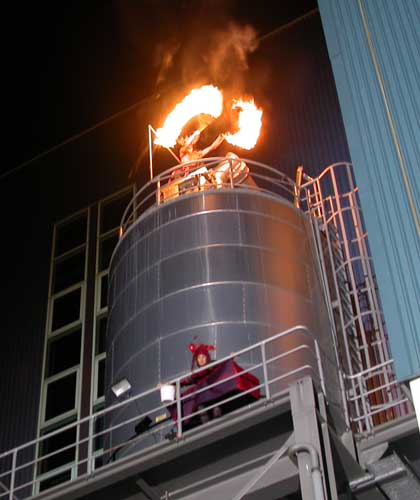
First act outside – what the pictures don’t bring out is that the singers were in the middle of the audience much of the time):

POC20_050923w.jpg

Act 2 inside:

POC34_050923w.jpg

POC39_050923w.jpg

Going up many stairs to act 3:

POC45_050923w.jpg

POC50_050923w.jpg

POC48_050923w.jpg

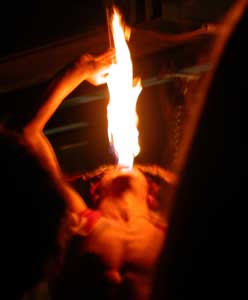
Act 4: 2 singers seen from below through a mesh floor. Some of the action also took place below us, seen through the same kind of mesh floor.

POC79_050923w.jpg

Encore:

POC104_050923w.jpg

Pocket Opera Company (DE/EN)
Purcell: The Fairy Queen / Bussotti: La Passion Selon Sade
CD
3 sets of Impressionen at left show good photos of the event

Waste incineration plant / Müllverbrennungsanlage

POC1_050923w.jpg

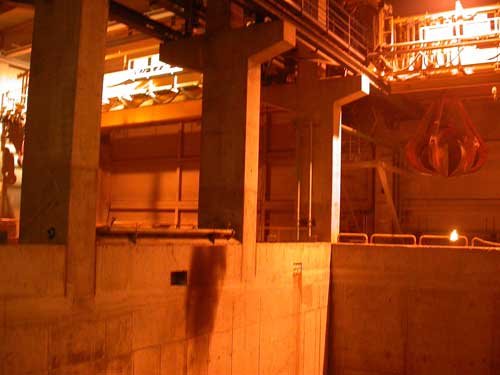
This waste incineration plant didn’t work properly.

Carbonisation process
The combination of pyrolysis and subsequent combustion is utilised in the carbonisation process. First of all the shredded waste is degassed in a rotating carbonisation drum at 450°C and separated into pyrolysis gas and solid pyrolysis residue. The pyrolysis gas is transferred directly to a further combustion chamber. The remaining pyrolysis residue is cooled and separated into fractions larger and smaller than 5 mm. The fine fraction consists almost exclusively of carbon which is crushed and injected into the combustion chamber with the pyrolysis gas. At temperatures of 1300°C, even the mineral residue melts. It granulates in a water bath and can be used later in the road construction sector. The only German plant of this kind to date is located in Fürth. It was shut down following an accident in summer 1998 and, on account of technical and other problems, will not be starting operation again. According to the company which developed the carbonisation process, these problems do not essentially cast doubt on the technology. However, the Federal Environmental Agency and the manufacturing firm no longer assume that this technology will be implemented in the short term in Germany.

And here (Galileo, bottom of page 24):

In Germany, an entire neighborhood in the town of Furth had to be evacuated in 1998 when gas leaked from the thermolysis plant. The incident prompted the Siemens Company to shelve its waste treatment business altogether.

POC4_050923w.jpg

But it makes a wonderful opera house, with first-class acoustics!

(See earlier entry)

Lawyer jokes / Witze über Anwälte

LOWERING THE BAR
Lawyer jokes and legal culture
Marc Galanter 430pp. | University of Wisconsin Press. $45; distributed in the UK by Eurospan. £32.95. | 0 299 21350 1

It’s obvious that many U.S. lawyer jokes aren’t specifically about the law, and Galanter apparently sets about researching their origins. Details from an article in the TLS:

bq. A certain sharpening in the jokes about lawyers came about when the profession
introduced hourly billing, from the 1960s onwards. Many of us will remember a billing joke, more than a century old, about the lawyer who demanded a fee “For waking up in the night and thinking about your case, $5”, later capped by the tale of a rival who charged “For crossing the street to talk to you, then discovering it wasn’t you at all, $125”. Galanter says that “Billing for thinking about the client while showering or engaging in other grooming activities is encouraged by many firms”.

Are there any German lawyer jokes? I think not. Lawyers are respected (although Galanter says the large number of jokes about lawyers also indicate a kind of respect). The topic is touched on in relation to the Netherlands:

bq. If this book is right, there are no lawyer jokes in Holland. “In civil law countries”, the author explains, “with their smaller number of lawyers and larger contingents of judges, lawyers do not seem to play an important part in the public imagination.” In the Netherlands they lack social influence. A Dutch sociologist is quoted as saying, “No need for jokes. The Dutch couldn’t care less”.

(Thanks very much to Isabella)

Request from a fellow-translator/Kollegenanfrage

Email:

bq. Sehr geehrte Frau Kollegin, sehr geehrter Herr Kollege,
ich bin ebenfalls als Dolmetscher und Übersetzer (staatl. gepr. und vereidigt PL/RUS) tätig.
Auf diesem Wege bitte ich Sie um ein Kollegenangebot für die Übersetzung von gerichtlichen Unterlagen (Haftbefehl, Gesetzestexte) aus dem Deutschen ins Englische.
Der Umfang der deutschen Texte beträgt 7 Seiten (ca. 216 Normzeilen á 55 Zeichen).
Die betreffenden Unterlagen liegen im Original vor und werden als PDF-Datei per Email an Sie gesandt. Die Übersetzung soll als Word-Datei und als zwei beglaubigte Ausdrucke geliefert werden.
Ich bitte um ein umgehendes Angebot per Email unter Angabe:
1) des Preises in EUR pro Normzeile (55 Zeichen),
2) der Bearbeitungszeit,
3) der eigenen Referenzen (Information über Ihre Fachausbildung, Vereidigung etc. und über bearbeitete Übersetzungen vergleichbarer Texte),
Mit kollegialem Gruß